
<script type="application/ld+json" data-schema-version="grey-blog-v4"> [{"@context":"https://schema.org","@type":"BlogPosting","@id":"https://grey.co/blog/send-money-to-mpesa#article","headline":"How to send money to Tanzania accounts and Mpesa","description":"Learn how to send money to Tanzania or Mpesa with Grey from multiple countries at the best rates. Send money to Tigo, Vodacom, and Airtel networks. Here's how;","inLanguage":"en","url":"https://grey.co/blog/send-money-to-mpesa","mainEntityOfPage":{"@id":"https://grey.co/blog/send-money-to-mpesa#webpage"},"datePublished":"2023-03-08T10:32:17.976Z","dateModified":"2026-06-15T19:36:25.079Z","author":{"@type":"Person","@id":"https://grey.co/authors/winner#person","name":"Winner Ajibola","url":"https://grey.co/authors/winner"},"publisher":{"@type":"Organization","@id":"https://grey.co/#organization","name":"Grey","url":"https://grey.co","logo":{"@type":"ImageObject","url":"https://cdn.prod.website-files.com/6360022338a81bd6fdbb1145/6564ae1077a67e39d3c491a6_Grey%20Logo%20Lockup%20Black.svg"}},"image":{"@type":"ImageObject","@id":"https://grey.co/blog/send-money-to-mpesa#primaryimage","url":"https://cdn.prod.website-files.com/636a85d290ee58e70c17e1c0/6a301c38db937e572b447083_6a301c3767d82cf053c4978b_send-money-to-mpesa__header-image.webp","contentUrl":"https://cdn.prod.website-files.com/636a85d290ee58e70c17e1c0/6a301c38db937e572b447083_6a301c3767d82cf053c4978b_send-money-to-mpesa__header-image.webp","width":1200,"height":675}},{"@context":"https://schema.org","@type":"WebPage","@id":"https://grey.co/blog/send-money-to-mpesa#webpage","url":"https://grey.co/blog/send-money-to-mpesa","name":"How to send money to Tanzania accounts and Mpesa","description":"Learn how to send money to Tanzania or Mpesa with Grey from multiple countries at the best rates. Send money to Tigo, Vodacom, and Airtel networks. Here's how;","inLanguage":"en","primaryImageOfPage":{"@id":"https://grey.co/blog/send-money-to-mpesa#primaryimage"},"breadcrumb":{"@id":"https://grey.co/blog/send-money-to-mpesa#breadcrumb"}},{"@context":"https://schema.org","@type":"BreadcrumbList","@id":"https://grey.co/blog/send-money-to-mpesa#breadcrumb","itemListElement":[{"@type":"ListItem","position":1,"name":"Home","item":"https://grey.co/"},{"@type":"ListItem","position":2,"name":"Blog","item":"https://grey.co/blog"},{"@type":"ListItem","position":3,"name":"How to send money to Tanzania accounts and Mpesa","item":"https://grey.co/blog/send-money-to-mpesa"}]},{"@context":"https://schema.org","@type":"DefinedTermSet","@id":"https://grey.co/blog/send-money-to-mpesa#terms","name":"How to send money to Tanzania accounts and Mpesa glossary","hasDefinedTerm":[{"@type":"DefinedTerm","name":"Mpesa","description":"Mpesa is a mobile money transfer service in Tanzania. With this service, you can transfer money, make bill payments and purchases directly from your mobile phone. Also known as mobile money, it’s an alternative banking system that doesn’t require an actual bank account to make transactions.","inDefinedTermSet":{"@id":"https://grey.co/blog/send-money-to-mpesa#terms"}}]}] </script>

How to send money to Tanzania accounts and Mpesa

Winner Ajibola

TABLE OF CONTENT

SHARE THIS POST

Need to send money home to Tanzania from a foreign country? Perhaps you earn in foreign currencies, and you’re looking for a way to convert them into Tanzanian shillings? If you need to send money to Tanzania or Mpesa, you can easily do this with many online services. 

In this article, we’ll show you how to do this with Grey from multiple countries at the best rates. 

What is Mpesa?

Mpesa is a mobile money transfer service in Tanzania. With this service, you can transfer money, make bill payments and purchases directly from your mobile phone. Also known as mobile money, it’s an alternative banking system that doesn’t require an actual bank account to make transactions. 

With Grey, you can send money to Mpesa accounts in Tanzania in just a few steps. 

What Mpesa Networks Can I Send to from Grey?

At the moment, you can send money to three networks from Grey. So if you want to send money to an Mpesa account, you can choose between Tigo, Vodacom, and Airtel. All you need is their phone number to make this transaction.

How to Send USD to a Tanzanian Account

Need to swap your USD to Tsh? Here’s how to make money transfers from the United States to Tanzania;

  • For starters, you need a USD account on Grey. With this, you can receive Dollars directly into your account. If you don’t already have one, use this guide to get started.
  • Once you have your Grey USD account, top up by sending money to that account.
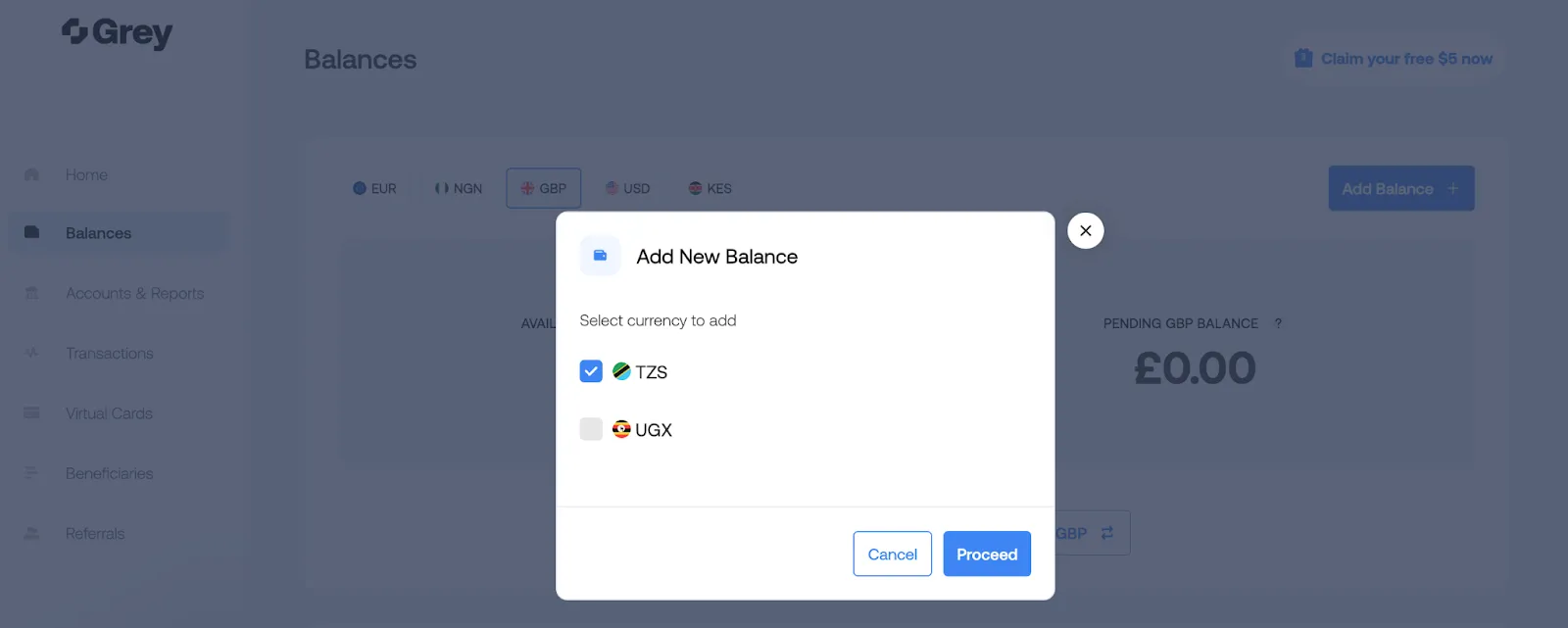
  • Next, create a TSh balance by tapping on the ‘Add balance’ button
add tsh balance
  • Click the checkbox beside TSH and ‘Proceed’
select-tsh-balance
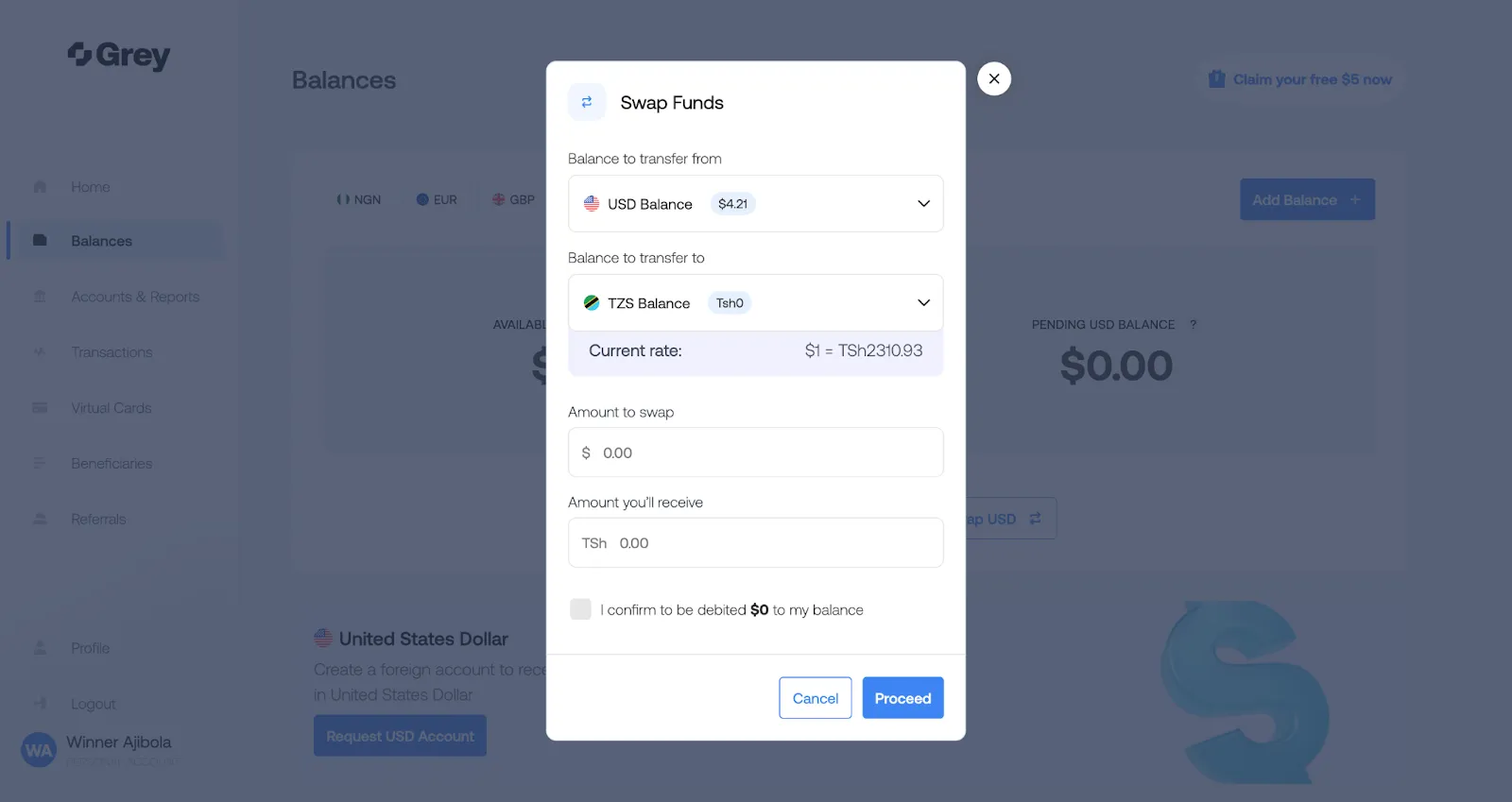
  • Now from your USD balance, tap on ‘Swap Funds’
  • Fill out the form (remember exchange rates aren’t fixed)
swap usd to tsh
  • The equivalent will be immediately sent to your Tsh balance

How to Withdraw Money from Your Grey Balance to Mpesa

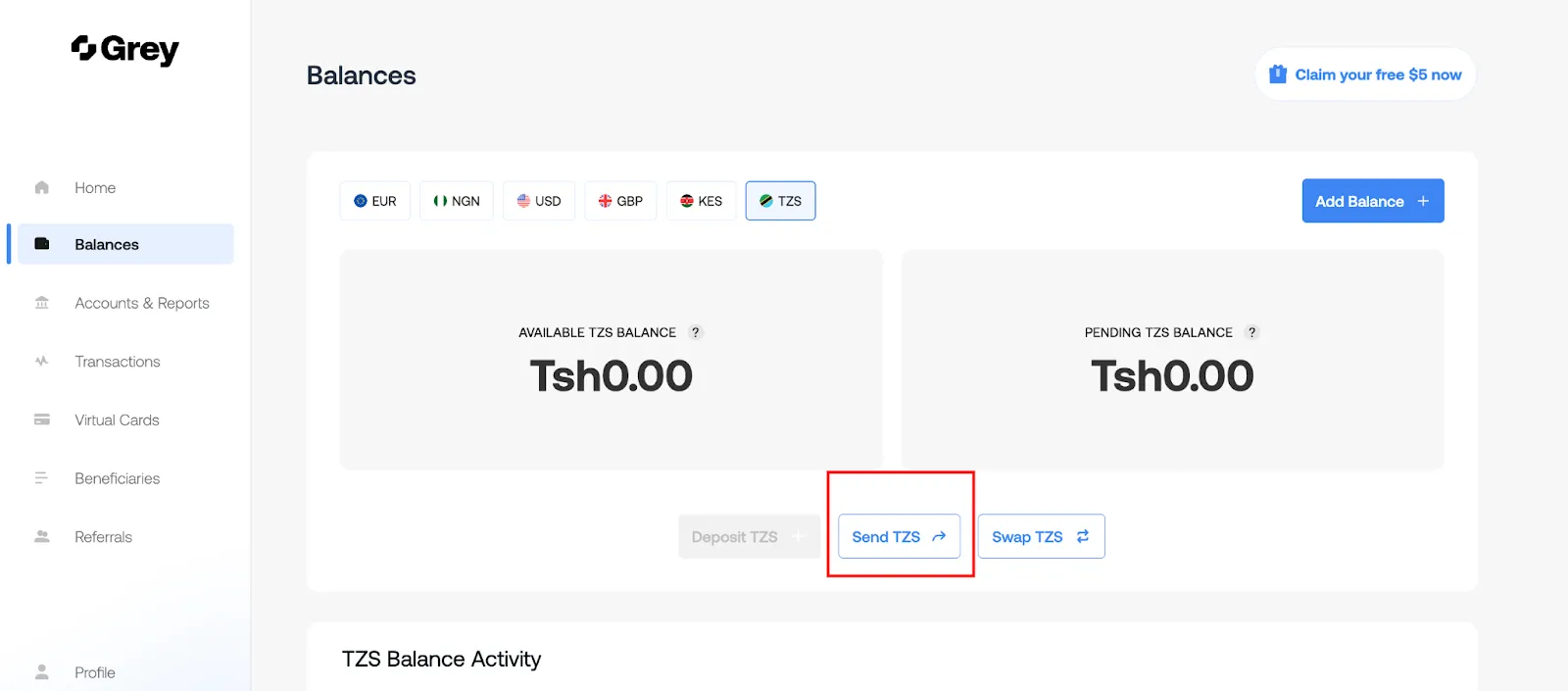
Now that you have the equivalent of your USD in TSh, it’s time to send it to Mpesa. We’ve got you covered whether you’re sending it to yourself, a loved one, or your employee. Here’s how to seamlessly do this on Grey;

‍

send-tsh-on-grey
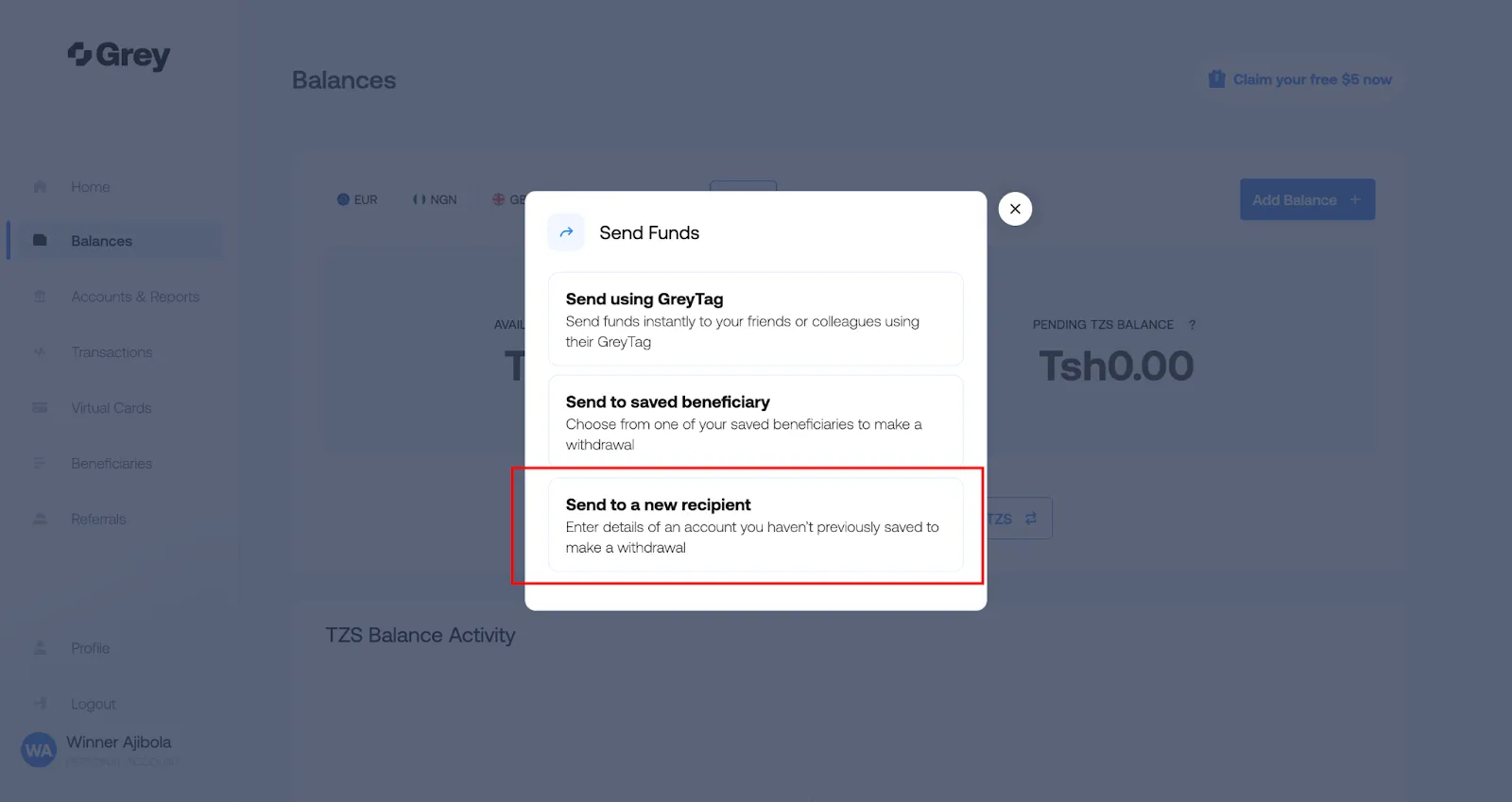
  • If you have a saved beneficiary, you can opt for that option. Else, ‘Send to a new recipient’
send to new account
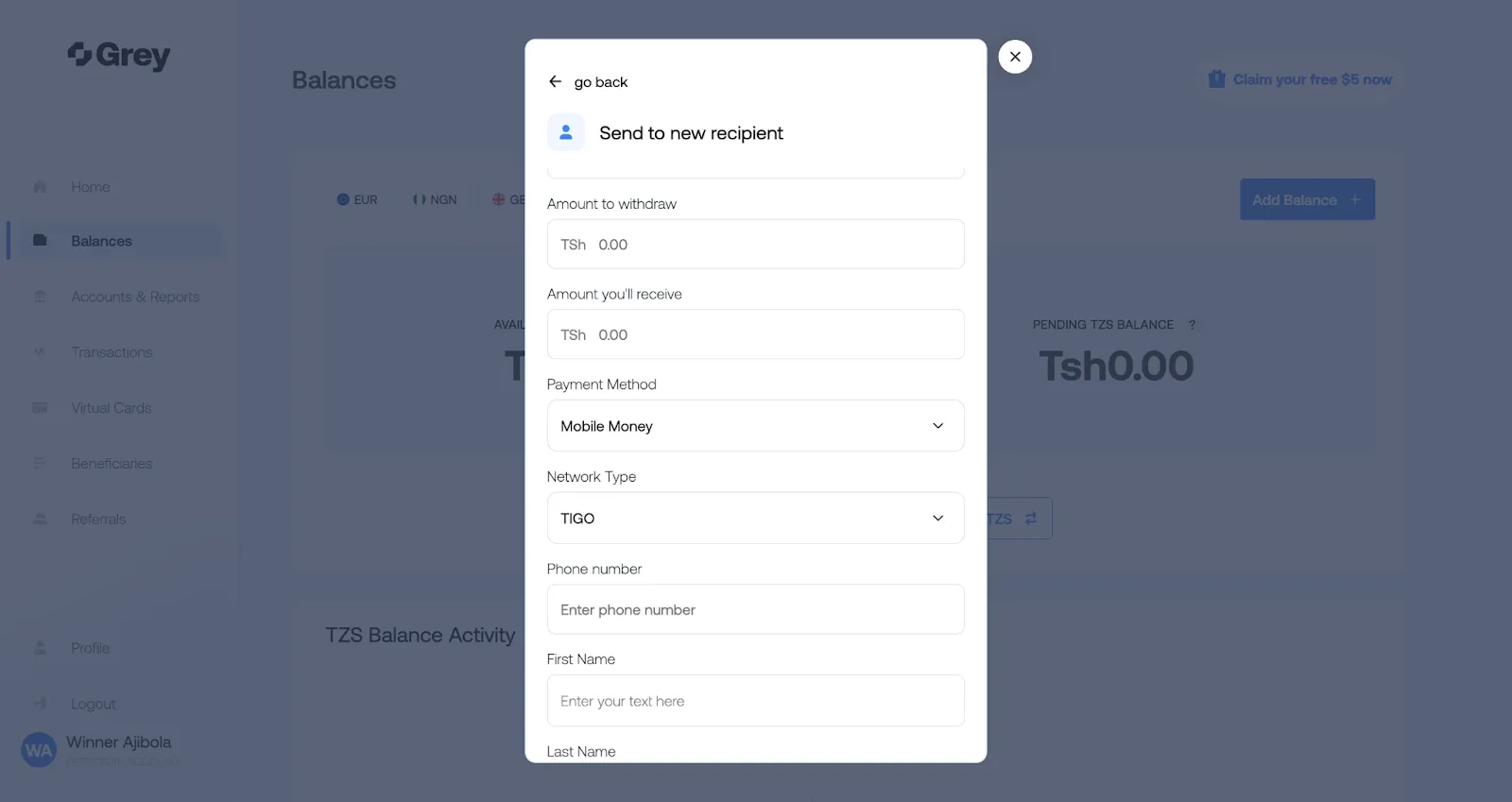
  • Fill out the form with the amount, network, and phone number of the recipient.
send to mpesa
  • Confirm the details and  click on ‘Proceed’
  • Your money will be sent to the recipient within a few minutes

With a Grey account, you can easily send money to your loved ones or employees in Tanzania or convert your foreign currencies into Tanzanian shillings.

Enjoy the best exchange rates and seamless transactions by creating your free account here.

‍

Last updated:

October 2, 2026

Open a free Grey account to get startedJoin 1 million digital nomads
IF YOU ENJOYED THIS, CHECK THESE OUT

NordVPN subscription pricing: Plans compared for 2026

•

•

2 min read

If you are comparing NordVPN plans, pricing is usually where you start. NordVPN has moved beyond a standalone VPN into a security suite that bundles next-generation antivirus, a password manager, dark web monitoring, and identity protection tools depending on the tier you choose. That makes the plan comparison more involved than a simple price-per-month decision.

This guide breaks down every NordVPN plan and what it costs in 2026. It also covers how to pay from Nigeria, India, Ghana, or any country where a local bank card may be declined or marked up on a USD-priced checkout.

NordVPN plans at a glance

NordVPN offers three tiers. All include a secure high-speed VPN, protection for up to 10 devices, and a Dark Web Monitor for up to 5 emails. The tiers differ in antivirus depth, password management, cloud storage, and identity protection.

Plan 2-year rate Key features added over Basic Best for
Basic $3.49/month VPN, next-gen antivirus, Dark Web Monitor (5 emails), scam call protection, ad and tracker blocker Users who want a VPN with antivirus bundled in
Complete $4.49/month Everything in Basic plus Dark Web Monitor Pro (8 emails, phone, credit card, national ID), unlimited password manager with data breach scanner, 1TB encrypted cloud storage Users who want broader security with password management and cloud storage
Prime $7.49/month Everything in Complete plus identity theft protection ($1M coverage), cyber extortion insurance ($100K coverage), credit monitoring and personal data removal via Incogni Users who want full identity protection on top of the security suite

Two-year rates are the discounted monthly equivalent for the first 27 months (2 years plus 3 bonus months). After that, plans renew at a higher annual rate. All prices in USD. Sales tax may apply.

Monthly plan pricing

The monthly plan has no commitment. It is the most flexible option and the most expensive per month. Worth it for short-term coverage but for consistent use the longer plans are substantially cheaper.

Plan Monthly price Devices Saving vs 2-year
Basic $14.99/month 10 Save ~69% with 2-year
Complete $19.99/month 10 Save ~75% with 2-year
Prime $21.99/month 10 Save ~69% with 2-year

One-year plan pricing

The one-year plan sits between monthly flexibility and two-year value. It reduces the monthly cost significantly and avoids the larger upfront commitment of the two-year plan.

Plan Monthly equivalent Total billed Devices
Basic $5.49/month $65.88/month 10
Complete $6.49/month $77.88/month 10
Prime $8.49/month $101.88/month 10

Two-year plan pricing

The two-year plan delivers the biggest savings and is the best value if you plan to use a VPN consistently. NordVPN adds 3 bonus months on top of the two years, giving you 27 months at the discounted rate.

Plan Monthly rate First 27 months total Then renews at Saving
Basic $3.49/month $94.23 $139.08/year 69%
Complete $4.49/month $121.23 $219.48/year 75%
Prime $6.49/month $175.23 $296.28/year 69%

The renewal rate after the initial 27-month period is significantly higher than the promotional rate. Note the renewal price at checkout and set a reminder before your renewal date.

Feature comparison by plan

Here is how the three tiers compare across every included tool:

Feature Basic Complete Prime
VPN (10 devices, high-speed, all servers) Yes Yes Yes
Next-gen antivirus Yes Yes Yes
Ad and tracker blocker Yes Yes Yes
Scam call protection Yes Yes Yes
Dark Web Monitor (5 emails) Yes Yes Yes
Dark Web Monitor Pro (8 emails, phone, card, ID) No Yes Yes
Password manager with data breach scanner No Yes Yes
1TB encrypted cloud storage No Yes Yes
Identity theft protection ($1M insurance) No No Yes
Cyber extortion insurance ($100K) No No Yes
Credit monitoring and VantageScore No No Yes
Personal data removal (Incogni) Add-on Add-on Add-on
Dedicated IP Add-on Add-on Add-on
30-day money-back guarantee Yes Yes Yes

Incogni and Dedicated IP are available as add-ons at checkout for all three plans. Identity theft protection under Prime is provided by Coveron. Additional terms apply.

Which NordVPN plan should you choose?

The first thing to note is that NordVPN's Basic plan already includes next-gen antivirus, which neither Surfshark nor ExpressVPN Basic includes at the same price point. If antivirus bundled with a VPN is what you need, Basic is competitive value even as the entry tier.

  • Basic: Basic is the right starting point if you want a VPN, built-in antivirus, scam call protection, and Dark Web Monitor for up to 5 emails. It covers the essentials at the lowest price and does not require upgrading just to get the antivirus.
  • Complete: Complete is the most popular tier and the best value for most users. The step up from Basic is $1 per month on the two-year plan and you gain Dark Web Monitor Pro covering 8 emails plus phone, credit card, and national ID numbers, an unlimited password manager with breach scanning, and 1TB of encrypted cloud storage. For users who want one subscription to cover VPN, antivirus, passwords, and cloud storage, Complete is the clear choice.
  • Prime: Prime adds identity theft protection with $1 million in insurance coverage, cyber extortion insurance, and credit monitoring. It is worth it if you specifically want those protections. Most users will find Complete covers everything they need at a significantly lower price.

What payment methods does NordVPN accept?

NordVPN accepts credit and debit cards, PayPal, Amazon Pay, Google Pay, and cryptocurrency payments. A range of regional payment methods are also available depending on your country. For users in Nigeria, India, and Ghana, the question is which of those methods will process without a declined card or a foreign transaction fee added on top of the USD price.

How to pay for NordVPN from Nigeria, India, or Ghana

NordVPN prices its plans in USD. For users whose accounts are in naira, rupees, or cedis, paying a USD-priced subscription can mean a declined card, a foreign transaction fee on top of the stated price, or both.

Pay with a Grey virtual card. Grey gives you a virtual Visa card linked to your USD balance. When you pay for NordVPN, the charge processes in USD from your Grey account, with no foreign transaction markup from a Nigerian or Indian bank and no risk of the card being declined on a foreign checkout. The card works on NordVPN's checkout, on auto-renewals, and on every other USD-priced subscription you use.

Auto-renewal is handled cleanly too: the card stays active for recurring charges without re-entering details at each renewal. Your multi-currency account keeps your USD balance ready for the next billing cycle.

One note: subscribing via the iOS App Store or Google Play uses a different billing flow managed by Apple or Google. Subscribing directly on nordvpn.com gives you more control over billing and is covered by the 30-day money-back guarantee.

Frequently asked questions

What is the cheapest NordVPN plan in 2026?

The Basic plan on the two-year subscription is the lowest monthly equivalent at $3.49 per month, billed $94.23 for the first 27 months. After that, it renews at $139.08 annually.

Is the Complete teir worth the extra cost over the Basic tier?

For most users, yes. The step up is $1 per month on the two-year plan and it adds Dark Web Monitor Pro covering 8 emails plus phone, credit card, and national ID numbers, an unlimited password manager with breach scanning, and 1TB of encrypted cloud storage. Basic only monitors 5 emails and has no password manager or cloud storage.

What is the difference between NordVPN Basic, Plus, and Ultimate?

NordVPN has updated its plan names. The current tiers are Basic, Complete, and Prime. Earlier articles may refer to Basic, Plus, and Ultimate, which were the previous names. Always check nordvpn.com/pricing for current plan names and features.

Can I pay for NordVPN from Nigeria or India?

Yes. NordVPN accepts international cards. If your local bank card is declined or applies a foreign transaction fee on USD checkouts, a Grey virtual card funded in USD processes the payment without those issues.

Does NordVPN offer a money-back guarantee?

Yes. All NordVPN plans include a 30-day money-back guarantee on subscriptions purchased directly on their website. This applies to all three tiers.

What happens when my NordVPN subscription auto-renews?

Subscriptions auto-renew at the renewal rate disclosed at checkout, which is higher than the introductory promotional rate. You can check your renewal date and manage auto-renewal settings in your NordVPN account dashboard.

Is NordVPN's antivirus actually built in or a separate app?

NordVPN's next-gen antivirus is built into the NordVPN app across all three plan tiers. It runs in the background alongside the VPN connection and does not require a separate download or installation.

Choosing the right VPN subscription is an investment in your online security, helping protect your personal data whether you're working, travelling or browsing on public Wi-Fi. Once your digital life is secure, simplify your global finances with Grey. Open a Grey account to receive international payments, manage multiple currencies and spend seamlessly across borders.

‍

Sources last checked: June 2026. NordVPN pricing and plan features change frequently. Always verify on nordvpn.com/pricing before subscribing.

This article is for general information purposes only. NordVPN pricing, features, and availability change at Nord Security's discretion. Grey product features and fees are subject to change. See grey.co/pricing for current Grey rates. This article is not affiliated with or endorsed by Nord Security.

ExpressVPN subscription pricing: Plans compared for 2026

•

•

2 min read

When comparing ExpressVPN plans, pricing is usually the deciding factor. ExpressVPN has moved beyond a standalone VPN into a broader security suite, with three tiers that bundle progressively more tools alongside the core VPN. If you commit to a longer plan, monthly equivalent drops sharply.

This guide breaks down every ExpressVPN plan and what it costs in 2026. It also covers how to pay from Nigeria, India, Ghana, or any country where a local bank card may be declined or marked up on a USD-priced checkout. A Grey virtual card funded in USD handles that cleanly.

Verify current rates on expressvpn.com/order before subscribing, as promotional rates and plan features change.

ExpressVPN plans at a glance

ExpressVPN offers three tiers. All include the full VPN with servers in 105 countries, the Lightway protocol, and post-quantum protection. The tiers differ in the number of devices covered, the depth of threat protection, and the bundled tools included.

Plan Devices 2-year rate Key additions over previous tier
Basic 10 $2.49/month VPN, lite protection (ads and malicious sites), 10 email relay aliases
Advanced 12 $2.99/month Full threat protection (ads, trackers, malicious and adult sites), 100 email relay aliases, unlimited password manager, 5 Identity Defender tools ($3M insurance), 3GB eSIM
Express Pro 14 $5.49/month Dedicated IP included, unlimited email relay, 11 Identity Defender tools ($5M insurance), 3GB eSIM (5 days), 500 private AI chat credits per day

Two-year rates are the discounted monthly equivalent for the first 28 months (2 years plus 4 bonus months). After that, plans renew at a higher annual rate. All prices in USD.

Monthly plan pricing

The monthly plan is the most flexible option with no long-term commitment. It is also the most expensive per month. Worth considering if you need short-term coverage for travel or a specific project, but for regular use the longer plans are significantly cheaper.

Plan Monthly price Devices Saving vs 2-year
Basic $15.99/month 10 Save ~84% with 2-year
Advanced $16.99/month 12 Save ~82% with 2-year
Express Pro $22.99/month 14 Save ~76% with 2-year

One-year plan pricing

The one-year plan sits between monthly flexibility and two-year value. It reduces the monthly cost substantially compared to monthly billing and avoids the larger upfront commitment of the two-year plan.

Plan Monthly equivalent Total billed Devices
Basic $3.99/month $59.85/month 10
Advanced $4.99/month $74.85/month 12
Express Pro $6.99/month $104.85/month 14

Two-year plan pricing

The two-year plan delivers the biggest savings and is the best value for anyone who plans to use a VPN consistently. ExpressVPN extends the subscription to 28 months (2 years plus 4 bonus months) at the discounted rate.

Plan Monthly rate First 28 months total Then renews at Saving
Basic $2.49/month $69.72 $99.95/year 84%
Advanced $2.99/month $83.72 $119.95/year 82%
Express Pro $5.49/month $153.72 $199.95/year 76%

The renewal rate after the initial 28-month period is significantly higher than the promotional rate. If you subscribe for the savings, note the renewal date and price in advance.

Feature comparison by plan

Here is how the three tiers compare across every bundled product:

Feature Basic Advanced Express Pro
VPN (105 countries, Lightway, post-quantum) Yes Yes Yes
Simultaneous devices 10 12 14
Ad and malicious site blocking Yes (lite) Yes (full) Yes (full)
Tracker and adult site blocking No Yes Yes
Dedicated IP Add-on Add-on Included
Email relay aliases (ExpressMailGuard) 10 100 Unlimited
Password manager (ExpressKeys) No Unlimited Unlimited
Identity Defender tools No 5 tools, $3M insurance 11 tools, $5M insurance
eSIM data (holiday.com) No 3GB, valid 3 days 3GB, valid 5 days
Private AI chat credits (ExpressAI) No No 500 credits/day
30-day money-back guarantee See note below See note below See note below

Money-back guarantee note: ExpressVPN offers a 30-day money-back guarantee on direct website subscriptions. This guarantee does not apply to iOS App Store or Google Play purchases. Verify guarantee status at the time of subscribing.

Which plan should you choose?

The choice between tiers comes down to whether you want just a VPN or the broader security bundle.

  • Basic: Basic is the right starting point if a VPN is all you need. Lite protection and 10 email relay aliases are included, but no password manager and no identity protection. At $2.49 per month on the two-year plan it is the lowest-cost entry point.
  • Advanced: Advanced is the most popular tier and the most sensible choice for most users. The step up from Basic is $0.50 per month on the two-year plan and it includes full tracker blocking, an unlimited password manager, and five Identity Defender tools with $3 million in identity theft insurance coverage. For most people the additional value is worth the small price difference.
  • Express Pro: Express Pro is the right choice only if you specifically need a dedicated IP address included in the plan, unlimited email relay, or the higher Identity Defender coverage ($5 million, 11 tools). For most users Advanced covers everything they need at a lower price.

What payment methods does ExpressVPN accept?

ExpressVPN accepts credit and debit cards (Visa, Mastercard, American Express, Discover, and others), PayPal, Apple Pay, and Google Pay. A range of regional payment methods including Boleto, Sepa Direct Debit, and Mercado Pago are also available depending on country.

For users in Nigeria, India, Ghana, and similar markets, the relevant question is which of those methods will actually process without a declined card or a foreign transaction fee added on top of the USD price.

How to pay for ExpressVPN from Nigeria, India, or Ghana

ExpressVPN prices its plans in USD. For users whose accounts are in naira, rupees, or cedis, paying a USD-priced subscription often means a declined card, a foreign transaction fee on top of the stated price, or both.

Pay with a Grey virtual card. Grey gives you a Mastercard virtual card linked to your USD balance. When you pay for ExpressVPN, the charge processes in USD from your Grey account, with no foreign transaction markup from a Nigerian or Indian bank and no risk of the card being declined on a foreign checkout. The card works on ExpressVPN's checkout, on auto-renewals, and across every other USD-priced subscription you use.

Auto-renewal works cleanly too. The card stays active for recurring charges without needing to re-enter details at each renewal. Your multi-currency account keeps your USD balance available so the next renewal goes through without interruption.

One note: subscribing via the iOS App Store or Google Play uses a different billing flow managed by Apple or Google, and those routes do not include ExpressVPN's 30-day money-back guarantee. Subscribing directly on expressvpn.com gives you more control over billing.

Frequently asked questions

What is the cheapest ExpressVPN plan in 2026?

The Basic plan on the two-year subscription is the lowest monthly equivalent at $2.49 per month, billed $69.72 for the first 28 months. After that it renews at $99.95 annually.

Is the Advanced tier worth it over the Basic tier?

For most users, yes. The step up is $0.50 per month on the two-year plan and it adds full tracker blocking, an unlimited password manager, and five identity protection tools including $3 million in identity theft insurance coverage. Basic only includes lite protection and no password manager.

What is the difference between Advanced and Express Pro?

Express Pro adds a dedicated IP included in the plan (not an add-on), unlimited email relay instead of 100, 11 Identity Defender tools instead of 5, $5 million identity theft insurance instead of $3 million, and 500 daily private AI chat credits. The two-year price difference is $2.50 per month. Most users will not need the additional features.

Can I pay for ExpressVPN from Nigeria or India?

Yes. ExpressVPN accepts international cards. If your local bank card is declined or applies a foreign transaction fee on USD checkouts, a Grey virtual card funded in USD processes the payment without those issues.

Does ExpressVPN offer a money-back guarantee?

ExpressVPN offers a 30-day money-back guarantee on subscriptions purchased directly on their website. This does not apply to iOS App Store or Google Play purchases. The guarantee was also suspended during the FIFA World Cup promotional period (June 10 to July 11, 2026). Verify the current guarantee status before subscribing.

What happens when my ExpressVPN auto-renews?

Subscriptions purchased with a credit or debit card, PayPal, Apple Pay, or Google Pay auto-renew by default. The renewal rate is higher than the introductory promotional rate and is disclosed at checkout. Check your renewal date and rate in your ExpressVPN account dashboard.

An ExpressVPN subscription can help protect your privacy and secure your internet connection, whether you're working remotely, travelling or managing clients online. Pair your digital security with smarter financial tools by opening a Grey account to receive international payments, hold multiple currencies and spend globally with ease.

‍

This article is for general information purposes only. ExpressVPN pricing, features, and availability change at ExpressVPN's discretion. Grey product features and fees are subject to change. See grey.co/pricing for current Grey rates. This article is not affiliated with or endorsed by ExpressVPN.

7 best virtual cards in the UK (2026)

•

•

2 min read

Most people only think about getting a virtual card when they need one. You’ve just opened a new account and don’t want to wait three days for the physical card to arrive. You’re about to buy something from a website you’ve never used before and would rather not hand over your main card number. Or you’re tired of one currency quietly costing you more every time you tap to pay.

A virtual card solves all three. It has a full card number, expiry date, and CVV that works immediately. But not every virtual card does the same job. Picking the right one depends on what you need.

1. Monzo

Monzo lets you create a virtual card straight from the app, and it pairs nicely with Pots, Monzo’s sub-account feature. Give your subscriptions their own Pot and card, give travel another, and you’ve got a simple way to keep spending separated without opening several bank accounts. The card spends from your main balance unless you’ve linked it to a specific Pot, and you can add it to Apple Pay or Google Pay as soon as it’s created.

Best for: people who already use Pots for budgeting and want each spending category to have its own card.

2. Starling Bank

Starling does something similar to Monzo, but leans harder into budgeting. You can tie a virtual card directly to a chosen Space, Starling’s version of a sub-account, so money only ever leaves that specific pocket when the card is used. Starling also charges no foreign transaction fees on any plan, and that applies to virtual card spending just as much as to physical card spending.

Best for: anyone who wants a strict split between spending categories, with no foreign exchange fees getting in the way.

3. Revolut

Revolut goes further than the other mainstream UK apps here. Paid plans support multiple virtual cards at once, plus a disposable option that generates a new number for each transaction and can never be reused. That’s a real safety net when you’re buying from a site you don’t fully trust, since a stolen disposable number is worthless the moment you’ve used it once. Revolut also lets you set spending limits and merchant locks on individual cards, something the simpler apps above don’t offer.

Best for: people who want maximum control, including one-time disposable numbers for riskier purchases online.

Also read: South Africa visa requirements for UK citizens

4. Chase UK

Chase’s main card is deliberately numberless, with the actual details only visible in-app after biometric login, but it also lets you create a virtual card for online spending, just like the others. Chase backs this up with 1% cashback on everyday spending, up to £15 a month, something none of the other free accounts on this list currently offer.

Best for: people who want cashback and a working virtual card, rather than choosing a provider for the card alone.

Also read: Mexico visa requirements for UK citizens

5. Wise

Wise’s virtual card is multi-currency by design. It debits the balance in whichever currency matches the transaction, converting at the mid-market rate only if you don’t already hold that currency. That makes it a different kind of card from everything above. It’s less about everyday UK spending and more about removing the friction of being paid in, or regularly spending in, more than one currency.

Best for: freelancers and remote workers who need a card that spends naturally from foreign currency, not just pounds.

6. Curve

Curve doesn’t hold any money at all. You link the debit and credit cards you already own to the Curve app, and one Curve Mastercard, virtual or physical, routes each payment to whichever card you’ve chosen. Its best trick, Go Back in Time, lets you move a transaction to a different linked card after the fact, up to 30 days back on the free plan.

Best for: people who already carry several cards and want one virtual card to manage them, without opening a new account that holds their money.

Also read: How Grey differs from a UK bank

7. Grey

Grey gives UK residents a virtual USD card linked to a dollar balance held directly in the app, alongside GBP and EUR balances linked to their own real account details. You top up the dollar balance by converting from another currency you hold, or by receiving USD payments directly, and the card spends from that balance the same way a normal UK debit card spends from your current account.

That makes it useful for one job in particular: paying for things billed in dollars, subscriptions, software, and online shopping from US retailers, without your everyday bank converting the price at its own rate and tacking on a foreign transaction fee. Creating the card costs a one-time $5 fee, and, interestingly, you can create multiple cards for different purposes and set spending limits on each. You can even freeze your cards entirely for security reasons. For convenience, you can connect your card to Google Pay or Apple Pay so you can tap to pay.

Best for: UK residents who regularly pay for dollar-billed subscriptions or purchases and want to skip their usual bank’s exchange rate and fees on every one of them.

How to choose

If you want a virtual card built into everyday banking with no extra steps, Monzo or Starling both do this naturally if you bank with them already. If you want the most control, including one-time disposable numbers? Revolut is the strongest fit. If currency matters more than UK-specific features, Wise removes a layer of friction that the others don’t touch. If you’d rather not open a new account at all and just want one card sitting on top of the ones you already have, Curve is built specifically for that. And if dollar-billed subscriptions or purchases are a regular cost for you, Grey’s USD card is built around exactly that problem.

Frequently asked questions

How much does it cost to create a Grey virtual card?

There’s a one-time fee of $5 to create the card. There’s no ongoing monthly fee just to hold the card afterwards.’

How do I top up the dollar balance my Grey card spends from?

You can convert money you’re already holding in GBP or EUR into your USD balance at the rate shown in the app, or receive USD directly into that balance, through ACH, FedNow, or Fedwire, if you’re being paid in dollars. The card always spends from your USD balance. If that is exhausted, it pulls from the next highest available balance.

What can I use a Grey virtual card for?

Anything billed in US dollars: subscriptions, software, and online shopping from US retailers. It works on most international subscription platforms, including Netflix, Spotify, ChatGPT Plus, X Premium, Midjourney, and Adobe. Essentially, anywhere Visa is accepted

Is a Grey virtual card as safe as a physical one?

Yes. It runs on the same card network as a physical card, with the same fraud protections, and is further protected by Grey’s own security measures, including two-factor authentication and real-time fraud monitoring. If you ever need to, you can freeze or replace the card instantly from the app, rather than waiting for a physical replacement.

Can I use a Grey virtual card for in-store payments?

Like most virtual cards, it can only be used if it’s been added to a mobile wallet such as Apple Pay or Google Pay, and the terminal accepts contactless. On its own, without sitting in a phone wallet, a virtual card number can’t be tapped or used for chip-and-PIN, since there’s no physical card to hand over.

Does a Grey virtual card work for cash withdrawals?

No. It’s built for online and in-app dollar spending, not for cash machines. If you need physical cash, you’d need a different card entirely.

What happens if my USD balance runs out mid-subscription?

The card will pull from your next highest available balance. It’s worth keeping a small buffer in your USD balance if you’re using the card for recurring subscriptions, to avoid being charged conversion fees when paying from your EUR or GBP accounts.

Surfshark subscription pricing: Plans compared for 2026

•

•

2 min read

Surfshark pricing is organised around two decisions: how long you commit, and which feature tier you want. Get both right, and you pay a fraction of the headline monthly rate. Get them wrong, and you overpay for features you do not use.

This guide breaks down every Surfshark plan and its current pricing, so you know exactly what each option costs before you subscribe. We also cover how to pay for your Surfshark subscription from Nigeria, India, Ghana, or any other country where your bank card may not work smoothly on a USD or GBP-priced checkout. A Grey virtual card solves that problem simply.

Surfshark plan overview

Surfshark is a virtual private network service that offers three plan tiers across three billing periods. Every tier includes full VPN access, unlimited device connections, and the core security features. Higher tiers add antivirus, data breach monitoring, and data removal tools.

Plan tier Core features Added in this tier Best for
Starter VPN, ad blocker, alternative ID Base package Users who only need a VPN
One Everything in Starter Antivirus, data breach alerts, private browsing Users who want security beyond VPN
One+ Everything in One Incogni data removal service Users who want to remove personal data from broker sites

Every plan includes a 30-day money-back guarantee. All pricing below must be verified on Surfshark's official pricing page before purchase, as prices vary by country and change over time.

Monthly plan pricing

The monthly plan has no commitment. You can cancel at any time. It is the most expensive way to subscribe, but the right choice if you need it for a short period.

Plan Monthly price What is included
Starter From $16.45/month VPN, ad blocker, alternative ID
One From $18.95/month Starter features + antivirus, breach alerts + web content blocker
One+ From $21.85/month One features + Incogni data removal + identity theft coverage in some locations

12-month plan pricing

Committing to a year (12 months) cuts the monthly equivalent by up to 80 per cent compared to monthly billing. Surfshark typically includes bonus months on top of the stated period. Verify the current offer on the pricing page when you subscribe.

Plan Monthly equivalent Approximate total
Starter From $3.39/month $50.85 for the first 15 months
One From $3.59/month $53.85 for the first 15 months
One+ From $7.49/month $112.35 for the first 15 months

After the initial period, plans renew at the standard annual rate. Check the renewal price before committing if you intend to subscribe long-term.

24-month plan pricing

The two-year plan is Surfshark's best-value option and typically includes an extra two or three months at the discounted rate. Savings can reach up to 87 per cent compared to monthly billing on the Starter plan.

Plan Monthly equivalent Approximate total
Starter From $2.49/month From ~$67.23 over 27 months
One From $2.79/month From ~$75.33 over 27 months
One+ From $4.49/month From ~$121.23 over 27 months

All two-year prices above are in USD and must be verified on Surfshark's pricing page. Prices shown at checkout vary by country and billing currency.

Which Surfshark plan should you choose?

The decision is simple if you approach it in two steps.

  • Start with the tier. If you only need a VPN, Starter is sufficient. If you want antivirus and breach monitoring bundled in, One is the step up. One+ is only worth the premium if you specifically want the Incogni data removal service.
  • Then choose the billing period. If you intend to use a VPN long-term, the two-year plan saves the most money, and the Starter tier on a two-year plan is the most cost-effective option on the market.
  • Monthly billing makes sense only if you need a VPN for a specific short-term purpose, travel, a work project, or testing the service before committing.

How to pay for Surfshark from Nigeria, India, or Ghana

Surfshark prices its plans in USD, EUR, or GBP depending on your region.
Sometimes, their website may display prices in your local currency for convenience. However, your final checkout and billing will generally be converted to and charged in one of these three main currencies, which can sometimes result in small conversion fees.

For users in Nigeria, India, Ghana, and most emerging markets, paying for a subscription billed in foreign currency comes with two problems.

  • Your local bank card may be declined at checkout
  • The transaction may incur a foreign transaction fee in addition to the stated price.

This is why you might need a virtual card that draws directly from USD or GBP balances. Fintech platforms like Grey. Grey gives you a virtual Visa card linked to your USD, EUR, and GBP balances. When you pay for Surfshark, the charge is processed in the platform’s currency (USD, EUR, or GBP) from your Grey account. It works just as if you are using a debit card from a US or UK bank. This avoids any foreign transaction markup from a Nigerian or Indian bank and is unlikely to be declined at checkout. The card works anywhere Mastercard is accepted online, which includes Surfshark's checkout and every major subscription service.

Here is how to set it up before you subscribe:

  • Open a Grey account if you do not have one. Identity verification is done fully online.
  • Fund your foreign currency account by receiving a direct payment (preferably in Surfshart’s charged currency for your region) or by converting from your local currency in the app.
  • Create your virtual card in the Grey app. The card is issued instantly.
  • Enter the card number, expiry date, and CVV at Surfshark's checkout exactly as you would with a standard debit card.

If you subscribe to the two-year plan, your Grey virtual card handles the recurring annual renewal automatically. You will not need to re-enter card details. Your multi-currency account keeps the USD, EUR, and GBP balances available for the next charge.

Creating a virtual Visa card on Grey costs $5, and the cross-border card fee is 2% + $0.50 on non-USD transactions. USD, EUR, and GBP deposits are charged at 0.8% (minimum: 2 USD/2 GBP/2 EUR; maximum: 10 USD/10 GBP/10 EUR). Currency conversion depends on the corridor and can be capped at $6. See grey.co/blog/fees-and-charges-on-grey for current rates.

Compare the Grey virtual card with other cards.

Frequently asked questions

What is the cheapest Surfshark plan in 2026?

The Starter plan on a two-year subscription is Surfshark's lowest monthly equivalent, from around $1.99 per month. Verify the current price on Surfshark's pricing page before subscribing, as rates change frequently.

Is Surfshark worth it compared to paying monthly?

For long-term VPN users, the two-year plan typically saves more than 80 per cent compared to monthly billing. If you only need a VPN for a short period, the monthly plan is more flexible but significantly more expensive.

Can I pay for Surfshark from Nigeria or India?

Yes. Surfshark accepts international card payments. If your local bank card is declined or charges a foreign transaction fee, a Grey virtual card, funded in USD, processes the payment without those issues.

Does Surfshark offer a free trial?

Surfshark does not offer a free trial but includes a 30-day money-back guarantee on all plans. You can subscribe, test the service, and request a refund within 30 days if it does not meet your needs.

What happens when my Surfshark subscription renews?

Surfshark auto-renews at the standard rate after the introductory period ends. The renewal price is typically higher than the initial promotional rate. Check the renewal terms before subscribing. A Grey virtual card handles the renewal charge automatically if your USD balance is sufficient.

This article is for general information purposes only. Surfshark pricing, plan features, and availability change frequently. Verify all figures on Surfshark's official website before subscribing. Grey product features and fees are subject to change; see grey.co/blog/fees-and-charges-on-grey for current rates.

5 best multi-currency accounts in the UK (2026)

•

•

2 min read

If you’re paid in a foreign currency, travel often, or send money abroad regularly, a multi-currency account can save you a surprising amount. Instead of every payment landing in pounds and being converted straight away, a multi-currency account lets you hold pounds, dollars, euros, and other currencies side by side, in the same app. You decide when to convert, and at what rate, rather than your bank deciding for you.

Not every “international” account actually works this way, though. Some genuinely let you hold a balance in another currency for as long as you like. Others, including a couple of well-known UK banking apps, only convert your money the moment you spend it, and never actually let foreign currency sit in your account at all.

What makes a multi-currency account?

A multi-currency account gives you a separate balance for each currency you hold. If someone pays you in US dollars, that money is added to your dollar balance until you choose to convert it. It doesn’t automatically convert to pounds the moment it arrives.

This is the key difference between a multi-currency account and a travel card. A travel card converts your money every single time you spend, with nothing held back. A real multi-currency account lets you wait for a better rate, or skip converting altogether if you have ongoing costs in that currency.
Here are five of the best multicurrency accounts for UK residents.

1. Wise

Wise is built almost entirely around holding and moving money in different currencies, rather than everyday banking. You can hold balances in more than 40 currencies, and for many of the most popular ones you get local account details too, a UK account number and sort code, a US routing number, or a euro IBAN. That means people can pay you as if you had a local account in their country, instead of sending an expensive international wire.

Most conversions happen at the mid-market rate, the same rate you’d see if you looked it up on Google. Wise’s fee is shown separately and upfront, rather than hidden inside a worse exchange rate. That fee changes slightly depending on the currency and how you’re funding the transfer, but there’s no monthly charge just to hold the account or keep a balance in any currency.

Wise isn’t a traditional bank. It’s a regulated electronic money institution, so your money is kept safe in segregated accounts rather than automatically protected by the Financial Services Compensation Scheme. Wise does offer a separate product, Wise Assets, for anyone who specifically wants that kind of protection.

Best for: freelancers and remote workers paid by international clients who want local receiving details without opening a bank account abroad, and anyone who converts currency often enough that a clear, low fee beats a bank’s hidden margin.

Also read: Open a UK GBP account online from Saudi Arabia without a UK address

2. Revolut

Revolut lets you hold and exchange more than 30 currencies inside the app. Since March 2026, it’s operated under a full UK banking licence, so eligible balances are now protected by the Financial Services Compensation Scheme up to £85,000, a real step up from its earlier status as an e-money provider.

The free Standard plan covers the basics well: holding several currencies, exchanging between them during market hours at the interbank rate, and spending abroad on a linked card. The catch most people miss is the weekend markup. Outside market hours, roughly Friday 5 p.m. to Sunday 6 pm, a fee of around 1% applies to exchanges, because the wholesale currency markets themselves are closed. The free plan also caps fee-free exchanges at £1,000 a month, after which a 1% fee kicks in. Paid plans raise that limit and add perks like travel insurance and airport lounge access, costing anywhere from around £4 to £55 a month.

Where Revolut tends to beat a more focused app like Wise is breadth. Budgeting tools, savings pots, and even stocks and crypto trading sit inside the same app, which suits people who'd rather manage everything from one place.

Best for: people who travel or spend abroad often enough to want one app for currency and everyday spending, and who don't mind working around the weekend FX markup.

Also read: Summer vacation ideas for families in the UK

3. Currencies Direct

Currencies Direct takes a different approach to the accounts above. Rather than positioning itself as an everyday banking app, it’s built around international transfers and currency management, with a dedicated account manager and phone support available alongside the app itself. It’s been around since 1996, has served more than 500,000 customers, and is regulated by the FCA as an electronic money institution.

You can hold several currency wallets, top them up when the rate suits you, and leave the balance there for as long as you want before sending it on or spending it. A linked multi-currency Mastercard draws straight from those balances when you’re spending abroad. There's no fee to open the account or hold it month to month; you only pay when you actually convert or transfer money. The dedicated support and account management make this a better fit for people moving larger sums, such as paying for a property abroad or managing a pension paid in another currency, than for someone who just wants to hold a bit of spare euros for a city break.

Best for: people handling bigger international transactions, like overseas property purchases, relocations, or pension payments, who'd rather have dedicated support than a self-service app alone.

Also read: How to create US and UK bank accounts as a migrant worker in the UK

4. Moneycorp Bank

Moneycorp isn’t as well-known as Wise or Revolut for everyday spending, but it’s a genuine multi-currency account for people who want a higher level of service around larger balances or less common currencies. Its banking arm, regulated in Gibraltar, lets personal customers hold and manage balances in major currencies, with interest paid on larger holdings. Eligible deposits are protected up to £120,000 under the Gibraltar Deposit Guarantee Scheme, which is a higher limit than the UK’s standard FSCS protection.

Separately, Moneycorp also offers a prepaid Explorer Mastercard that lets you load up to 10 currencies for spending and withdrawals abroad, with no Moneycorp fees on those transactions. That card works more like a travel card than a true holding account, since the conversion happens when you load it, not when the money sits and waits.

Best for: people holding larger balances or less common currencies, who want interest on their holdings and stronger deposit protection than the standard FSCS limit.

5. Grey

Grey lets you hold balances in USD, GBP, and EUR, each with its own real account details. That means a US routing number and account number, a UK sort code and account number, and a euro IBAN, so you can receive payments in any of those currencies just as you would with a local account in that country. UK residents can open a Grey account directly, and you can convert between currencies at the rate shown in the app before confirming.

Grey is most useful for moving money across borders rather than for everyday domestic spending. You can receive US dollars via ACH or Fedwire, pounds via Faster Payments, BACS, or CHAPS, and euros via SEPA, all into balances you control, then convert or spend with a linked virtual dollar card whenever you choose. Fees vary by method and currency: receiving USD via ACH or FedNow costs 0.8% (minimum $2, maximum $10), GBP via Faster Payments costs 0.8% (minimum £2, maximum £10), and GBP via BACS or CHAPS costs a flat £15 or £25. There’s no monthly account fee.

Best for: UK residents who regularly receive or hold money in USD, GBP, and EUR and want it all in one place, especially anyone paid by, or paying, clients, family, or contractors across more than one of those currencies.

How to choose between them

If you’re paid by clients abroad and want receive payments to feel local, Wise’s local account details across major currencies make the biggest practical difference, since you skip an expensive SWIFT wire entirely. If you’d rather have one app for everyday spending, currency holding, and a few extra financial tools, Revolut is the stronger fit, as long as you’re comfortable with the weekend FX rule. If you’re moving larger sums and want a dedicated person to call, Currencies Direct or Moneycorp are built for that, rather than everyday spending. And if your money regularly crosses USD, GBP, and EUR, Grey is built around exactly that combination.

Open a free Grey account today or download the app to get started

Frequently asked questions

How many currencies do I actually need to hold?

For most people, two or three: your home currency, plus whichever one you’re paid in or spend in most. Holding ten or twenty currencies you rarely touch doesn’t really add anything and can make it harder to keep track of your money. It’s worth checking which currencies you actually use regularly before choosing a provider.

Can a multi-currency account replace my main bank account?

For most of the accounts above, not entirely. Wise and Currencies Direct are electronic money institutions, so they’re not really built to be your main salary account with the full range of services a bank offers, like overdrafts or certain credit products. Revolut comes closer to replacing a main account, since it now operates as a full UK bank. If you’re thinking about switching entirely, check what the provider actually offers beyond holding currency.

Is my money protected if the provider isn’t a traditional bank?

It depends on how the provider is regulated. Revolut, as a full UK bank, protects eligible balances under the FSCS up to £85,000. Wise and Currencies Direct, as electronic money institutions, keep customer funds in segregated accounts instead, which is a standard and regulated approach, not a sign that your money is unsafe. Moneycorp’s Gibraltar arm protects eligible deposits up to £120,000 under its own deposit guarantee scheme. It’s always worth checking a provider’s specific protection model before holding a large balance with them.

Do I need a different account for spending abroad versus holding currency long-term?

Not necessarily, but it helps to know what a provider is built for. Some accounts are designed purely for spending, giving you a good rate the moment you tap your card, without ever letting the money sit as a foreign balance. Others are built for holding, letting you receive and store currency for as long as you like before converting or spending it. All five accounts above are genuine holding accounts, so they tend to work well for spending, too, but an account built only for spending won’t necessarily work for holding.

Italy Golden Visa 2026: Requirements, costs and how to apply

•

•

2 min read

This article is for general information purposes only and does not constitute legal, financial, tax, or investment advice. The Italy Golden Visa involves significant financial commitments and legal obligations that vary by individual circumstance, nationality, and Italian law. Always consult a qualified Italian immigration lawyer and independent financial advisor before making any investment decision.

Key takeaways

  • Italy's Golden Visa (officially the Investor Visa for Italy) offers residency in exchange for qualifying investments starting from EUR 250,000 in an innovative startup , the most accessible entry point
  • Four investment routes: government bonds (EUR 2M), Italian company equity (EUR 500,000), innovative startup equity (EUR 250,000), and philanthropic donation (EUR 1M non-refundable)
  • The visa is initially granted for two years, renewable for three-year periods, with a pathway to permanent residency after five years and citizenship after ten
  • No minimum stay requirement , you do not need to live in Italy full time to maintain the visa, only to maintain the qualifying investment
  • The application process takes 90 to 120 days from submission to Nulla Osta approval
  • Family members including spouse, children, and dependent parents can be included without additional investment

Italy's Golden Visa program offers non-EU nationals a formal route to European residency in exchange for a qualifying financial investment. For professionals from Nigeria, India, Ghana, and other markets who have spent years building savings in USD or GBP, it represents one of the more structured and legally clear pathways to long-term European residency,  and at the EUR 250,000 innovative startup entry point, it is within reach for serious savers who have accumulated capital over time.

This guide covers every aspect of the Italy Golden Visa in 2026: the four investment routes and their minimum thresholds, the eligibility requirements, the full application process step by step, costs beyond the investment itself, the tax implications, and what family inclusion looks like. It also covers the practical question of how to hold and transfer investment-scale funds internationally before they go to Italy.

A note before we begin: this is an overview guide, not legal advice. The Italy Golden Visa involves significant commitments and the rules are detailed. Work with a qualified Italian immigration lawyer before submitting any application.

What is the Italy Golden Visa?

The Italy Golden Visa is the common name for the Investor Visa for Italy program, officially established to attract high-net-worth individuals and investors who can contribute meaningfully to Italy's economy. It grants a residence permit to non-EU nationals and their immediate family in exchange for making one of four qualifying investments.

It is not a fast track to citizenship. The typical timeline from first application to citizenship eligibility is ten years, and that only applies if you have maintained legal residence throughout. But it does offer:

  • A renewable Italian residence permit valid initially for two years
  • The right to live, work, and study in Italy
  • Visa-free travel across the entire Schengen Area, covering 27 European countries
  • A pathway to permanent residency after five years of legal residence
  • The option to apply for Italian citizenship after ten years, with Italy allowing dual citizenship
  • Family inclusion: spouse, children, and dependent parents can join without additional investment

There is no general minimum physical stay requirement to maintain the Investor Visa itself. You need to maintain the qualifying investment, not your physical presence. However, spending enough time in Italy is necessary if your goal is permanent residence or Italian citizenship.

Also read: Italy digital nomad visa: Requirements, costs and process

The four investment routes

Italy provides four distinct routes to qualify for the Italy Investor Visa. They differ significantly in minimum investment size, risk profile, liquidity, and what the capital goes toward. Here is how they compare:

Route Minimum investment Capital at risk? Return possible? Hold period
Government bonds EUR 2,000,000 Low Interest only Minimum 2 years
Italian company equity EUR 500,000 Medium to high Yes Duration of visa
Innovative startup equity EUR 250,000 High Yes (high upside) Duration of visa
Philanthropic donation EUR 1,000,000 N/A No Non-refundable

Route 1: Italian government bonds (EUR 2,000,000)

The highest minimum investment but the lowest risk. Government bonds are debt securities issued by the Italian state, held for a minimum of two years. The capital is not lost if Italy maintains its debt obligations, and the bonds pay interest over their term. This route suits investors who prioritise capital preservation over return and want exposure to Italian residency with the lowest probability of losing their principal. The downside is the EUR 2 million threshold, which puts it out of reach for most investors looking at this program for the first time.

Route 2: Equity in an Italian company (EUR 500,000)

A minimum of EUR 500,000 equity investment in an existing Italian company that is active and registered. This is a genuine equity stake, which means the value of the investment moves with the performance of the company. There is potential for financial return if the company grows, but equally a risk of loss. The equity must be held for the duration of the visa period. This route requires meaningful due diligence on the target company before committing, which is where legal and financial advisors earn their fees.

Route 3: Innovative startup equity (EUR 250,000)

The lowest-cost investment route and one of the most accessible options for first-time applicants. A minimum EUR 250,000 equity investment in a company officially registered on Italy's innovative startup register. These are early-stage, high-growth businesses in technology and innovation sectors. The risk is higher than the company equity route because startups are earlier in their development, but so is the upside potential. For investors with a background in technology or entrepreneurship who can evaluate early-stage companies with informed judgment, this is the most compelling route on both price and potential.

Italy's innovative startup register is a formal list maintained by the Italian Chamber of Commerce. Eligible companies must meet specific criteria, including being less than five years old, having less than EUR 5 million in annual revenues, and investing meaningfully in research and development. Your legal advisor can help identify registered companies.

Route 4: Philanthropic donation (EUR 1,000,000)

A non-refundable donation of at least EUR 1,000,000 to a public-interest project in Italy. Eligible projects typically include cultural heritage preservation, scientific research, education, environmental restoration, and immigration management. This is the only route where the capital does not come back. There is no financial return and the donation is irrecoverable. It suits investors for whom the Italian residency is the primary goal, the social impact is meaningful, and the EUR 1 million is treated as a cost of that objective rather than an investment.

You may also like: Best cities to work in the Mediterranean

Eligibility requirements

To qualify for the Italy Golden Visa, you must meet all of the following:

  • Be a non-EU and non-EEA national. EU and EEA citizens already have freedom of movement in Italy and do not need this program.
  • Have proof of funds: the investment capital must be legally acquired, documented, and available. Italy requires a clear audit trail of where the money came from.
  • Choose and commit to one of the four qualifying investment routes above.
  • Submit the required documentation, including background checks, financial statements, proof of health insurance, and, depending on the route, a business plan or investment transfer proof.
  • Once in Italy, apply within eight days for a permesso di soggiorno (residence permit) at your local Questura (police headquarters).

Applicants must be legally able to make the qualifying investment. There is no language requirement at the visa stage. Italian language proficiency may become relevant if you later pursue citizenship by naturalisation after ten years, but it is not a condition of the initial visa or renewals.

How to apply: the full process step by step

Step 1: Pre-application preparation

Before submitting anything officially, you need to make three decisions: which investment route, which specific investment (for equity routes), and which Italian lawyers and advisors to engage. For the innovative startup route, identifying and conducting due diligence on a suitable registered company is the most time-intensive pre-application task. For the government bond route, engaging a licensed Italian financial intermediary is required.

Document preparation at this stage includes gathering proof of source of funds, obtaining background check documentation from your home country, and ensuring your passport is valid for at least two years beyond your intended application date.

Step 2: Apply for Nulla Osta

The Nulla Osta is the Italian government's pre-clearance for the visa. You submit an application to the Investor Visa Committee through the official Italian government portal, providing evidence of your investment readiness, source of funds, and intended investment route.

The Investor Visa Committee typically takes 90 to 120 days to review and issue the Nulla Osta. This is often the longest single stage in the process. The decision is either approval, a request for additional documentation, or rejection. Most first-time applications that are rejected are rejected at this stage due to incomplete source of funds documentation.

Step 3: Apply for a national visa at the Italian consulate

Once you have the Nulla Osta, apply for a D-type national visa at the Italian consulate in your country. You will need the Nulla Osta document, proof that your investment funds are available, proof of health insurance covering Italy, and any other supporting documentation the consulate requests. Attend the biometric appointment and interview if required, and pay the consular visa fee.

Step 4: Travel to Italy and obtain the residence permit

After the visa is issued, travel to Italy. Within eight working days of arrival, apply for the permesso di soggiorno at your local Questura. Within three months of arrival, you must complete the qualifying investment and upload proof through the dedicated investor portal. The investment must be made within Italy during this window; you cannot complete it before you arrive.

Step 5: Renewal and ongoing maintenance

The initial residence permit is valid for two years. Before it expires, apply for renewal. The renewal period is typically three years, and subsequent renewals follow the same three-year cycle. At each renewal, you must demonstrate that the qualifying investment is still maintained. If you liquidate or transfer the investment before renewal, you will not meet the renewal conditions.

Also read: A simple guide to digital nomad visas in the Mediterranean

Italy Golden Visa timeline

Stage What happens Typical duration
Pre-application Investment selection, due diligence, document preparation 4 to 12 weeks
Nulla Osta review Investor Visa Committee reviews the application 90 to 120 days
Consular visa application D-type visa application at Italian consulate 2 to 4 weeks
Arrival and permit Travel to Italy, apply for residence permit within 8 days, complete investment within 3 months 3 months from arrival
First renewal Apply before 2-year permit expires, demonstrate investment maintained At 2-year mark
Permanent residency Eligible after 5 years of legal residence 5-year mark
Citizenship eligibility Application possible after 10 years legal residence 10-year mark

Costs beyond the investment amount

The investment itself is only part of the financial picture. Before budgeting for this program, account for all of the following:

Cost item Estimated range Notes
Nulla Osta application fee EUR 500 One-time government fee
Residence permit processing EUR 200 to EUR 300 per person At the Questura
Biometric data collection EUR 50 to EUR 100 At the consulate
Consular visa fee (UK-based) GBP 95 to GBP 150 Varies by consulate
Legal services for application EUR 8,000 to EUR 15,000 Depends on complexity and family size
Due diligence and investment structuring EUR 3,000 to EUR 12,000+ Higher for equity routes
Tax planning (initial) EUR 2,000 to EUR 5,000 Assessment before residency
Ongoing tax compliance EUR 3,000 to EUR 10,000+ per year If Italian tax resident
Health insurance (required) EUR 1,000 to EUR 3,000 per year Private cover for Italy
Investment management fees 0.5% to 3% per year Varies by investment type

Government fees and professional costs vary depending on your nationality, family size, chosen investment route, and legal adviser. The figures above are estimates.

For a first-time applicant pursuing the EUR 250,000 startup route with one additional family member, total first-year costs beyond the investment typically range from EUR 20,000 to EUR 40,000, covering legal, advisory, compliance, government fees, and health insurance. Factor this into your planning.

Tax implications for Italy Golden Visa holders

Holding an Italian residence permit does not automatically make you an Italian tax resident. Tax residency in Italy is triggered by spending more than 183 days in Italy in a calendar year, or by having your primary home or principal economic interests there.

If you become an Italian tax resident, two options apply:

  • Standard progressive income tax rates on worldwide income, ranging from 23% at the lowest band to 43% at the highest
  • The flat-rate tax regime: eligible high-net-worth individuals can pay a fixed EUR 200,000 lump sum per year to cover all foreign-sourced income regardless of amount. Family members can join for an additional EUR 25,000 per person per year. The regime also offers significant tax advantages for qualifying foreign assets. The exact treatment depends on individual circumstances and should be reviewed with a qualified tax adviser.

For investors whose foreign income significantly exceeds EUR 200,000 annually, the flat-rate regime is typically more advantageous than standard rates. Whether the flat-rate regime is beneficial depends on your personal circumstances, including your income, assets, country of residence, and tax treaty position.

Tax between countries is complicated and the interaction between Italian tax rules and the tax laws of Nigeria, India, Ghana, or wherever you are currently resident requires specialist advice. Italy has double taxation treaties with many countries including Nigeria and India, which can prevent paying tax twice on the same income.

Family inclusion

One of the more practical advantages of the Italy Investor Visa is that the main applicant's immediate family can be included without additional investment. Eligible family members are:

  • Spouse or civil partner
  • Dependent children of any age (if unmarried and financially dependent)
  • Dependent parents, where it can be demonstrated that they rely on the main applicant financially

Each family member requires their own documentation and residence permit application, and there are additional administrative fees per person (see the costs table above). However, no additional qualifying investment is required for dependents.

How to accumulate and hold your investment funds

One of the practical questions that rarely appears in Golden Visa guides is how to manage money during the years of accumulating toward an investment threshold like EUR 250,000. For professionals earning in USD or GBP from international remote work or employment, the answer is not a local bank account in your home country; it is an account that holds international currencies cleanly, without forced conversion, until you are ready to deploy them.

Keep your international income in the currency you earn it. A Grey multi-currency account gives you USD, GBP, and EUR account details. If your income arrives from US or UK employers, freelance platforms, or payroll services, it lands in your Grey account in the original currency without automatic conversion. You hold in USD or GBP, convert when rates are favourable, and track your accumulation toward your investment goal without a local bank account taking a cut at every deposit.

Italy Golden Visa benefits: a summary

Benefit Detail
Schengen travel Visa-free movement across 27 Schengen countries for the duration of your permit
No minimum stay You do not need to live in Italy full time , the investment must be maintained, not your presence
Family inclusion Spouse, dependent children, and dependent parents included without additional investment
Dual citizenship Italy permits dual citizenship , you do not need to renounce your current nationality
Flat-rate tax option EUR 200,000 per year covers all foreign income if you opt into the special tax regime
Path to citizenship Permanent residency after 5 years, citizenship eligibility after 10 years
EU market access Right to work, study, and establish businesses across Italy and the EU

Risks to consider

  • Capital risk: equity routes (startup and company) carry capital risk. The investment may lose value or fail entirely. The EUR 250,000 startup investment is not insured or guaranteed.
  • Regulatory risk: Italy's Golden Visa rules, investment thresholds, and tax regimes can change. The program has been amended before and may change again.
  • Illiquidity: you must maintain the investment for the duration of your permit. Liquidating early means losing your residency basis at renewal.
  • Tax exposure: if you spend more than 183 days in Italy, you become a tax resident with obligations that need careful planning.
  • Advisory costs: legal, advisory, and compliance costs are substantial and ongoing. Budget for them separately from the investment amount.

Frequently asked questions

What is the minimum investment for the Italy Golden Visa?

The lowest entry point is EUR 250,000, required for an equity investment in a registered Italian innovative startup. The other routes require EUR 500,000 (Italian company equity), EUR 1,000,000 (philanthropic donation), or EUR 2,000,000 (government bonds).

Do I need to live in Italy to keep the Golden Visa?

No. There is no minimum stay requirement to maintain the visa. You need to maintain the qualifying investment, not your physical presence in Italy. This is separate from the residence requirements that apply if you later wish to obtain permanent residence or Italian citizenship. Tax residency rules are also separate and depend on how many days per year you actually spend in Italy.

Can my family come with me on the Italy Golden Visa?

Yes. Spouses, dependent children, and dependent parents can be included in the application without requiring additional investment. Each family member requires their own documentation and residence permit.

How long does the Italy Golden Visa application take?

The Nulla Osta review by the Investor Visa Committee typically takes 90 to 120 days. Including pre-application preparation and the consular visa stage, most applicants complete the process in 6 to 9 months from starting to receiving the residence permit.

Can I get Italian citizenship through the Golden Visa?

Not directly. After five years of legal residence, you become eligible for permanent residency. After ten years, you can apply for citizenship by naturalisation if you meet language and integration requirements. Italy allows dual citizenship, so you do not need to give up your current nationality.

Is the EUR 250,000 startup investment refundable?

It is an equity investment, not a refundable deposit. The value of your investment depends on the performance of the startup. If the startup succeeds, the equity may be worth significantly more than you paid. If it fails, the investment is lost. This route carries the highest risk of the four.

What is the flat-rate tax regime for Golden Visa holders?

Italy offers an optional flat-rate tax regime where eligible individuals pay EUR 200,000 per year as a fixed tax covering all foreign-sourced income, regardless of amount. Family members can join for EUR 25,000 per person per year. This regime also exempts foreign assets from inheritance, gift, and wealth taxes. It is typically most advantageous for individuals with foreign income above EUR 500,000 to EUR 700,000 per year.

How do I prove the source of funds for the application?

The Investor Visa Committee requires documented evidence that the investment capital is legally acquired and available. This typically includes bank statements, tax returns, employment or business income records, and a clear paper trail showing how the capital was accumulated. Your Italian immigration lawyer will advise on the specific format required.

This article is provided for general information purposes only. It does not constitute legal, financial, tax, or investment advice. The Italy Golden Visa involves significant financial commitments and legal obligations that vary by individual circumstance, nationality, Italian law, and international agreements. Rules and requirements change. Always consult a qualified Italian immigration lawyer and an independent financial advisor before making any investment decision. Grey is not a licensed investment advisor and does not provide investment advice. Grey product features and transfer fees are subject to change; see grey.co for current rates.

Arrow (up)

Back to top