<script type="application/ld+json" data-schema-version="grey-blog-v4"> [{"@context":"https://schema.org","@type":"BlogPosting","@id":"https://grey.co/blog/how-to-receive-payments-on-etsy-as-a-seller-in-ghana#article","headline":"How to receive payments on Etsy as a seller in Ghana","description":"Learn how Etsy sellers in Ghana can receive payments seamlessly with Grey and grow their creative business on a global scale.","inLanguage":"en","url":"https://grey.co/blog/how-to-receive-payments-on-etsy-as-a-seller-in-ghana","mainEntityOfPage":{"@id":"https://grey.co/blog/how-to-receive-payments-on-etsy-as-a-seller-in-ghana#webpage"},"datePublished":"2024-12-10T06:01:46.116Z","dateModified":"2026-06-15T17:28:05.101Z","author":{"@type":"Person","@id":"https://grey.co/authors/olayoyin-olorunmota#person","name":"Olayoyin Olorunmota","url":"https://grey.co/authors/olayoyin-olorunmota","jobTitle":"Content Writer","sameAs":["http://www.linkedin.com/in/olayoyinolorunmota","http://x.com/yoyin_michael"]},"publisher":{"@type":"Organization","@id":"https://grey.co/#organization","name":"Grey","url":"https://grey.co","logo":{"@type":"ImageObject","url":"https://cdn.prod.website-files.com/6360022338a81bd6fdbb1145/6564ae1077a67e39d3c491a6_Grey%20Logo%20Lockup%20Black.svg"}},"image":{"@type":"ImageObject","@id":"https://grey.co/blog/how-to-receive-payments-on-etsy-as-a-seller-in-ghana#primaryimage","url":"https://cdn.prod.website-files.com/636a85d290ee58e70c17e1c0/6a3017c5ee103d2c91bc96f1_6a3017c4290dac557602cbf3_how-to-receive-payments-on-etsy-as-a-seller-in-ghana__header-image.webp","contentUrl":"https://cdn.prod.website-files.com/636a85d290ee58e70c17e1c0/6a3017c5ee103d2c91bc96f1_6a3017c4290dac557602cbf3_how-to-receive-payments-on-etsy-as-a-seller-in-ghana__header-image.webp","width":1200,"height":675}},{"@context":"https://schema.org","@type":"WebPage","@id":"https://grey.co/blog/how-to-receive-payments-on-etsy-as-a-seller-in-ghana#webpage","url":"https://grey.co/blog/how-to-receive-payments-on-etsy-as-a-seller-in-ghana","name":"How to receive payments on Etsy as a seller in Ghana","description":"Learn how Etsy sellers in Ghana can receive payments seamlessly with Grey and grow their creative business on a global scale.","inLanguage":"en","primaryImageOfPage":{"@id":"https://grey.co/blog/how-to-receive-payments-on-etsy-as-a-seller-in-ghana#primaryimage"},"breadcrumb":{"@id":"https://grey.co/blog/how-to-receive-payments-on-etsy-as-a-seller-in-ghana#breadcrumb"}},{"@context":"https://schema.org","@type":"BreadcrumbList","@id":"https://grey.co/blog/how-to-receive-payments-on-etsy-as-a-seller-in-ghana#breadcrumb","itemListElement":[{"@type":"ListItem","position":1,"name":"Home","item":"https://grey.co/"},{"@type":"ListItem","position":2,"name":"Blog","item":"https://grey.co/blog"},{"@type":"ListItem","position":3,"name":"How to receive payments on Etsy as a seller in Ghana","item":"https://grey.co/blog/how-to-receive-payments-on-etsy-as-a-seller-in-ghana"}]}] </script>

How to receive payments on Etsy as a seller in Ghana

Olayoyin Olorunmota

TABLE OF CONTENT

SHARE THIS POST

Etsy is a global marketplace for creative entrepreneurs, offering a platform to sell unique, handcrafted items, vintage goods, and craft supplies. For Ghanaian sellers, Etsy presents an opportunity to connect with millions of buyers worldwide. However, navigating payments on Etsy can be challenging, as Ghana isn't directly supported for payouts.

This guide will show you how to receive Etsy payments seamlessly using Grey.

Why selling on Etsy is worth it

Etsy is a favourite among buyers and sellers for several reasons:

  • Global reach: Reach millions of buyers worldwide who value handmade and vintage products.
  • Diverse product categories: From jewellery and clothing to art and home decor, Etsy caters to nearly every creative niche.
  • Supportive community: Etsy fosters a network of sellers and buyers who appreciate craftsmanship and creativity.

How to receive Etsy payments as a seller in Ghana

Grey provides an easy solution for receiving international payments as a Ghanaian Etsy seller. Follow these steps to get started:

1. Open your Grey app

Log in to your Grey account or create one to access international bank accounts in USD, GBP, or EUR.

2. Link your Grey account to Etsy

  • Choose how you get paid.
How to receive payments on Etsy as a seller in Ghana
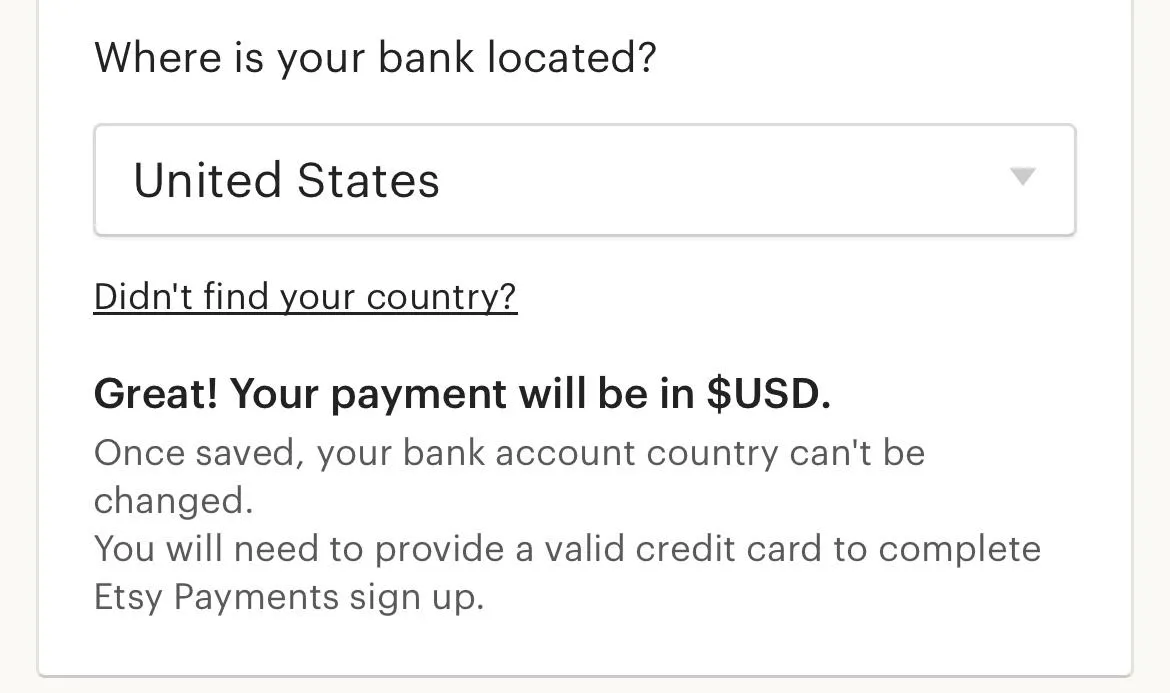
  • Select your bank’s country.
How to receive payments on Etsy as a seller in Ghana
  • Choose whether you’re registering as an individual or a business.
How to receive payments on Etsy as a seller in Ghana
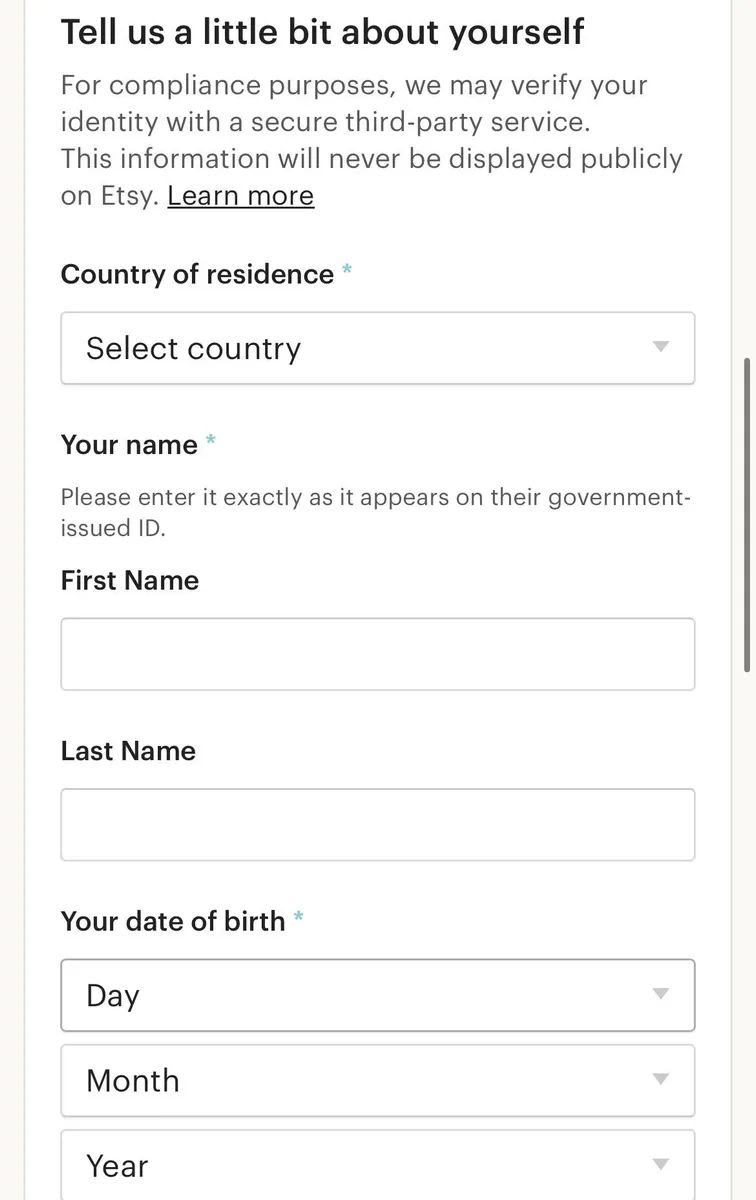
  • Enter your personal information, i.e. name and address.
How to receive payments on Etsy as a seller in Ghana
  • Add your Grey US, EU, or UK bank account details, depending on your preference.
How to receive payments on Etsy as a seller in Ghana
  • Etsy will process payments to your Grey account, making it easy to manage your earnings.

With your Grey account linked, you can receive Etsy payouts directly into your international bank account. It is important to note that you will have to provide a valid ID and depending on the location you pick, may have to fill in a valid address and social security number for your account to be verified.

Why use Grey for Etsy payments?

Grey simplifies the payment process for Ghanaian Etsy sellers. Here’s why it’s the best choice:

  • Access to multiple currencies: Receive payments in USD, GBP, or EUR depending on your buyers’ preferences.
  • Competitive exchange rates: Maximise your earnings when converting to Ghanaian Cedi (GHS).
  • Secure transactions: Grey’s robust security features ensure your funds are protected.
  • Hassle-free withdrawals: Transfer your earnings to your local bank account with ease.

Also read: How to withdraw to your local bank account on Grey

Tips for succeeding as a Ghanaian seller on Etsy

  • Optimise your listings: Use high-quality photos and detailed descriptions to make your products stand out.
  • Offer international shipping: Expand your customer base by providing global shipping options.
  • Respond quickly: Engage with buyers by answering queries promptly and addressing concerns professionally.
  • Leverage social media: Promote your products on platforms like Instagram and Pinterest to drive traffic to your Etsy shop.

Simplify Etsy payments with Grey

With Grey, you can stop worrying about receiving payments or converting your earnings from Etsy. Manage your finances seamlessly and focus on growing your creative business.

Sign up for a Grey account today and unlock a world of possibilities for your Etsy shop in Ghana.

‍

Last updated:

October 2, 2026

Open a free Grey account to get startedJoin 1 million digital nomads
IF YOU ENJOYED THIS, CHECK THESE OUT

Top remote jobs for Nigerians in 2026: Roles, pay and how to get paid

•

•

2 min read

Remote jobs for Nigerians in 2026 are no longer a niche or a fallback. Software developers, data analysts, designers, and marketers from Nigeria are working full-time for companies in the US, UK, and Europe, earning in dollars, and doing it all from home. The roles are real, the salaries are competitive, and the infrastructure to support it has never been more accessible.

One thing most guides skip: when you apply to platforms like Upwork or Turing, they ask for your banking details before you land your first job. Having a Grey account ready means you can provide a US ACH routing number and account number on the spot and receive USD payments from day one without scrambling for a solution after you have already been hired.

This guide covers the highest-paying remote roles for Nigerians, realistic salary ranges, where to find legitimate international opportunities, and how to set up the payment side before you start applying.

Software developer and engineer

Software development remains the highest-paying remote role accessible to Nigerian professionals. International companies hire Nigerian developers for frontend, backend, mobile, and full-stack roles across fintech, SaaS, AI, and healthtech.

Employment Freelance rates
USD 30,000 to 90,000 per year USD 25 to 80 per hour

Also read: Remote work in Lagos: how Nigerians earn and manage global dollar income

Skills in demand: React, Node.js, Python, TypeScript, Go, cloud infrastructure. Employers prioritise portfolios and real-world experience over credentials.

Data analyst and data scientist

Remote data analyst roles are growing as global businesses rely on data-driven decisions. Nigerians with SQL, Python, and business intelligence skills are finding long-term contracts with international teams, often with flexible schedules.

Employment Freelance rates
USD 25,000 to 70,000 per year USD 20 to 60 per hour

Skills in demand: SQL, Python, Tableau, Power BI, dbt, statistical modelling.

Digital marketer and growth specialist

Digital marketing is one of the most accessible remote roles for Nigerians. Results matter more than location, and Nigerian marketers are securing international roles in SEO, paid advertising, content, and email marketing with global startups and brands.

Employment Freelance rates
USD 20,000 to 75,000 per year USD 15 to 50 per hour

Skills in demand: performance marketing, SEO, HubSpot, Google Analytics, Klaviyo, growth experimentation.

You may also like: How to receive USD freelance payments in Nigeria

Product designer — UI/UX

Remote design roles continue to grow as companies invest in digital products. Nigerian designers with strong portfolios work remotely with global teams on apps, websites, and SaaS platforms, competing on craft rather than location.

Employment Freelance rates
USD 30,000 to 75,000 per year USD 25 to 70 per hour

Tools in demand: Figma, Framer, user research, prototyping, design systems.

Technical writer and content specialist

Remote writing has expanded beyond blogging. Nigerian professionals are working as technical writers, documentation specialists, and content strategists for international companies in SaaS, fintech, and developer tools.

Employment Freelance rates
USD 20,000 to 55,000 per year USD 20 to 60 per hour

Virtual assistant and operations support

VA roles have evolved into full remote operations positions. Nigerian VAs now support founders and remote teams with scheduling, CRM management, customer support, and internal coordination, often on long-term retainers.

Employment Monthly retainer
USD 12,000 to 35,000 per year USD 800 to 2,500

Customer success and support

International companies value Nigerian professionals in customer success roles for communication skills and time zone alignment with Europe. These roles offer stable monthly income and career progression.

Employment Contract rates
USD 18,000 to 45,000 per year USD 10 to 25 per hour

Set up your payment account before you apply

Most international platforms and employers ask for your banking details during onboarding, not after your first payment. Upwork, Turing, Deel, and most payroll systems ask you to add a withdrawal method before you can accept work or receive a salary. If you do not have a USD account ready, you are either blocked at that step or forced to use a less efficient workaround.

Here is what the onboarding forms typically ask for:

  • Account type: Checking
  • ACH routing number
  • Account number
  • Bank name

A Grey account gives you a US ACH routing number and account number that works with all of the above. You fill in those four fields, and your dollar earnings arrive in your Grey USD account within 1 to 2 business days of each payment. Open your multi-currency account before you start applying so the payment side is ready the moment you land a role.

Once the money is in your account, you hold it in USD, convert to naira when the rate works for you, and spend internationally with a virtual card. There is no pressure to convert immediately and no automatic conversion that locks you into a bad rate.

Also read: Best digital platforms for freelancers to receive money in Nigeria

Where to find legitimate remote jobs as a Nigerian

These platforms consistently list international remote opportunities suitable for Nigerians:

  • LinkedIn — remote-first roles and direct hiring from international companies
  • We Work Remotely — curated global remote jobs across tech, design, and marketing
  • Remote OK — tech, data, and marketing roles
  • Wellfound — startups hiring internationally, often with equity
  • Upwork — freelance and long-term remote contracts across all categories
  • Turing — remote engineering roles with US companies, vetted entry process

Building a remote career from Nigeria that pays well

The professionals earning consistently in remote roles do three things: they build skills with long-term demand, they use the right platforms to find legitimate opportunities, and they set up reliable systems for getting paid before they need them. The payment side is the easiest part to solve in advance. Manage your earnings in USD, convert when the rate suits you, and focus your energy on the work itself.

Frequently asked questions

What are the highest-paying remote jobs for Nigerians in 2026?

Software development, data science, and UI/UX design offer the highest earning potential, with annual salaries ranging from USD 30,000 to USD 90,000 depending on experience and role level.

How do Nigerians get paid for remote jobs?

Most international employers and platforms pay via ACH direct deposit into a US bank account or via payroll platforms like Deel or Remote. Having a USD account with an ACH routing number, such as a Grey account, lets you receive these payments directly.

What banking details do I need for Upwork or Turing?

Both platforms ask for a checking account type, an ACH routing number, an account number, and a bank name. A Grey USD account provides all four.

Do I need to be in the US to receive dollar payments from remote work?

No. You receive the money into your USD account regardless of where you are. Grey accounts are available in Nigeria and 80+ other countries, and you access your USD balance from the Grey app.

Is it legal to earn in dollars from remote work in Nigeria?

Yes. Nigerians can legally earn in foreign currency from international employers and clients. You are responsible for declaring income to FIRS as required under Nigerian tax law. Consult a tax professional for advice on your specific situation.

Which remote jobs can Nigerians do with no experience?

Virtual assistant, data entry, customer support, and entry-level content writing roles are the most accessible for those starting out. These typically pay USD 10,000 to USD 25,000 per year and provide a foundation for moving into higher-paying categories.

Salary ranges are indicative and based on industry data available at the time of publication. Actual compensation varies by employer, experience level, and role scope. Tax obligations for remote workers in Nigeria are subject to Nigerian law; consult a qualified tax adviser for guidance specific to your situation.

‍

If you’re working online for international clients or employers, create a free account on Grey to receive USD, EUR, or GBP, manage your income efficiently, and focus on growing your remote career in 2026 and beyond.
How YouTubers receive earnings from abroad

•

•

2 min read

Across the globe, countless YouTubers with millions of followers are creating content, educating audiences, and building strong communities. Many are now attracting sponsorships and monetising their influence, but getting paid isn’t always easy. Some face challenges receiving funds from brands, while others struggle to access ad revenue in foreign currencies. Delays, conversion losses, and complicated payment systems can make the process stressful.

In this article, you’ll discover how top content creators manage international payments efficiently, ensuring their hard work is rewarded on time, so they can stay focused on what they do best: creating amazing content.

Also read: Best ways to receive payments from international clients

How YouTubers earn money from international audiences

YouTubers today aren’t limited by borders. With audiences and brands worldwide, creators have multiple income streams coming from international sources. Understanding how these earnings work helps you maximise revenue, get paid reliably, and grow your channel sustainably.

1. Ad revenue from global views

YouTube’s AdSense pays creators based on views, engagement, and ad placement. International audiences often generate higher CPMs, meaning a video watched in the US or Europe can earn significantly more than local views. Travel vloggers or tech reviewers with global subscribers benefit from this. The more your content resonates worldwide, the higher your ad revenue grows over time.

2. Brand sponsorships

Brands across the globe pay creators to promote their products or services. These sponsorships can range from one-off campaigns to long-term partnerships and are often paid in foreign currencies. Tech reviewers partnering with European software firms or lifestyle creators showcasing US products are good examples. Sponsorships also open doors to networking with international companies, building your channel’s credibility globally.

Also read: How creators receive payouts from international platforms

3. Affiliate marketing

YouTubers earn commissions by recommending products or services to a global audience. Every purchase made through their affiliate link generates income. Gaming channels using Amazon Affiliates or software creators promoting tools internationally can generate consistent revenue. By choosing products that match your audience, you create trust and repeat income while expanding your influence beyond your home country.

4. Selling digital products or Merchandise

Creators turn their knowledge into products like e-books, online courses, or branded merchandise for global fans. A fitness YouTuber selling training guides to US or European followers, or a designer offering digital templates worldwide, can generate substantial revenue. Selling internationally also helps diversify income streams, giving creators stability and control over their financial growth.

Challenges YouTubers face when receiving international payments

Creators often face hurdles when dealing with international earnings. Understanding these challenges helps you plan more effectively and stay focused on content creation.

1. Currency fluctuations

Earnings from abroad often arrive in foreign currencies, and fluctuating exchange rates can reduce your actual income. Without a strategy to convert at favourable rates, creators can lose money unexpectedly, affecting budgeting and reinvestment plans for their channel. Managing these fluctuations is essential to keep your earnings stable.

2. Payment platform limitations

Not every platform supports all countries or currencies, and some have high fees or limited withdrawal options. YouTubers can struggle to access funds efficiently, with complicated interfaces adding stress. Choosing reliable and flexible platforms is critical to ensure your earnings reach you safely and without unnecessary hassle.

Also read: Financial tips for freelancers and creators: How to manage your finances effectively in 2023

3. Tax and compliance issues

Receiving international funds may involve understanding multiple tax systems. Mismanaging taxes or failing to report income correctly can cause fines or payment blocks. YouTubers must stay informed about their legal obligations, both locally and abroad, to keep their channels profitable and their earnings secure.

4. Brand or platform disputes

Sometimes, payments get held up due to misunderstandings with sponsors or payment platforms. Incorrect invoices, contract issues, or verification problems can create friction. YouTubers must maintain clear communication and proper documentation to avoid conflicts and ensure smooth payment from global partners.

How to receive payments globally using Grey

Grey makes getting paid from international platforms easy and secure, helping creators focus on their content rather than payment hassles.

  • Sign up or download the app: Start your Grey account in minutes.
  • Get a foreign account instantly: Open a free EUR, USD, or GBP account with Grey in minutes.
  • Link your account to payment platforms: Use Grey banking details to receive funds from YouTube, sponsors, or affiliate programs.
  • Fast transfers to local accounts: Move your international funds quickly to your home currency whenever you need them.

LDMAG1

Receive your YouTube earnings with Grey

Earning from YouTube is a huge opportunity for creators worldwide. You no longer need complicated banking to receive international payments. With Grey, you can get paid globally and access your funds locally, all while focusing on growing your channel. Sign up or download the Grey app today to start receiving your earnings securely and effortlessly.

‍

Virtual cards in Egypt for online payments

•

•

2 min read

It is one thing to have the funds for online payments; it is another thing to have the means to complete the payment without getting frustrated. Managing international payments in Egypt can be quite a hassle. If you’ve tried paying for an international subscription, a work tool, online shopping, or an online course from Egypt, perhaps you can relate to the struggle. Local Egyptian bank cards are often restricted from international transactions, offer poor exchange rates, or aren’t supported by global platforms.

Virtual cards exist mostly to solve these problems, and they have become one of the most efficient options for anyone who shops online, pays for subscriptions, or needs a reliable way to spend in foreign currency without the limitations of a standard local bank card.

This article explains how virtual cards work, who they are for, and the main options available to people in Egypt right now.

What is a virtual card, and how does it work?

A virtual card is a digital payment card that works just like a traditional debit or credit card, except it exists only electronically. Instead of receiving a plastic card, you get the card details instantly on your phone or computer, including the card number, expiration date, and CVV security code.

Because virtual cards are issued digitally, they are typically available within minutes, unlike physical cards that must be printed and delivered.

Most virtual cards operate as prepaid or debit cards, meaning you spend funds you already have. In many cases, the card is connected to a multi-currency account, so payments are deducted directly from your balance in currencies such as USD, GBP, or EUR. This eliminates the need to manually top up the card before each purchase.

For example, Grey virtual cards are linked directly to your foreign currency balance, allowing you to pay online or in apps without transferring funds to the card first.

In practice, using a virtual card is no different from using a physical one. You simply enter the card details at checkout when making online payments, subscriptions, or international purchases. Many virtual cards can also be added to Apple Pay or Google Pay, enabling secure contactless payments with your phone wherever mobile wallets are supported.

Also read: Managing USD income as a remote worker in Egypt

What to look for when choosing

Not all virtual cards work the same way. The best option for you will depend on how you plan to use it, which currencies you deal with most often, and how frequently you make international payments. Before choosing a provider, it’s worth looking closely at a few key factors.

Currency support. Many virtual cards are designed primarily for USD payments, but international platforms often charge in other currencies such as EUR or GBP. If you regularly use services based in Europe or the UK, a card that supports multiple currencies can help you avoid additional conversion fees. Choosing a provider with a multi-currency account allows you to hold and spend different currencies more efficiently.

Funding options. Different platforms allow you to add funds in different ways. Some accept local bank transfers, others allow crypto deposits such as USDT, and some link directly to a multi-currency account balance, like Grey. Before signing up, check that the funding method available actually works for your situation and location.

Platform compatibility. Not every virtual card works equally well across all international platforms. Some services, particularly advertising platforms or large marketplaces, may reject certain cards depending on the issuing network or region. If you plan to use your card for a specific purpose, such as paying for Google Ads or cloud hosting, it’s worth confirming that the card is widely accepted on those platforms.

Fees and exchange rates. Virtual card costs can vary significantly between providers. Some charge a card creation fee, others add transaction fees, and most apply a small markup on currency conversions. A card that appears free at first glance may become more expensive if the exchange rate spread is high. Always look at the total cost of using the card, not just the upfront fee.

Security and regulation. Security should always be a priority when choosing a financial platform. Look for providers that follow proper identity verification processes and operate with licensed financial partners. Features such as two-factor authentication, transaction alerts, spending limits, and the ability to instantly freeze your card add an important layer of protection.

Contactless payments. Some virtual cards can be added to mobile wallets like Apple Pay or Google Pay, allowing you to make contactless payments with your phone. This can be particularly useful when travelling or making in-store purchases abroad. If this feature matters to you, make sure the card supports mobile wallet integration in your region.

Taking a few minutes to compare these factors can help you choose a virtual card that fits your spending habits and avoids unnecessary fees or payment issues later.

The top virtual cards in Egypt for online payments

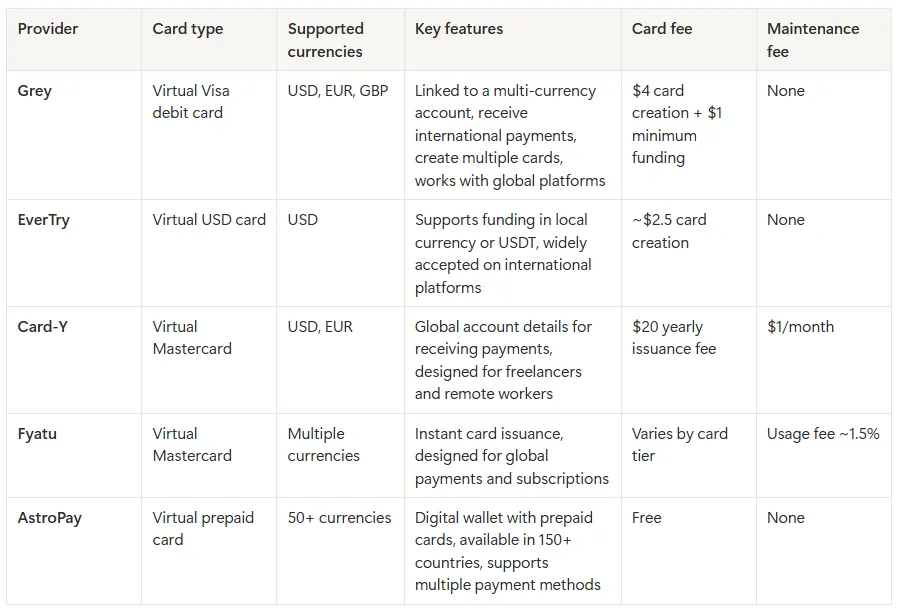
While cards issued by local banks work well for domestic spending, they are not always reliable for international payments. Here is a list of the top virtual cards in Egypt for online payments.

Grey

Grey offers virtual cards linked to a multi-currency account that supports USD, EUR, and GBP. You can create multiple cards for various uses to properly plan your finances. One card can be for online shopping while another could be for subscriptions and or online course. Grey cards are globally accepted and works with the full range of international platforms

You can receive international payments into your Grey USD, GBP, or EUR account or fund your account in EGP and convert to USD to spend on your cards directly.

Fees: Grey virtual USD cards cost a one-time creation fee of $4, plus a minimum of $1 to fund the card, totalling $5 to get started. There are no monthly maintenance fees.

EverTry

EverTry offers a solution for international payment restrictions in Egypt through their virtual dollar card platform. It allows Egyptian users to pay for global services that often decline local bank cards. It supports funding in local currency and USDT, making it accessible to users who are comfortable with crypto. The card works across a wide range of international platforms, including Netflix, Spotify, AWS, DigitalOcean, Namecheap, Facebook Ads, and Google Ads.

Fees: Card creation typically costs $2.5, with no monthly maintenance fees.

Card-Y

Card-Y is a fintech platform that offers multi-currency global accounts with a linked virtual card, designed for Egyptian freelancers and remote workers. It offers USD and EUR account details for receiving international payments, with a free virtual card included that draws from those account balances. It also issues local Egyptian bank cards to subscribers.

Fees: Card-Y offers virtual Mastercard issuance for a $20 USD fee, which is valid for one year and does not add to the card balance. The service features a $1 monthly maintenance fee, a 1% USD transaction fee ($1 min/$5 max), and a 1.5% foreign currency conversion fee.

Fyatu

Fyatu provides instant virtual Mastercards with support for multiple currencies, aimed at users who need to make global payments and manage international subscriptions. Onboarding is digital, and card issuance is immediate. It is a straightforward option for users whose primary need is an international spending card rather than a full suite of banking features.

Fees: Fyatu virtual card costs include a 1.5% fee for card usage (for either withdrawal or payments), with card replacement fees of $5 for World cards and $10 for Platinum cards. A $1.00 fee applies to declined transactions. Funding methods vary, with fees such as 3% for MTN MoMo and various percentages for online wallets like PayPal (3.5% + $0.30).

AstroPay

AstroPay is a globally recognised digital wallet and virtual card platform, available in over 150 countries, including Egypt. It has been around since 2009 and has a particularly strong footprint in emerging markets across Africa, Latin America, and Asia. The platform supports more than 50 currencies, issues virtual prepaid cards instantly, and does not require a traditional bank account to sign up.

For Egyptian users, AstroPay works as a prepaid spending tool. You load funds onto your wallet using a local payment method, then use the virtual card for international purchases on platforms that accept Visa or Mastercard. Card details are issued instantly through the app, and the platform supports one-time or multi-use cards depending on the denomination.

However, bank withdrawals from AstroPay can attract fees of up to 6% depending on the institution. There is a margin of 1% to 3% on exchange rate.

Fees: No card purchase or maintenance fee. No annual fee. Transaction fees of 2–5% depending on the payment method used. FX markup of approximately 1–3% on non-native currency transactions. Withdrawals to a bank account: up to 6%.

Comparison of the top virtual cards in Egypt

Before exploring each option in detail, the table below summarises some of the key differences between the most popular virtual cards available to users in Egypt, including supported currencies, card type, and typical fees.

Table comparing virtual cards from Grey, EverTry, Card-Y, Fyatu and AstroPay

Quick recommendations

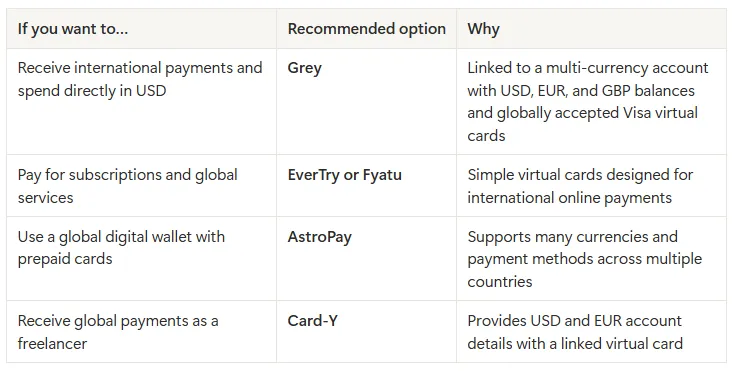
If you’re not sure which virtual card to choose, here’s a quick guide based on common use cases in Egypt.

Table recomending different cards for each need

For most freelancers, remote workers, and online entrepreneurs in Egypt, a virtual card linked to a multi-currency account is often the most practical option. It allows you to receive money from abroad, hold foreign currencies, and pay for global services without converting funds every time you make a transaction.

Also read: Grey card vs other virtual cards: What you should know

Make international payments with Grey

The advent of virtual cards has brought significant flexibility to managing international payments. Grey gives Egyptians a virtual card linked to your multi-currency account. This allows you to receive international payments and spend internationally from the same platform. Whether you are paying for software subscriptions, running digital ads, shopping on international platforms, or managing online tools for your work, Grey's virtual card is accepted globally and straightforward to set up.

Ready to get your virtual card? Sign up on Grey and download the app to create your virtual USD card in minutes.

‍

11 best virtual mailbox services for digital nomads

•

•

2 min read

A virtual PO box, or virtual mailbox, gives you a real street address where a provider receives your post, scans it and forwards or shreds it on request. Digital nomads use one to keep a stable address for banks, tax letters and deliveries, even when they move between countries.

Without a permanent home, managing important mail can become complicated. You might miss a bank statement, struggle to receive a replacement card or need an address to register a business. A virtual mailbox helps you handle these tasks without relying on friends or family to collect your post.

However, providers differ in their locations, monthly fees, mail-scanning limits, forwarding options and international shipping costs. Some offer additional services, such as check deposits and package consolidation.

This guide covers 11 virtual mailbox services worth considering, helping you compare their features, pricing and availability to find an option that fits your travel routine and mailing needs.

What is a virtual PO box?

A virtual PO box is a mail-handling service that gives you a physical mailing address without requiring you to rent or visit a mailbox in person. As a digital nomad, you can use it to receive letters, bank statements and packages while travelling or living abroad.

Unlike a traditional PO box, a virtual mailbox typically provides a real street address. When you sign up, your provider assigns you an address at its mail-handling facility. You can use this address for eligible correspondence, and the provider receives your mail on your behalf.

Your address may include a private mailbox (PMB) number, such as 123 Main Street, PMB 456. This identifies your individual mailbox within the provider’s facility. The exact format varies by provider, and you should follow its instructions when entering your address on forms.

A USPS PO box, by contrast, is rented directly from the United States Postal Service and usually uses a PO box number rather than a street address. A virtual mailbox may accept deliveries from multiple carriers, depending on its policies, and lets you view scanned mail online, request forwarding or arrange secure shredding.

The 11 best virtual mailbox services

The 11 best virtual mailbox services offer different address locations, mail scanning features, forwarding options and pricing plans. Whether you travel frequently, live abroad or run a remote business, compare each provider’s features to find a mailbox service that fits your needs.

Rank Provider Starting price Address locations Scans included Forwarding cost Best for
1 iPostal1 $9.99/mo 4,250+ locations globally Up to 30 exterior scans; content scans cost $2.25 per envelope for up to 10 pages Carrier rates plus handling fee, varying by location Overall network and local presence
2 Anytime Mailbox 4.98–9.99/mo, depending on address 2,500+ locations globally 30 incoming items and 5 open-and-scan pages monthly on the standard tier Carrier rates plus $5 per shipping bundle Budget and flexibility
3 Traveling Mailbox $15/mo 25+ US locations 35 page scans and 40 incoming envelopes monthly Carrier rates plus $2 per shipment; consolidation is free Digital nomads and RVers
4 PostScan Mail $10/mo 1,000+ locations 30 exterior scans; content scans cost $2 per envelope for up to 10 pages Carrier rates plus $2 for the first item and $0.50 per additional item Mobile app and multiple profiles
5 Physical Address $7.98/mo 6 regional hubs 30 incoming items monthly; unlimited exterior image views Carrier rates plus material costs Extended mail storage
6 US Global Mail 9.95–19.95/mo Locations across 23+ US states Unlimited exterior envelope scans; content scans depend on your plan Discounted carrier rates, advertised savings of up to 80% Expats and check deposits
7 Earth Class Mail 19–39/mo 80–90 US locations Envelope scans included; content scans charged according to volume Carrier rates plus handling charges Businesses and automated workflows
8 Stable Varies Selected premium office locations Custom high-volume limits for business accounts Secure, tracked priority shipping options Tech startups and API integrations
9 SavvyNomad Varies Residential-style addresses Digital envelope scanning and processing included, according to the supplied plan details Custom domestic and international forwarding Expats and financial correspondence
10 Northwest Registered Agent Varies All 50 US states Up to 5 document scans free annually on standard registered-agent plans Forwarding for state and business documents LLC formation and business privacy
11 Alliance Virtual Offices 37–49/mo 1,200+ locations worldwide Mail reception and notification tracking Scheduled forwarding using your chosen carrier Hybrid businesses needing meeting space

‍

How to choose a virtual mailbox

Choosing a virtual mailbox starts with understanding how much mail you receive and how you want to manage it. Compare each provider’s scanning allowance, including the number of incoming envelopes covered and the cost of opening and scanning their contents. If you receive important documents regularly, a plan with generous scanning limits may offer better value than a cheaper subscription with extra fees.

Next, consider forwarding costs. Providers may charge handling fees in addition to postage, and international deliveries can become expensive. Look for options such as mail consolidation, which combines multiple items into one shipment, and check whether storage limits apply before forwarding.

Your address type also matters. A commercial address may suit general correspondence and business mail, but some banks or government agencies require a residential address. Confirm that the address meets the requirements of the organisations where you intend to use it.

Finally, check the provider’s process for USPS Form 1583. This form authorises a commercial mail receiving agency to handle your mail. You generally need to provide identification and complete the required notarisation or identity verification process before your mailbox becomes active.

Also read: Virtual US accounts explained: Who they work for

Can you use a virtual mailbox for banking and business?

Yes, you can use a virtual mailbox for some banking and business purposes, but acceptance depends on the bank, service provider and intended use. Many virtual mailboxes provide a business mailing address for receiving bank statements, tax notices and official correspondence. However, a mailing address is not necessarily accepted as proof of your physical residential address. Before applying, review the bank’s address requirements and its rules for opening a business account.

Banks may flag a virtual mailbox as a commercial mail receiving agency (CMRA), which means it may not satisfy their physical-address verification requirements. This does not automatically prevent you from opening an account, but you must provide accurate details and any additional documents requested.

For business registration, a virtual mailbox may serve as your mailing address, depending on state rules. An LLC may also need a registered agent with a physical address in its state of registration to receive legal notices. Before applying, review this guide on how to open a business bank account and confirm the bank’s requirements.

Managing money while you travel

Managing money while travelling can get complicated when your income, savings and expenses involve different currencies. You might earn dollars from a US client, pay for accommodation in another country and still need money for expenses back home. Keeping track of exchange rates, transfer fees and spending limits can quickly become frustrating.

Grey helps simplify cross-border money management by giving you a way to receive international payments and manage multiple currencies. Instead of constantly converting money whenever you get paid, you can hold supported currencies and exchange them when it suits your needs.

When you need to pay for flights, accommodation or online subscriptions, Grey’s virtual card for spending abroad gives you another way to make international payments. And if you’re travelling while working remotely, you can get paid from the US while abroad by sharing your Grey USD account details with clients. That way, earning and spending across borders becomes easier to manage

Frequently asked questions about virtual mailbox services for digital nomads

1. What is a virtual PO box?

A virtual PO box, also called a virtual mailbox, gives you a mailing address where a provider receives your letters and packages. You can view scanned images of incoming mail online and choose to have items forwarded, stored or shredded. It is useful for travellers, remote workers and businesses that need reliable mail access.

2. Is a virtual mailbox legal?

Yes, virtual mailboxes are legal in the United States when used in accordance with applicable laws and postal regulations. Providers receiving USPS mail on behalf of customers operate as Commercial Mail Receiving Agencies (CMRAs) and must follow USPS requirements. You must provide accurate identification, complete required forms and avoid using the address for unlawful activities.

3. Can you use a virtual mailbox as a permanent address?

You can use a virtual mailbox as a long-term mailing address, even when you travel frequently. However, it may not qualify as your legal residence or physical address for every purpose. Government agencies, banks, insurers and licensing authorities may require a residential address, so check their specific rules before using one.

4. Do banks accept virtual mailbox addresses?

Some banks accept virtual mailbox addresses for mailing statements and correspondence, but others may reject them for account verification. A virtual mailbox is generally a commercial mailing address, not proof of where you live. Banks may require a separate residential or physical business address to meet identity-verification and compliance requirements.

5. What is USPS Form 1583?

USPS Form 1583 is an application that authorises a Commercial Mail Receiving Agency to receive mail on your behalf. You must provide identifying information and acceptable identification documents. Your signature must be witnessed by the provider or an authorised employee, or acknowledged before a qualified notary. Requirements should be confirmed with your mailbox provider.

6. How much does a virtual mailbox cost?

A virtual mailbox typically costs around $5 to $40 per month, depending on the provider, address location and plan features. Basic plans may include limited mail scanning, while higher-priced options offer more scans, storage or business services. Budget for additional charges such as postage, forwarding, document scanning, package handling and international shipping.

What is the currency of France? Euro symbol and code

•

•

2 min read

The currency in France is the euro, represented by the symbol € and the ISO currency code EUR. If you are travelling to Paris, shopping in Lyon or paying for accommodation in Nice, you will use euros for everyday transactions. France replaced the French franc with euro banknotes and coins in 2002, making the euro its official currency.

The euro is used across mainland France and its outermost regions, including Guadeloupe, Martinique, Réunion, French Guiana and Mayotte. However, not all French territories use the euro. French Polynesia, New Caledonia and Wallis and Futuna use the CFP franc (XPF), a separate currency pegged to the euro at a fixed rate.

When budgeting for a trip, remember that prices are generally displayed in euros, whether you are paying for meals, transport or shopping. If your money is in another currency, check the exchange rate and any conversion fees before making payments. Using a suitable travel card or payment service can also help you manage spending abroad.

What currency does France use?

France uses the euro (€), with the ISO currency code EUR. If you are planning a trip to Paris, exploring the French Riviera or shopping in Marseille, you will pay for most goods and services in euros.

France previously used the French franc as its national currency. The country adopted the euro for electronic and financial transactions in 1999, before euro banknotes and coins entered circulation on 1 January 2002. The franc was then gradually withdrawn, completing France’s transition to the shared European currency.

When checking prices during your visit, look for the € symbol, which usually appears before or after the amount depending on the format. For example, €25 represents twenty-five euros. If you are converting money from naira, pounds or US dollars, the amount you receive will depend on the current exchange rate and any fees charged by your bank or payment provider.

Before travelling, compare conversion costs and payment options so you can manage your spending in France more confidently.

Do the French still use the franc anywhere?

France no longer uses the French franc as its official currency. The euro (€), code EUR, replaced it, with euro banknotes and coins introduced in 2002. However, France still uses a different franc in some of its Pacific territories: the CFP franc (XPF).

If you travel to French Polynesia, New Caledonia or Wallis and Futuna, you will encounter the CFP franc rather than the euro for everyday payments. Although these territories are French, they have a separate currency arrangement suited to their regional economies.

The CFP franc is linked to the euro at a fixed exchange rate of €1 = 119.3317 XPF. This means its value against the euro does not fluctuate with ordinary market exchange-rate movements. However, when converting your money from another currency, such as US dollars or Nigerian naira, the amount you receive can still change with exchange rates and provider fees.

If you are visiting these Pacific territories, check whether your bank card supports local payments and compare conversion charges before travelling. The CFP franc remains distinct from the former French franc, despite sharing the name.

Paying in France: notes, coins, cash and cards

When paying in France, you can use euro banknotes, coins and payment cards. Euro banknotes come in €5, €10, €20, €50, €100 and €200 denominations, while coins range from 1 cent to €2. Prices are displayed in euros, so check the total before paying.

Debit and credit cards are widely accepted in shops, hotels, restaurants and supermarkets. Contactless payments are common, allowing you to tap your card or compatible phone at checkout. However, some transactions may require a PIN, and individual merchants can set minimum card payment amounts where permitted.

Cash remains useful when visiting local markets, buying from smaller vendors, using certain public facilities or making purchases at businesses that do not accept cards. Keeping a little cash available can help you avoid payment difficulties.

If you need a convenient way to pay while travelling, Grey’s virtual card can help you make online and supported card payments in euros. Before your trip, check the card’s currency conversion rates, applicable fees and acceptance conditions so you can plan your spending with confidence.

Also read: Cheapest cities in France for international students

How to get euros for a trip to France

You can get euros for your trip to France through bank ATMs, currency exchange bureaux or your bank before departure. Withdrawing euros from an ATM in France can be convenient, but check your bank’s foreign transaction fees and the ATM operator’s charges. Use ATMs attached to established banks where possible.

Exchange bureaux at airports and tourist areas are easy to find, but they may offer less favourable rates. Compare the final amount you will receive after fees rather than relying only on advertised exchange rates.

When paying by card or withdrawing cash, you may be asked whether you want to pay in euros or your home currency. Choose euros to decline dynamic currency conversion. This usually lets your card provider handle the conversion, which may offer a better rate, although your provider’s fees still apply.

For cross-border payments, Grey offers a way to send money from the US to France. Compare the available exchange rate, transfer fees and delivery times before sending funds, so you can budget for your trip and manage your euros more effectively.

How to send money to France

Whether you are paying rent, covering tuition or supporting family, choosing the right transfer service can help you manage international payments to France. Grey supports cross-border money transfers, allowing you to send money from the UK to France and manage international payments through its platform.

Before sending money, compare exchange rates, transfer fees and delivery times to understand how much your recipient will receive. Bank transfers can include intermediary charges, while card payments may attract foreign transaction fees depending on your provider.

Grey’s multi-currency account helps you hold and manage supported currencies in one place, making it easier to organise international finances. Its virtual card also lets you make eligible online payments and pay for supported purchases in euros. Depending on your card terms and transaction, this may help you avoid certain foreign transaction fees.

Frequently asked questions about the currency of France

1. Does France use the euro or the franc?

France uses the euro as its official currency. The French franc was replaced by euro banknotes and coins in 2002. However, some French Pacific territories still use the CFP franc, a separate currency linked to the euro at a fixed exchange rate.

2. What is the euro symbol and code?

The euro symbol is €, and its three-letter ISO currency code is EUR. You will see the symbol on price tags, receipts and menus across France. For example, €50 means fifty euros. When exchanging money, use EUR to identify the currency correctly.

3. Can you use US dollars in France?

US dollars are not generally accepted for everyday purchases in France. You will usually need euros to pay for meals, transport, shopping and accommodation. Exchange your dollars before travelling or withdraw euros from an ATM. Check conversion rates and fees to manage costs.

4. Is card or cash better in France?

Cards are widely accepted across France, including in hotels, restaurants and shops. Contactless payments are common, making cards convenient for everyday spending. However, cash remains useful at local markets and smaller businesses. Carrying a little of both gives you greater flexibility during your trip.

5. What currency is used in French Polynesia?

French Polynesia uses the CFP franc, abbreviated XPF, rather than the euro for everyday transactions. The currency is pegged to the euro at a fixed rate of €1 = 119.3317 XPF. Check your card’s international payment fees before travelling to the islands.

6. How do you send money to France?

You can send money to France through a bank or an international transfer service. Compare exchange rates, transfer fees and delivery times before choosing. Grey supports cross-border payments, including transfers from the US to France. Confirm service availability and recipient details before sending.

Ways remote workers protect income across countries

•

•

2 min read

If it has ever crossed your mind that someone might be spending your income behind your back, then you are not alone. One minute, you get paid, and the next minute, the funds have dried up, and you are looking forward to the next payday. On second thought, there might actually be someone else spending your money. Unfavourable exchange rates, local currency devaluation, high platform charges, and unplanned taxes can affect your income. Here are the most effective ways remote workers protect their income while working across countries.

They separate their income from their spending

Separating your earnings from your spending helps you manage money better. Remote workers would rather take a regular salary, which is a fraction of their income. They receive payments into an account and periodically move the money they need (maybe monthly) to a separate account where they spend it.

They avoid forced conversions

One of the biggest mistakes remote workers make is converting foreign income into local currency immediately, especially with traditional banks. This exposes you to poor exchange rates and removes the flexibility to decide when you want to convert your income. The OG remote workers know to keep income in the currency it is paid in, then convert only when they need to spend locally or when rates are favourable.

Using multi-currency accounts allows them to receive USD, EUR or GBP, hold balances securely and manage conversions strategically. This simple separation alone can preserve a significant portion of income over time.

They avoid dynamic currency conversion

If you use an international ATM with your local card and choose to be debited in your home currency, that is one of your income drains. Dynamic currency conversion automatically converts payments at unfavourable rates. Remote workers would choose to pay or withdraw in the local currency of the transaction, not their home currency, to avoid hidden mark-ups.

They invoice in stable currencies

Remote workers charge in stable currencies like USD, EUR, and GBP. This improves their earning potential and ensures their money is protected from local economic factors and currency fluctuations. Quoting in these currencies also ensures the income value remains predictable. Even if their home currency weakens, their income in stable currencies acts as a hedge against inflation or sudden devaluation.

They plan for taxes across borders

Unplanned taxes are a recipe for financial disaster. Unexpected tax liabilities can wipe out months of earnings. Remote workers who protect their income understand their tax residency, keep accurate records and set aside money regularly for tax obligations.

They track invoices, payment dates and conversions carefully. Even when working in multiple countries, having organised records prevents penalties and reduces stress.

Also read: How to plan your taxes across multiple income sources

They use contracts and clear payment terms

Working without a clear contract can affect your income. Defining payment terms, timelines, currencies, late fees, and dispute processes beforehand helps remote workers manage expectations and financial disruptions. This reduces delayed payments and gives them leverage if issues arise.

They also avoid working extensively without upfront deposits or milestones, especially with new clients.

Also read: Negotiating cross-border freelance contracts: Tips and templates

They have financial discipline

The money you make from remote work can be seasonal. Sometimes, you’re doing great; other times, you are grasping at straws. Remote workers understand their earnings can be irregular, so they maintain emergency funds to cover three to six months of expenses. They’d usually keep part of their money in stable foreign currencies to protect against local economic changes. Financial discipline involves solid financial planning, strict budgeting, expense tracking, compulsory savings, and emergency funds.

Also read: Managing irregular income as a freelancer

Protecting your foreign income with Grey

Protecting your income as a remote worker boils down to smart planning and the right payment solution. Grey is tailored to help remote workers maximise their earnings with their multi-currency accounts. Users can hold their earnings in USD, GBP, and EUR or convert to local currencies at competitive exchange rates.

Sign up on Grey today and download the mobile app to protect your foreign income.

‍

Arrow (up)

Back to top