<script type="application/ld+json" data-schema-version="grey-blog-v4">
[{"@context":"https://schema.org","@type":"BlogPosting","@id":"https://grey.co/blog/how-to-receive-freelance-payments-in-egypt#article","headline":"How to receive freelance payments in Egypt in 2026: Banks, apps, and workarounds","description":"Egypt's currency controls make it complicated to receive international freelance payments. Here is a practical guide to the options that work — including USD accounts, Wise, and alternatives to PayPal.","inLanguage":"en","url":"https://grey.co/blog/how-to-receive-freelance-payments-in-egypt","mainEntityOfPage":{"@id":"https://grey.co/blog/how-to-receive-freelance-payments-in-egypt#webpage"},"datePublished":"2026-03-23T11:02:48.923Z","dateModified":"2026-06-15T16:54:53.606Z","author":{"@type":"Person","@id":"https://grey.co/authors/tunde-aladeloba#person","name":"Tunde Aladeloba","url":"https://grey.co/authors/tunde-aladeloba","jobTitle":"Content Writer","sameAs":["https://ng.linkedin.com/in/aladeloba-babatunde-b1114b100"]},"publisher":{"@type":"Organization","@id":"https://grey.co/#organization","name":"Grey","url":"https://grey.co","logo":{"@type":"ImageObject","url":"https://cdn.prod.website-files.com/6360022338a81bd6fdbb1145/6564ae1077a67e39d3c491a6_Grey%20Logo%20Lockup%20Black.svg"}},"image":{"@type":"ImageObject","@id":"https://grey.co/blog/how-to-receive-freelance-payments-in-egypt#primaryimage","url":"https://cdn.prod.website-files.com/636a85d290ee58e70c17e1c0/6a300a336ab44a5de30d0329_6a300a31d63db472293fb426_how-to-receive-freelance-payments-in-egypt__header-image.webp","contentUrl":"https://cdn.prod.website-files.com/636a85d290ee58e70c17e1c0/6a300a336ab44a5de30d0329_6a300a31d63db472293fb426_how-to-receive-freelance-payments-in-egypt__header-image.webp","width":1200,"height":675}},{"@context":"https://schema.org","@type":"WebPage","@id":"https://grey.co/blog/how-to-receive-freelance-payments-in-egypt#webpage","url":"https://grey.co/blog/how-to-receive-freelance-payments-in-egypt","name":"How to receive freelance payments in Egypt","description":"Egypt's currency controls make it complicated to receive international freelance payments. Here is a practical guide to the options that work — including USD accounts, Wise, and alternatives to PayPal.","inLanguage":"en","primaryImageOfPage":{"@id":"https://grey.co/blog/how-to-receive-freelance-payments-in-egypt#primaryimage"},"breadcrumb":{"@id":"https://grey.co/blog/how-to-receive-freelance-payments-in-egypt#breadcrumb"}},{"@context":"https://schema.org","@type":"BreadcrumbList","@id":"https://grey.co/blog/how-to-receive-freelance-payments-in-egypt#breadcrumb","itemListElement":[{"@type":"ListItem","position":1,"name":"Home","item":"https://grey.co/"},{"@type":"ListItem","position":2,"name":"Blog","item":"https://grey.co/blog"},{"@type":"ListItem","position":3,"name":"How to receive freelance payments in Egypt in 2026: Banks, apps, and workarounds","item":"https://grey.co/blog/how-to-receive-freelance-payments-in-egypt"}]},{"@context":"https://schema.org","@type":"FAQPage","@id":"https://grey.co/blog/how-to-receive-freelance-payments-in-egypt#faq","mainEntity":[{"@type":"Question","name":"Why do international payments often arrive lower than what clients actually send?","acceptedAnswer":{"@type":"Answer","text":"This usually happens due to layered deductions across payment systems. Funds pass through processing fees, currency conversion spreads, and intermediary bank charges before reaching you. As a result, the final amount in your account is often lower than the original invoice your client approved."}},{"@type":"Question","name":"What causes delays in receiving freelance payments even after a client has sent the money?","acceptedAnswer":{"@type":"Answer","text":"Delays often come from compliance checks, cross-border routing through multiple intermediary banks, and settlement cycles between platforms and local banks. Each step adds processing time, which is why payments can take hours, days, or even longer to reflect in your account."}},{"@type":"Question","name":"Is it safe to use the black market for currency exchange?","acceptedAnswer":{"@type":"Answer","text":"While some freelancers use it to access better rates, it comes with serious risks. These include legal consequences, lack of protection, and unreliable pricing. It may seem beneficial in the short term, but it is not a stable or secure solution for managing long-term freelance income."}},{"@type":"Question","name":"How can you reduce fees when receiving international payments?","acceptedAnswer":{"@type":"Answer","text":"You can reduce fees by choosing platforms with transparent pricing, low conversion rates, and ACH support. Avoid unnecessary intermediaries and compare total costs per transaction. Holding funds in USD or EUR before converting can also help you maximise value, especially during currency fluctuations."}},{"@type":"Question","name":"Why are PayPal fees so high in Egypt?","acceptedAnswer":{"@type":"Answer","text":"PayPal combines multiple charges, including transaction fees and currency conversion, which can total up to 8.5%. You may also face delays like 30-day holds. These factors make it less cost-effective for regular freelance income, especially when compared to newer, lower-fee alternatives"}}]}]
</script>
Freelancer
•
March 23, 2026
•
8 min read
How to receive freelance payments in Egypt in 2026: Banks, apps, and workarounds
Tunde Aladeloba
TABLE OF CONTENT
SHARE THIS POST
In 2024, I walked into a busy workstation in Cairo. Interestingly, many of the people there were freelancers. After a few conversations, I learned they had built strong communities in Maadi, New Cairo, and Zamalek, sharing opportunities and supporting one another across different fields.
As we spoke, the conversation quickly shifted from finding clients to something more specific: how to receive payments properly. Some mentioned delays, others unclear fees, and a few were unsure how much they would actually receive after conversion to Egyptian pounds. The concern was not just getting paid, but how much of that payment they could actually keep.
That was the real gap. Earning globally was one part, but receiving money without unnecessary losses required better choices. This article explains the best ways to receive freelance payments in Egypt, how each option works, and what to consider before choosing one.
What are the challenges of receiving freelance payments in Egypt?
Freelancers in Egypt often struggle to receive international payments smoothly, facing delays, high fees, currency losses, and structural banking limits that reduce earnings and complicate access to money.
Unfavourable rates
Many freelancers in Egypt quickly realise that earning in foreign currency does not always mean keeping its full value. Local banks often convert USD, EUR, or GBP into Egyptian Pounds at rates below the true market value. This difference, while not always obvious, quietly reduces income. Over time, freelancers lose a meaningful portion of their earnings, especially when handling frequent payments from international clients.
High withdrawal fees
Receiving money can be costly due to layered charges. PayPal fees, for instance, can reach up to 8.5% when you combine transaction fees and exchange rate markups. Western Union can cost around 5.1% on a $1,000 transfer for the same reasons. These charges may seem small at first, but they quickly add up. For freelancers working on tight margins or smaller projects, this significantly reduces actual take-home income.
Slow bank transfers
SWIFT transfers are slow because they pass through multiple intermediary banks before reaching the final account. Each bank performs compliance checks, currency processing, and routing, which adds time. Transfers can take several days or even weeks, especially when time zones, weekends, or errors are involved. For freelancers relying on steady cash flow, these delays can disrupt planning and create uncertainty around when payments will actually arrive.
Limited access to USD accounts
Access to USD accounts is restricted due to local banking regulations and foreign currency controls. Banks often require extensive documentation, proof of income sources, and minimum balance commitments before opening such accounts. In some cases, availability depends on the liquidity of foreign currency within the banking system. This makes it harder for freelancers to receive and hold USD directly, forcing conversions that reduce value and limit financial flexibility.
Egyptian freelancers and the black market trade off
Egypt’s freelance economy is growing within a broader macroeconomic environment that has been under sustained pressure since 2022–2024. While the sector is projected to contribute around $4.2 billion to GDP by 2027, its performance is heavily shaped by foreign exchange constraints, inflation, and currency depreciation.
Egypt has faced persistent dollar shortages driven by high import dependence, external debt servicing, and reduced foreign inflows during global tightening cycles. According to IMF country assessments, foreign reserves pressure and capital outflows have periodically forced tighter controls on USD access through formal banking channels. This has created delays and limits on converting foreign freelance income into local currency.
This gap has historically contributed to a parallel FX market, where freelancers sometimes turn to informal channels to access better rates. With inflation reaching 15% in March 2026, preserving value has become urgent. Official rates sit around 53–54 EGP per USD, while black market rates are roughly 6% higher, making the option appear attractive despite the underlying risks, which includes:
Legal risks: Engaging with the black market exposes freelancers to potential legal consequences. Authorities treat unlicensed currency exchange as a violation, which can lead to fines, account scrutiny, or restrictions that disrupt long term financial stability.
Volatility: Black-market rates are neither fixed nor transparent. Prices can change rapidly within hours, leaving freelancers uncertain about actual value. This instability makes it difficult to plan income, savings, or long-term financial decisions with confidence.
Lack of protection: Transactions in the black market are informal and unregulated. If something goes wrong, such as fraud or incomplete transfers, there is no formal system to resolve disputes or recover lost funds.
Limited scalability for growth: While useful for small transactions, the black market is unreliable for larger or more frequent payments. As freelance income grows, depending on informal channels becomes risky and difficult to sustain professionally.
As a freelancer in Egypt, getting paid internationally can feel complicated due to fees, currency limits, and banking restrictions. The right platforms help you protect your income, reduce losses, and access global clients more smoothly.
1. Grey
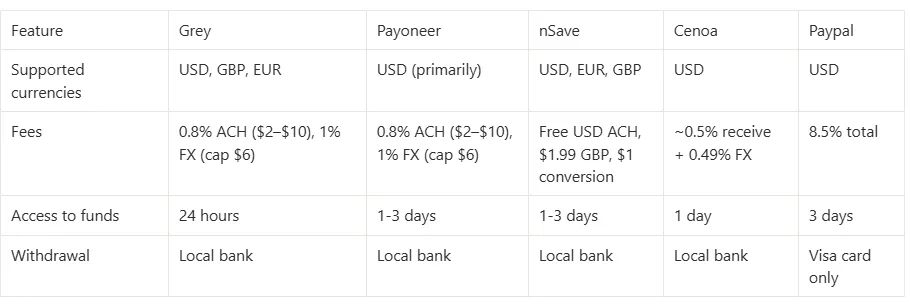
Grey is ideal for receiving USD, GBP, or EUR directly, making it a strong option for you as an Egyptian freelancer working with international clients. It offers competitive conversion rates when you move funds into EGP and supports fast transfers, often within 24 hours to your local bank account. Fees are transparent and relatively low, including a 0.8% ACH deposit fee (minimum $2, maximum $10) and a 1% currency conversion fee capped at $6. This helps you keep more of what you earn while still enjoying quick access to your money.
2. Payoneer
Payoneer is widely used across global freelance platforms, making it easy for you to receive payments from international clients. You can receive USD and withdraw directly into your local Egyptian bank account. However, fees can add up, including around a 1% fee to receive funds, 3% for withdrawals, and up to 4.5% for currency conversion into EGP. While it is slightly more expensive, it integrates smoothly with platforms like Upwork and Fiverr, which many freelancers rely on to secure consistent work.
3. nsave
nsave allows you to hold USD, EUR, or GBP and receive payments using US routing details, which is useful if you work with American clients. It gives you more control over when and how you convert your money. Fees are relatively low, with free USD ACH deposits, $1.99 for GBP accounts, and a flat $1 fee when converting and sending funds to your Egyptian account. This makes it a practical option if you want to store earnings in stable currencies before converting during better market conditions.
4. Cenoa
Cenoa gives you a USD-based account designed for freelancers in emerging markets like Egypt. You can receive and hold foreign currency while keeping total fees low, usually around 0.99% to 1%. This includes a 0.5% receiving fee and a 0.49% FX conversion fee. It helps you stay in control of your earnings, especially when you want to delay conversion into EGP during volatile market periods. For you, this means more stability and fewer losses to hidden charges.
5. PayPal
PayPal is easy for you to set up and widely accepted, but it is often the most expensive option. Fees can reach up to 8.5% when you combine transaction costs and currency conversion. In some cases, funds may be held for up to 30 days, delaying your access to them. Withdrawals are typically limited to Visa cards rather than direct bank transfers. While convenient at the start of your freelance journey, it becomes less efficient as your income grows due to high deductions.
Comparing different payment platforms for freelancers in Egypt
What to look out for when choosing a payment platform
Choosing the right payment platform as a freelancer in Egypt helps you reduce fees, access your money faster, and manage international payments with more control and confidence.
Local bank linking
You need a platform that connects smoothly to your Egyptian bank account. Direct transfers to EGP accounts make it easier to access your money without relying on third parties. If a platform lacks reliable local bank integration, you may face delays, extra steps, or added costs. Prioritising this feature ensures your earnings move seamlessly from international clients into your everyday financial system without unnecessary friction or complications.
Withdrawal speed
Fast access to your money is essential, especially when you rely on freelance income for daily expenses. Some platforms process withdrawals within the same day, while others take one to two business days or longer. Delays can disrupt your cash flow and planning. Choosing a platform with consistent, quick payout times gives you more financial stability and ensures you can meet obligations without unnecessary waiting.
Compatibility with freelance marketplaces
If you work through platforms like Upwork or Fiverr, compatibility matters. Some payment services integrate directly, making it easier to receive funds without extra steps or conversions. Without this compatibility, you may need workarounds that increase fees or processing time. Choosing a platform that aligns with where you earn ensures smoother transactions, fewer disruptions, and a more professional experience when managing your freelance income.
Withdrawal fees
Fees can significantly reduce what you actually take home. Look closely at receiving fees, withdrawal charges, and currency conversion rates, as these often stack together. Even small percentages add up over time, especially with frequent payments. A platform with transparent and lower fees helps you retain more of your earnings. Always calculate the real cost per transaction before committing to any payment solution.
ACH/Wire support
Platforms that provide a virtual US bank account with ACH routing details give you a major advantage. This allows you to receive USD directly from clients as if you had a local US account. It reduces friction, avoids unnecessary intermediaries, and can lower fees. For freelancers working with international clients, this feature makes payments faster, simpler, and more aligned with global payment expectations.
Frequently asked questions
Why do international payments often arrive lower than what clients actually send?
This usually happens due to layered deductions across payment systems. Funds pass through processing fees, currency conversion spreads, and intermediary bank charges before reaching you. As a result, the final amount in your account is often lower than the original invoice your client approved.
What causes delays in receiving freelance payments even after a client has sent the money?
Delays often come from compliance checks, cross-border routing through multiple intermediary banks, and settlement cycles between platforms and local banks. Each step adds processing time, which is why payments can take hours, days, or even longer to reflect in your account.
Is it safe to use the black market for currency exchange?
While some freelancers use it to access better rates, it comes with serious risks. These include legal consequences, lack of protection, and unreliable pricing. It may seem beneficial in the short term, but it is not a stable or secure solution for managing long-term freelance income.
How can you reduce fees when receiving international payments?
You can reduce fees by choosing platforms with transparent pricing, low conversion rates, and ACH support. Avoid unnecessary intermediaries and compare total costs per transaction. Holding funds in USD or EUR before converting can also help you maximise value, especially during currency fluctuations.
Why are PayPal fees so high in Egypt?
PayPal combines multiple charges, including transaction fees and currency conversion, which can total up to 8.5%. You may also face delays like 30-day holds. These factors make it less cost-effective for regular freelance income, especially when compared to newer, lower-fee alternatives
Managing freelance payment from Egypt
Managing international freelance payments in Egypt is now much easier with modern digital payment solutions. Platforms like Grey provide Egyptian freelancers and remote workers with GBP, USD, and EUR accounts for receiving global payments. With these details, your international clients can pay you as if it were a local bank transfer, removing cross-border friction and delays.
Grey charges fees on deposits, conversions, and withdrawals. Deposits via ACH, SEPA, or FPS incur a 0.8% fee (minimum $2/€2/£2, maximum $10/€10/£10). Currency conversions are charged at 1%, capped at $6. Withdrawal fees vary by currency: ₦35 for NGN, 0.5% for EUR/GBP (minimum €2/£2, maximum €10/£10), and $0.50 to $0.65 for KES/UGX/TZS. Cross-border card transactions (non-USD purchases on a USD card) incur a 2% fee plus $0.50. Exchange rates are variable and include a margin over the mid-market rate. Always review fees and the rate before confirming a transaction. Visit our pricing page for current rates.
One of the biggest challenges after getting international clients is protecting your income from exchange rate swings. The ideal sequence is that after you complete a project, you send your invoice, and then receive payment in dollars or pounds. It feels rewarding, but living in Nigeria means constantly thinking about the naira. Should you convert immediately or wait? In a market where FX rates change quickly, even a short delay can significantly affect how much ends up in your account.
From Lagos to Abuja to Port Harcourt, freelancers and tech professionals manage foreign income strategically. Some use domiciliary accounts, while others rely on fintech platforms to hold foreign currency. The goal is to avoid unnecessary conversions and reduce exposure to sudden drops.
This article explains practical methods Nigerians use to manage FX risk and protect the true value of their remote earnings.
How FX swings impact your remote earnings
Foreign exchange (FX) swings happen when the value of the naira rises or falls against currencies like the dollar or pound. In Nigeria, rates can change quickly because of inflation, demand for dollars, government policies, and market pressure. One week, the rate is stable; the next week it shifts sharply. For anyone earning in foreign currency, that movement is never just news, it directly affects your money.
First, FX swings can change how much your income is worth overnight. You might receive $1,000 feeling confident, only to see the rate drop before you convert. That difference can affect rent, family support, or savings plans.
Second, it affects planning. School fees, subscriptions, and travel costs become harder to budget when rates move unpredictably.
Finally, sudden swings create pressure to convert quickly, which can lead to rushed financial decisions and lost value.
Smart ways to protect your remote income from FX changes
In Nigeria, currency rates can change quickly, and protecting your foreign income takes planning and smart choices.
Earn in foreign currency
One of the easiest ways to avoid losing money to FX swings is to earn in foreign currency. Getting paid in dollars or pounds protects your income from the naira’s ups and downs.
Many Nigerian remote workers now look for international clients so their payments hold value before converting. This way, you keep more of what you earn. And once you start earning in foreign currency, the next step is knowing the best ways to receive your money safely and without losing value to unnecessary fees.
Grey: Grey lets Nigerians receive payments in USD, GBP, and EUR. You get foreign account details, hold funds safely, and convert when rates are favourable.
Payoneer: Payoneer allows freelancers to receive international payments from global clients and marketplaces. You can hold foreign currency and withdraw when exchange rates suit you.
Wise: Wise provides multi-currency accounts with local bank details abroad. Nigerian remote workers can receive, hold, and convert foreign income with transparent fees.
Monitor market rates
Exchange rates in Nigeria can move fast, and small changes affect your income. Checking the rates regularly, like people watch dollar or gold prices, helps you know when to convert. Converting straight away isn’t always best. Waiting for a better rate can mean keeping thousands of extra naira, especially when receiving bigger payments from overseas clients. Here’s how you can keep an eye on exchange rates.
Check both official and parallel market rates regularly to know the true value before converting.
Track trends over days or weeks instead of converting immediately for small fluctuations.
Set a target rate based on your expenses, like school fees, rent, or household bills, so you convert at the most useful time.
Another smart move is to save or invest some of your earnings in foreign assets, like dollars, stocks, or online savings accounts. By keeping part of your money in a stronger currency, you protect it from the naira losing value. This gives you more control, helps cover future expenses, and makes your income safer over the long term.
Open a trusted platform that allows Nigerians to buy foreign stocks, ETFs, or hold dollar-based investments.
Start small and invest a portion of your income, not everything at once.
Focus on stable, long-term options instead of risky**,** quick-profit schemes.
Keep records of your investments and review them regularly to ensure they still align with your financial goals.
Myths about FX swings for remote earners
You can always predict the rates: Many Nigerian remote workers think they can time the market perfectly, but FX rates are influenced by government policies, oil prices, and market demand. Even experts struggle to predict sudden changes. Relying on guesses can lead to converting at the wrong time and losing a significant portion of your hard-earned income.
Converting immediately is always best: It’s a common belief that you should convert your foreign earnings as soon as they arrive. In reality, converting immediately can mean losing money if the naira strengthens later. Waiting for a favourable rate, while monitoring trends, often helps you keep more value from international payments.
LDMAG1
Managing foreign earnings with Grey
Managing foreign currency earnings can be challenging as a Nigerian remote worker, especially with fluctuating exchange rates reducing your income. Grey helps protect your earnings from FX swings with multi-currency accounts for USD, GBP, and EUR, competitive exchange rates, virtual USD cards, and fast local withdrawals. You can receive, hold, and convert your income at the right time, keeping more of what you earn.
Budgeting used to be simple. You earned money, spent money, and tracked what was left. At that time, you had only one account with one currency, which required just one mental model.
Then remote work happened.
Now you might earn in EUR, pay for tools in USD, and travel in between. Discipline isn’t enough for budgeting anymore; you need structure. Without the right structure, even the most careful spender can lose track of where their money is going.
The Grey card comes in as a practical budgeting tool for people who live and spend across borders. I’ll explain.
Why budgeting in multiple currencies breaks down so easily
Most people don’t overspend because they’re irresponsible. Rather, they overspend because their money isn’t organised in a way that reflects how they live.
Here’s what usually goes wrong.
You’re spending across platforms, clients, and countries, but everything is tied to one card. Subscriptions, ads, one-off purchases, and travel expenses all blur together. When something goes wrong, such as a spike in ad spend or an unexpected renewal, it’s challenging to pinpoint the cause quickly.
Add foreign currencies to the mix, and it gets worse. The charges don’t always settle immediately, and these small amounts seem harmless until they quietly add up.
What should budgeting look like when you earn and spend globally?
Clarity, separation, and control are the most crucial factors when budgeting across multiple currencies. You should be able to:
See exactly what each type of spending is costing you.
Stop or pause spending instantly when needed.
Protect one part of your budget from another.
Make changes without disrupting everything else.
The Grey card is designed around solving these exact needs.
How does the Grey card help with budgeting?
Use multiple cards to separate your spending
One of the most effective budgeting habits is separation. Instead of using a single card for everything, you can create multiple cards with clear purposes.
For example, you can create:
One card for subscriptions and recurring tools
One card for ads and growth experiments
One card for travel or everyday spending
One card per client or project
Each card acts like its own budget lane. You don’t need to guess where the money went; you already know.
This is especially useful if you freelance, manage ads, or run multiple income streams. When spending is separated, budgeting becomes more straightforward.
Freeze cards instantly when spending goes off-track
Budgets fail when you can’t act fast enough.
With the Grey card, you can instantly freeze or unfreeze any card in the app. If an ad campaign starts burning cash, freeze the card. If a subscription you forgot about renews unexpectedly, freeze the card. If you’re travelling and want to lock down non-essential spending, freeze the card.
Freezing a card doesn’t affect your other cards or balances. It simply stops that specific spending lane, which is precisely how budgeting should work.
Set limits that protect your budget
Budgets can fail when they’re too rigid. Grey’s spending limits work more like guardrails.
You can set daily or monthly limits per card, receive alerts when you’re approaching your limit, and still stay flexible. The goal isn’t to punish spending. I mean, who wants that? It’s to keep you aware before things drift too far.
For shared cards or subscriptions, limits are especially useful. You know exactly how much can be spent, and nothing sneaks past unnoticed.
Track spending clearly in one place
When you’re budgeting across currencies, visibility matters more than perfection. Every Grey card transaction appears clearly in your app, linked to the card you used. That means you’re not just seeing how much you spent, but why you spent it.
When budgeting time comes around, you’re no longer reconstructing your month from memory. The structure is already there.
Spend confidently across borders
Trust helps with budgeting too. When you’re shopping internationally, paying for ads, or travelling, declined payments and unexpected charges can throw everything off. The Grey Card works across global merchants and even supports Apple Pay and Google Pay, so everyday spending feels normal, even when you’re far from home.
LDMAG1
A quick note on protection when spending abroad
An often-overlooked aspect of budgeting is preparing for contingencies in case things go wrong.
When you pay with your Grey card, you have access to Visa benefits, including purchase protection, extended warranties, and price protection, depending on the transaction and your activation status. It’s not something you think about daily, but it adds a layer of reassurance when you’re buying electronics, booking travel, or shopping internationally.
It’s one less thing to worry about while managing money across borders.
What budgeting in foreign currencies is like with the Grey card
When your card and your accounts are aligned, budgeting stops being guesswork. You know what you’re spending, which currency it’s coming from and more importantly, when something changes.
Instead of constantly reacting to your balance, you’re now making decisions with clarity. And that’s what good budgeting should be like, whether you’re at home, travelling, or working remotely.
If you’re ready to make your budget work wherever you are, create or update your Grey card and start spending and budgeting in the ways that matter to you.
Working online as an African freelancer opens doors to clients all over the world, and a foreign account makes the whole process a lot easier. Foreign accounts give you the flexibility to receive payments in multiple currencies, move money seamlessly across borders, and access funds whenever you need them. They put you in control of your income, rather than your income being limited by local systems.
These accounts also allow you to plan, save strategically, and operate professionally on a global scale. For anyone building a remote business, having access to foreign banking options is a way to grow your freelance career with confidence and freedom.
Grey is the best choice for African freelancers, offering fast, secure, and multi-currency digital accounts. Payments from anywhere in the world arrive instantly, and fees are transparent and minimal. With full African integration and seamless international banking, freelancers can manage earnings efficiently, hold multiple currencies, and operate professionally online. For freelancers seeking speed, flexibility, and ease of use, Grey stands out as the top solution.
Afriex
Afriex allows Africans to send and receive money globally, supporting multiple currencies with competitive rates. Transfers are generally fast, and fees are lower than those of traditional banks. It’s useful for freelancers receiving payments from international clients, providing a reliable way to manage earnings across borders. While it’s convenient, Afriex doesn’t offer instant multi-currency access or the full range of features some freelancers may need for global business.
Payoneer
Payoneer is widely used by African freelancers for international payments. It supports multiple currencies and allows withdrawals to local banks. Fees for currency conversion and card usage can add up, and transfers may take a few days. It’s reliable for online marketplaces and global clients, but freelancers should be aware of the processing times and cost structure before fully depending on it.
Wise
Wise is known for low fees and transparent, real exchange rates. It’s a solid choice for receiving international payments and transferring funds across borders. Transfers may not be instant, and it doesn’t provide the full suite of multi-currency account features some freelancers prefer. Wise is ideal for cost-effective cross-border payments, but may not meet all the needs of global freelancers.
Flutterwave barter
Flutterwave’s Barter account helps Africans receive international payments and manage multiple currencies. It’s strong for regional and business transactions, offering convenience and easy account setup. Fees apply for card issuance and some transfers. While it works well for freelancers, it may not have the same speed, flexibility, or international reach as other solutions designed specifically for global remote work.
Chipper cash
Chipper cash is ideal for fast, low-fee transfers across African countries. It’s simple, secure, and supports multiple African currencies, making it perfect for freelancers working regionally. However, it has limited options for international currencies and clients outside Africa. While it’s practical for intra-African payments, freelancers seeking fully global, multi-currency access may require additional solutions.
Revolut
Revolut offers multi-currency wallets, competitive exchange rates, and secure banking features. It’s convenient for managing money internationally, though monthly fees and card usage charges may apply. Some features aren’t available in all African countries. Freelancers with tech-savvy clients may find it useful, but it may not always cover the specific needs of African online workers.
Grey provides fast, secure international payments, enabling freelancers to access earnings efficiently without delays or complex banking procedures.
Multi-currency functionality allows seamless management of USD, EUR, GBP, and local African currencies in a single, consolidated account.
Transparent, competitive fees ensure freelancers retain more of their income, avoiding hidden charges or unexpected deductions.
Enterprise-grade security safeguards accounts and transactions, offering peace of mind when handling global payments.
Support for USDC enables freelancers to receive, store, and convert stable digital currency, minimising volatility in international earnings.
LDMAG1
Grey: The ideal foreign account for African remote workers
African freelancers and online workers need foreign accounts to receive international payments, manage multiple currencies, and operate without restrictions. Grey is ideal, offering fast, secure, multi-currency accounts with transparent fees, advanced security, and an intuitive interface built for African users.
If we give you the short answer, you have to make a pinky promise that you read this article to the end. Trust us, we have more to tell you than just ‘yes, non-residents can open a US bank account online in 2026.’ For the longer answer, there are many other things to consider. Stick with us and let’s go through this together by answering a few questions to give you a clear picture.
Can non-residents open a traditional US bank account online in 2026?
Opening a traditional US bank account, such as a Chase or Wells Fargo account, might be difficult due to their requirements. Here are the key reasons why this is next to impossible:
Requires your physical presence: Major traditional banks often require you visit a US branch to verify your identity and complete the process.
Requires Social Security Number (SSN): While some banks may allow an ITIN (Individual Taxpayer Identification Number) in place of an SSN, many automated online systems strictly require an SSN, which you might not have as a non-resident.
Proof of US address: A physical US address is almost always required to open a traditional bank account in compliance with "Know Your Customer" (KYC) regulations.
Traditional banks are strict on compliance: They adhere to strict regulations (KYC/AML) and find it easier to reject international applications than to verify their legitimacy remotely.
In summary, you cannot open a traditional bank account online as a non-resident living abroad. Even if a bank’s website says “open online,” the system usually blocks or flags non-US residents during the SSN/address checks.
If opening a traditional US bank account can be difficult, who do people bother?
Protects against local inflation: Keeping your earnings in USD protects against the volatility of your local currency.
Easier international payments: A USD account lets you receive USD and make international payments with ease. Whether you are a freelancer with international clients or paying for global subscriptions or tools, a USD account makes it more straightforward.
Reduces losses: When you receive international payments with your local account, the conversion is often done at unfavourable rates. Using a USD account help you time your conversion better and avoid losses.
How can non-residents open a US bank account online in 2026?
While non-US residents cannot open a traditional US bank account, they can still manage USD transactions seamlessly with fintech payment solutions that let you create an account from anywhere, without a physical visit. While these USD accounts might have some limitations, they are reliable and secure for receiving USD payments. They also let you keep USD, make international payments, and withdraw to your local bank account.
Which USD online banking options can non-residents use?
If you want to manage USD with ease, these are some of your best options.
Grey
This offers multicurrency accounts supporting USD, EUR, and GBP, allowing you to manage USD transactions as you would with a traditional USD account. It also seamlessly integrates with freelancing platforms like Upwork and Fiverr to withdraw your earnings. Grey offers you US banking details to receive USD with ease. It is pretty straightforward to create an account, and you can get started with Grey within minutes.
LDMAG1
Wise
Wise provides USD accounts with US routing and account numbers. Wise is known for transparent fees and mid-market exchange rates. It works well for freelancers and remote workers, though some features may vary depending on your country of residence.
Payoneer
Payoneer is widely used on global freelancing marketplaces. It provides USD receiving accounts and allows withdrawals to local banks. While reliable, its fees and exchange rates are generally higher and less transparent than those of newer fintechs.
PayPal
PayPal allows you to receive USD payments, but you cannot truly hold USD long-term in many countries. Withdrawals often force conversion to local currency at unfavourable rates. It works for occasional payments, but not as a long-term USD banking solution.
Why do people open US bank accounts online with Grey?
Grey remains a favourite among frequent international travellers, freelancers with global clients, and everyone managing multiple currencies. Here are the reasons non-residents open a US bank account online in 2026.
Low fees: Grey offers a transparent fee structure with low transaction fees.
Competitive exchange rates: Convert fees at market rates, with no hidden markups.
Swift transactions: Transactions are processed and completed within minutes to a few hours.
Virtual cards: Access multiple virtual cards for your international payments without requiring top-ups. These cards also work with Apple Pay and Google Pay for contactless payment.
Complete your ‘Know Your Customer’ verification by uploading a valid ID, a selfie, and proof of address.
Once verified, request your USD account details.
Share the details with clients, employers, or platforms and start receiving USD payments.
While non-residents cannot open traditional US bank accounts online from abroad, global payment solutions like Grey offer multicurrency accounts that support USD transactions without physically visiting a bank or wading through paperwork. Manage your USD at low cost and withdraw to your local accounts at competitive exchange rates.
Despite being around for a very long time, traditional banks have fallen out of favour with freelancers, and you cannot even blame them. Freelancing has moved beyond working with local clients to a global talent market where people now work for clients thousands of miles away, managing different currencies. Global freelancing has brought global needs, and traditional banking has, so far, not evolved to meet them. Here is why this shift from traditional banks to global accounts is happening.
The truth is, traditional banks are more familiar with managing local transactions in their local currency and less often deal with international payments. Cross-border payments go through the SWIFT network and, sometimes, intermediary banks. Unlike local payments, international transactions are processed over several business days. For freelancers who receive frequent international payments, this traditional system can be inefficient, slow, and frustrating.
Forced currency conversions of traditional banks reduce earnings
One of the biggest pain points for freelancers is the lack of control over currency conversion. Traditional banks usually convert foreign currency to local currency immediately at exchange rates that are less favourable than market rates. The freelancer doesn’t get a say in when or how the conversion happens. This essentially means that every time money comes in, it immediately loses some value. For freelancers who want to keep USD, EUR, or GBP as a hedge against inflation or wait for better exchange rates, this traditional setup just doesn’t cut it.
High charges and hidden fees of traditional banks
International payments through traditional banks usually involve several types of fees charged at different stages of the transaction. There may be incoming wire fees, intermediary bank deductions, and foreign exchange mark-ups applied. It gets even more frustrating that freelancers often cannot even predict how much they will actually receive. A client may send a fixed amount, but the final figure that arrives can be noticeably lower without a clear explanation.
Traditional banks have slow international payment processing
Freelancing income is often unstable. This can make financial planning for many freelancers difficult. Waiting several days for an international payment makes this worse and can affect scheduled payments like rent, subscriptions, and business expenses. Unlike traditional banks, global accounts are designed to settle international payments faster. This helps freelancers access their income earlier and better manage their cash flow.
International clients prefer global accounts
Many foreign clients, especially those based in the US or Europe, prefer to pay into local bank accounts (accounts in their own currency). Asking them to initiate international wire transfers to your local bank can feel inconvenient and, in some cases, unprofessional. Global accounts solve this problem by providing freelancers with banking details in major currencies, making it appear as if clients are making local transactions. This allows freelancers to receive payments as if they were based in the same country as their client, even while working remotely.
Integration with freelance platforms and tools
Freelancers often earn through platforms built with global payments in mind. Global account providers integrate more easily with these systems, ensuring you can withdraw your payout with ease. Payment solutions like Wise, Payoneer, and Grey are commonly supported by global freelancing platforms. On the other hand, traditional banks often struggle with integrating with these platforms.
For freelancers in countries with volatile currencies or rising inflation, holding foreign currency is now more relevant than ever. Before now, holding foreign currency seemed exclusively for wealthy people. But with global accounts, you can easily keep EUR, GBP, and USD. It is a form of financial protection. Traditional banks often restrict this flexibility or impose stringent conditions on foreign currency accounts. Global accounts make it easier for freelancers to hold, manage, and use USD or EUR without unnecessary barriers.
Physical bank visits are inconvenient
Visiting a banking hall can be rather uncomfortable. Traditional banking still relies heavily on in-person visits, physical documents, and long verification processes. This feels out of place for freelancers who work entirely online and from their comfort spaces. Meanwhile, you can access global account services online with remote onboarding and verifications that can be completed in minutes rather than weeks. Avoiding repeated trips to a banking hall is not just convenient; it saves time that can be spent earning.
Freelancers are not abandoning traditional banks because they are unsafe or irrelevant. They are leaving because the evolving global work environment requires financial tools that better meet their needs. Managing cross-border payments requires payment systems that are fast, flexible, affordable, and optimised for cross-border income. This is why Grey offers multi-currency accounts supporting USD, EUR, and GBP payments. This way, freelancers can receive their income at low and transparent fees, competitive rates, and swift payment processing. Grey also simplifies international payments with virtual cards that support direct payment in foreign currencies.
If you’ve been looking for a sign to start selling your freelancing services globally, here is the sign. Indian freelancers have the unique opportunity to expand their client base and improve their earning potential by targeting international clients who pay better and in stable currencies like USD, EUR, and GBP.
The thought of managing international payments might be daunting for many Indian freelancers. Understandably so, receiving global payouts with traditional payment options has discouraged many Indian freelancers. From payment delays to account restrictions, cumbersome paperwork, forced conversion at unfair rates, and payment delays, you have a lot to worry about without the right payout options. This article explores the best payout options for Indian freelancers selling services globally to make sure you maximise your earnings.
Managing payouts in India with multi-currency accounts
Using a multi-currency account is a silver bullet that fixes the challenges with traditional banks when managing foreign income. Multi-currency accounts provide you with virtual bank details in major currencies (USD, EUR, GBP, etc.) that clients can pay into as if you had a local bank account in their country. Once funds arrive, you can hold them in those currencies and convert to INR when rates are favourable. With multicurrency accounts, you can avoid slow bank transfers and unfavourable forced conversions, and keep better control over exchange timing and fees. Here are the things you should look out for when managing payouts in India with multi-currency accounts:
Access to USD, EUR, and GBP
Transparent fee structure
Low-fee conversion to INR
Fast transfers to Indian bank accounts
Ability to pay for global tools and subscriptions
There are some top choices:
Grey: Offers US, EUR, and GBP accounts that function like local bank accounts for international clients, with easy conversion and withdrawals to local banks in India. Grey integrates seamlessly with freelancing platforms and online stores where you might be receiving payouts.
Wise: Provides multi-currency accounts, supports withdrawal at mid-market exchange rates, and has a clear fee structure.
Payoneer: A bit pricey compared to Grey and Wise, but widely supported by freelance marketplaces and includes receiving accounts.
Revolut: Best known for their global cards, but also offers multicurrency accounts.
More indigenoushomegrown fintech solutions are emerging to simplify access to international banking for Indians.
Winvesta: Provides multi-currency accounts supporting 30+ currencies with local collection details in the US, UK, and EU. It charges $3 + 0.99% for cross-border payments with no USD forex markup.
Razorpay: This is a leading Indian fintech that offers two primary methods for managing international payouts: the MoneySaver Export Account for platform-based withdrawals and the International Payment Gateway for direct client invoicing.
PayPal is one of the most widely recognised ways to receive international payments. Many international clients are already familiar with it and can easily pay in foreign currency to your PayPal account. You can then withdraw to your Indian bank account in INR.
However, PayPal is expensive. The fees and exchange rates are often higher than those of multi-currency accounts, and conversion to INR on withdrawal eats into your earnings. There’s also the risk of account holds or restrictions if PayPal flags unusual activity.
Freelance marketplace payouts
If you work through platforms such as Upwork, Fiverr, Toptal, or Freelancer.com, the platforms themselves provide payout options:
Most marketplaces let you withdraw earnings via:
Grey
Direct bank transfer to an Indian bank
Payoneer
Wise
These options are embedded in the platform itself and may be the simplest choice if you earn mostly through a single marketplace. Receiving your payout in a stable currency give your better control and helps you maximise your earnings, compared to withdrawing directly to your local account.
Cryptocurrency payouts
Crypto talks can be confusing most of the time. But for those who understand how it works, freelancers are now accepting payments in cryptocurrencies such as Bitcoin, Ethereum, and stablecoins (e.g., USDC, USDT) if the clients are comfortable with it. These can then be converted to INR through exchanges. ****Crypto transactions are typically faster and cheaper. ****However, you must be wary of crypto volatility if you are not opting for stablecoins. You might also need to find how tax and compliance apply in India
Indian freelancers selling services globally have never had more options. While we are generally moving away from traditional banks, fintech solutions now offer better options for managing international payouts. So, if managing payment was going to be a problem, Grey’s got you. Manage USD, GBP, and EUR payments on one platform at low transaction fees and withdraw INR to your local account at competitive exchange rates and without payment delays. Grey cards make online payments on global platforms seamless for freelancers.



.svg)