


<script type="application/ld+json" data-schema-version="grey-blog-v4"> [{"@context":"https://schema.org","@type":"BlogPosting","@id":"https://grey.co/blog/how-to-get-an-instant-usd-debit-card-in-tunisia#article","headline":"How to get an instant USD debit card in Tunisia","description":"Discover how to get an instant USD debit card in Tunisia with Grey. Simplify global transactions, manage subscriptions, and save on currency conversion fees.","inLanguage":"en","url":"https://grey.co/blog/how-to-get-an-instant-usd-debit-card-in-tunisia","mainEntityOfPage":{"@id":"https://grey.co/blog/how-to-get-an-instant-usd-debit-card-in-tunisia#webpage"},"datePublished":"2024-12-27T07:19:23.419Z","dateModified":"2026-06-15T17:14:11.941Z","author":{"@type":"Person","@id":"https://grey.co/authors/adeolu-titus-adekunle#person","name":"Adeolu Titus Adekunle","url":"https://grey.co/authors/adeolu-titus-adekunle","jobTitle":"Content Writer","sameAs":["https://www.linkedin.com/in/titusadeoluadekunle/"]},"publisher":{"@type":"Organization","@id":"https://grey.co/#organization","name":"Grey","url":"https://grey.co","logo":{"@type":"ImageObject","url":"https://cdn.prod.website-files.com/6360022338a81bd6fdbb1145/6564ae1077a67e39d3c491a6_Grey%20Logo%20Lockup%20Black.svg"}},"image":{"@type":"ImageObject","@id":"https://grey.co/blog/how-to-get-an-instant-usd-debit-card-in-tunisia#primaryimage","url":"https://cdn.prod.website-files.com/636a85d290ee58e70c17e1c0/6a30167ff530256f0c494f3c_6a30167e51e9fcfea6c730fe_how-to-get-an-instant-usd-debit-card-in-tunisia__header-image.webp","contentUrl":"https://cdn.prod.website-files.com/636a85d290ee58e70c17e1c0/6a30167ff530256f0c494f3c_6a30167e51e9fcfea6c730fe_how-to-get-an-instant-usd-debit-card-in-tunisia__header-image.webp","width":1200,"height":675}},{"@context":"https://schema.org","@type":"WebPage","@id":"https://grey.co/blog/how-to-get-an-instant-usd-debit-card-in-tunisia#webpage","url":"https://grey.co/blog/how-to-get-an-instant-usd-debit-card-in-tunisia","name":"How to get an instant USD debit card in Tunisia","description":"Discover how to get an instant USD debit card in Tunisia with Grey. Simplify global transactions, manage subscriptions, and save on currency conversion fees.","inLanguage":"en","primaryImageOfPage":{"@id":"https://grey.co/blog/how-to-get-an-instant-usd-debit-card-in-tunisia#primaryimage"},"breadcrumb":{"@id":"https://grey.co/blog/how-to-get-an-instant-usd-debit-card-in-tunisia#breadcrumb"}},{"@context":"https://schema.org","@type":"BreadcrumbList","@id":"https://grey.co/blog/how-to-get-an-instant-usd-debit-card-in-tunisia#breadcrumb","itemListElement":[{"@type":"ListItem","position":1,"name":"Home","item":"https://grey.co/"},{"@type":"ListItem","position":2,"name":"Blog","item":"https://grey.co/blog"},{"@type":"ListItem","position":3,"name":"How to get an instant USD debit card in Tunisia","item":"https://grey.co/blog/how-to-get-an-instant-usd-debit-card-in-tunisia"}]}] </script>

How to get an instant USD debit card in Tunisia

Adeolu Titus Adekunle

TABLE OF CONTENT

SHARE THIS POST

As Tunisia integrates further into the global economy, a USD debit card is crucial for hassle-free international transactions. Known for its vibrant culture and increasing connectivity to the global economy, Tunisia is home to freelancers, remote workers, tourists who require efficient ways to manage cross-border payments.

Traditional banks in Tunisia often make obtaining a USD debit card challenging due to long processing times, hidden fees, and complex funding methods. Grey provides an easy, secure, and instant way to get a virtual USD debit card in just a few simple steps. This guide will show you how.

Why you need a USD debit card in Tunisia

  1. Shop on global platforms: Buy from international websites without the stress of declined transactions or high conversion fees.
  2. Save on conversion costs: Avoid the recurring expense of converting Tunisian Dinar (TND) to USD for every purchase.
  3. Simplify travel payments: Use your USD debit card for flights, accommodations, and travel-related expenses while abroad.
  4. Manage subscriptions easily: Pay for services like Netflix, Spotify, and Adobe, which charge in USD.
  5. Ideal for freelancers: Receive international payments smoothly without worrying about local banking restrictions.

How to get a Grey USD debit card in Tunisia

Step 1: Sign up and verify your Grey account

Start by signing up on the Grey website or app.

Read also: How to open virtual US bank accounts for freelancers outside the USA

To gain full access to your account, complete the KYC (Know Your Customer) verification process by uploading a valid government-issued ID, such as a Tunisian passport or national ID. This ensures your account is secure and compliant with global financial regulations.

Tip: If you face issues during KYC verification, Grey offers a detailed guide to resolve common KYC problems.

Read also: Best places to go for a summer vacation in Africa

Step 2: Request and fund a foreign currency account

Once your KYC is approved, request a foreign currency account in USD, EUR, or GBP via Grey.

This account allows you to receive international payments and fund it through local or international bank transfers, making it easy to maintain a balance in foreign currency.

Step 3: Apply for your virtual USD debit card

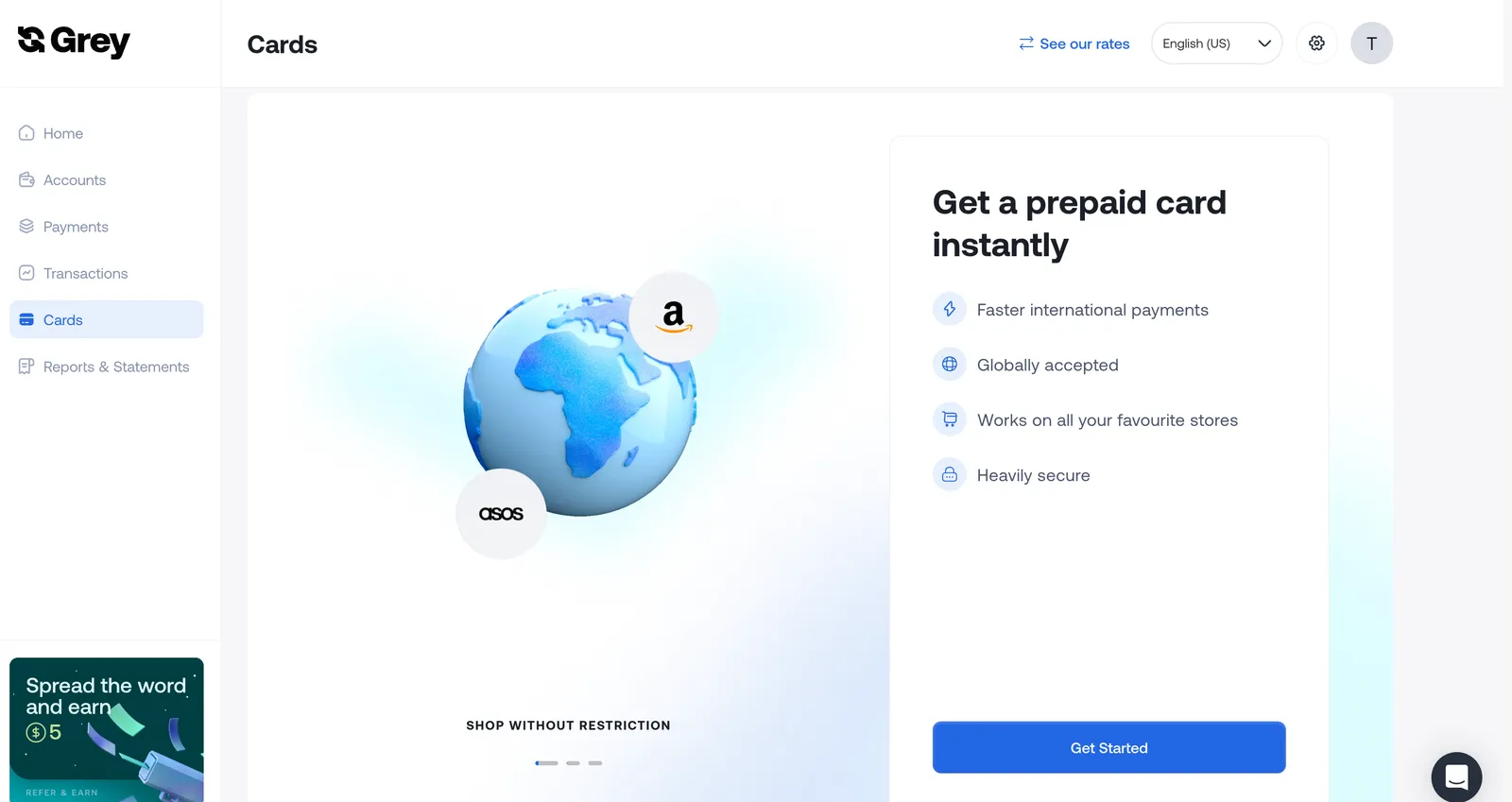
Navigate to the “Card” section in the Grey app or dashboard and click “Get started.”

__wf_reserved_inherit

Pay the one-time card creation fee of $4 and fund your virtual USD debit card with at least $1. Your card should be ready for use within a few minutes.

Why choose Grey’s USD debit card in Tunisia?

  1. Swift card issuance: Receive your virtual card immediately after completing the setup.
  2. Global acceptance: Use your card on any platform or store that accepts MasterCard.
  3. Easy funding: Fund your card directly from your Grey foreign currency account.
  4. Low and transparent fees: Get a virtual USD debit card at a minimal one-time card creation fee without hidden charges.
  5. Secure transactions: Grey ensures your payments are protected with advanced security measures.

Conclusion

Getting a USD debit card in Tunisia has never been easier. Grey’s USD debit card is tailored to meet the needs of Tunisians looking for a cost-effective, secure, and instant solution for global transactions.

Ready to take charge for your finances and enjoy a reliable cross-border payment solution? Get a USD card after you sign up with Grey today!

‍

Last updated:

October 2, 2026

Open a free Grey account to get startedJoin 1 million digital nomads
IF YOU ENJOYED THIS, CHECK THESE OUT

How to budget in foreign currencies using the Grey card

•

•

2 min read

Budgeting used to be simple. You earned money, spent money, and tracked what was left. At that time, you had only one account with one currency, which required just one mental model.

Then remote work happened.

Now you might earn in EUR, pay for tools in USD, and travel in between. Discipline isn’t enough for budgeting anymore; you need structure. Without the right structure, even the most careful spender can lose track of where their money is going.

The Grey card comes in as a practical budgeting tool for people who live and spend across borders. I’ll explain.

Why budgeting in multiple currencies breaks down so easily

Most people don’t overspend because they’re irresponsible. Rather, they overspend because their money isn’t organised in a way that reflects how they live.

Here’s what usually goes wrong.

You’re spending across platforms, clients, and countries, but everything is tied to one card. Subscriptions, ads, one-off purchases, and travel expenses all blur together. When something goes wrong, such as a spike in ad spend or an unexpected renewal, it’s challenging to pinpoint the cause quickly.

Add foreign currencies to the mix, and it gets worse. The charges don’t always settle immediately, and these small amounts seem harmless until they quietly add up.

At that point, your budget is broken.

Also read: How to use your Grey card to manage all your subscriptions

What should budgeting look like when you earn and spend globally?

Clarity, separation, and control are the most crucial factors when budgeting across multiple currencies. You should be able to:

  • See exactly what each type of spending is costing you.
  • Stop or pause spending instantly when needed.
  • Protect one part of your budget from another.
  • Make changes without disrupting everything else.

The Grey card is designed around solving these exact needs.

How does the Grey card help with budgeting?

Use multiple cards to separate your spending

One of the most effective budgeting habits is separation. Instead of using a single card for everything, you can create multiple cards with clear purposes.

For example, you can create:

  • One card for subscriptions and recurring tools
  • One card for ads and growth experiments
  • One card for travel or everyday spending
  • One card per client or project

Each card acts like its own budget lane. You don’t need to guess where the money went; you already know.

This is especially useful if you freelance, manage ads, or run multiple income streams. When spending is separated, budgeting becomes more straightforward.

Also read: How to pay for ads easily with your Grey card

Freeze cards instantly when spending goes off-track

Budgets fail when you can’t act fast enough.

With the Grey card, you can instantly freeze or unfreeze any card in the app. If an ad campaign starts burning cash, freeze the card. If a subscription you forgot about renews unexpectedly, freeze the card. If you’re travelling and want to lock down non-essential spending, freeze the card.

Freezing a card doesn’t affect your other cards or balances. It simply stops that specific spending lane, which is precisely how budgeting should work.

Set limits that protect your budget

Budgets can fail when they’re too rigid. Grey’s spending limits work more like guardrails.

You can set daily or monthly limits per card, receive alerts when you’re approaching your limit, and still stay flexible. The goal isn’t to punish spending. I mean, who wants that? It’s to keep you aware before things drift too far.

For shared cards or subscriptions, limits are especially useful. You know exactly how much can be spent, and nothing sneaks past unnoticed.

Track spending clearly in one place

When you’re budgeting across currencies, visibility matters more than perfection. Every Grey card transaction appears clearly in your app, linked to the card you used. That means you’re not just seeing how much you spent, but why you spent it.

When budgeting time comes around, you’re no longer reconstructing your month from memory. The structure is already there.

Spend confidently across borders

Trust helps with budgeting too. When you’re shopping internationally, paying for ads, or travelling, declined payments and unexpected charges can throw everything off. The Grey Card works across global merchants and even supports Apple Pay and Google Pay, so everyday spending feels normal, even when you’re far from home.

LDMAG1

A quick note on protection when spending abroad

An often-overlooked aspect of budgeting is preparing for contingencies in case things go wrong.

When you pay with your Grey card, you have access to Visa benefits, including purchase protection, extended warranties, and price protection, depending on the transaction and your activation status. It’s not something you think about daily, but it adds a layer of reassurance when you’re buying electronics, booking travel, or shopping internationally.

It’s one less thing to worry about while managing money across borders.

Also read: How to claim your Visa card benefits

What budgeting in foreign currencies is like with the Grey card

When your card and your accounts are aligned, budgeting stops being guesswork. You know what you’re spending, which currency it’s coming from and more importantly, when something changes.

Instead of constantly reacting to your balance, you’re now making decisions with clarity. And that’s what good budgeting should be like, whether you’re at home, travelling, or working remotely.

If you’re ready to make your budget work wherever you are, create or update your Grey card and start spending and budgeting in the ways that matter to you.

‍

Can Non-Residents Open a US Bank Account Online? What Works in 2026

•

•

2 min read

If we give you the short answer, you have to make a pinky promise that you read this article to the end. Trust us, we have more to tell you than just ‘yes, non-residents can open a US bank account online in 2026.’ For the longer answer, there are many other things to consider. Stick with us and let’s go through this together by answering a few questions to give you a clear picture.

Can non-residents open a traditional US bank account online in 2026?

Opening a traditional US bank account, such as a Chase or Wells Fargo account, might be difficult due to their requirements. Here are the key reasons why this is next to impossible:

  • Requires your physical presence: Major traditional banks often require you visit a US branch to verify your identity and complete the process.
  • Requires Social Security Number (SSN): While some banks may allow an ITIN (Individual Taxpayer Identification Number) in place of an SSN, many automated online systems strictly require an SSN, which you might not have as a non-resident.
  • Proof of US address: A physical US address is almost always required to open a traditional bank account in compliance with "Know Your Customer" (KYC) regulations.
  • Traditional banks are strict on compliance: They adhere to strict regulations (KYC/AML) and find it easier to reject international applications than to verify their legitimacy remotely.

In summary, you cannot open a traditional bank account online as a non-resident living abroad. Even if a bank’s website says “open online,” the system usually blocks or flags non-US residents during the SSN/address checks.

Also read: Best banks for non-residents to open UK and US accounts

Why do non-residents open US bank accounts?

If opening a traditional US bank account can be difficult, who do people bother?

  • Protects against local inflation: Keeping your earnings in USD protects against the volatility of your local currency.
  • Easier international payments: A USD account lets you receive USD and make international payments with ease. Whether you are a freelancer with international clients or paying for global subscriptions or tools, a USD account makes it more straightforward.
  • Reduces losses: When you receive international payments with your local account, the conversion is often done at unfavourable rates. Using a USD account help you time your conversion better and avoid losses.

How can non-residents open a US bank account online in 2026?

While non-US residents cannot open a traditional US bank account, they can still manage USD transactions seamlessly with fintech payment solutions that let you create an account from anywhere, without a physical visit. While these USD accounts might have some limitations, they are reliable and secure for receiving USD payments. They also let you keep USD, make international payments, and withdraw to your local bank account.

Which USD online banking options can non-residents use?

If you want to manage USD with ease, these are some of your best options.

Grey

This offers multicurrency accounts supporting USD, EUR, and GBP, allowing you to manage USD transactions as you would with a traditional USD account. It also seamlessly integrates with freelancing platforms like Upwork and Fiverr to withdraw your earnings. Grey offers you US banking details to receive USD with ease. It is pretty straightforward to create an account, and you can get started with Grey within minutes.

LDMAG1

Wise

Wise provides USD accounts with US routing and account numbers. Wise is known for transparent fees and mid-market exchange rates. It works well for freelancers and remote workers, though some features may vary depending on your country of residence.

Payoneer

Payoneer is widely used on global freelancing marketplaces. It provides USD receiving accounts and allows withdrawals to local banks. While reliable, its fees and exchange rates are generally higher and less transparent than those of newer fintechs.

PayPal

PayPal allows you to receive USD payments, but you cannot truly hold USD long-term in many countries. Withdrawals often force conversion to local currency at unfavourable rates. It works for occasional payments, but not as a long-term USD banking solution.

Why do people open US bank accounts online with Grey?

Grey remains a favourite among frequent international travellers, freelancers with global clients, and everyone managing multiple currencies. Here are the reasons non-residents open a US bank account online in 2026.

  • Low fees: Grey offers a transparent fee structure with low transaction fees.
  • Competitive exchange rates: Convert fees at market rates, with no hidden markups.
  • Swift transactions: Transactions are processed and completed within minutes to a few hours.
  • Virtual cards: Access multiple virtual cards for your international payments without requiring top-ups. These cards also work with Apple Pay and Google Pay for contactless payment.

Also read: How freelancers choose the right platform to work with

How do you open a US bank account online with Grey?

Opening a US bank account with Grey is straightforward. Follow these steps and your USD accounts will be up and running within minutes.

  • Sign up on Grey’s website or on the mobile app
  • Complete your ‘Know Your Customer’ verification by uploading a valid ID, a selfie, and proof of address.
  • Once verified, request your USD account details.
  • Share the details with clients, employers, or platforms and start receiving USD payments.

While non-residents cannot open traditional US bank accounts online from abroad, global payment solutions like Grey offer multicurrency accounts that support USD transactions without physically visiting a bank or wading through paperwork. Manage your USD at low cost and withdraw to your local accounts at competitive exchange rates.

Download the app and sign up on Grey today to manage USD transactions without breaking a sweat.

‍

Grey virtual card vs Chipper, Geegpay, and others: 2026 comparison

•

•

2 min read

Different virtual cards work differently depending on how you spend, where you shop, and which currencies you use. Some excel at simple travel spending, others at multi-currency holding. Some support crypto, others don’t. Understanding the real differences helps you pick which one works for you.

Today, I’m comparing the Grey card with six other well-known virtual card options, just so you know which one works best for you.

1. Wise multi-currency card

If you’ve ever needed a card that is like a multi-currency wallet first and a spending card, Wise probably fits that bill. Wise is widely used as a borderless account with a card that lets you tap into more than 50 currencies and spend internationally at transparent exchange rates.

For many global workers and travellers, such simplicity is appealing. You get the real exchange rate plus a small, clear fee. There are generally no hidden surprises, and you can hold currencies like USD, EUR, or GBP in one place.

Wise also doesn’t support crypto balances, so if you’re someone who keeps part of your funds in digital assets and wants to spend crypto, your Wise card won’t help.

People who want to hold and spend multiple currencies with clear exchange pricing, especially for everyday purchases and travel, will love the Wise card.

Also read: How to shop in the US or Europe with your Grey card

2. Revolut card

Revolut is one of the most talked-about fintech platforms in the world, and its card ecosystem reflects that breadth. You can have both virtual and physical cards, generate disposable virtual cards for added security, and even manage budgeting, investments, and crypto trading all in one app.

It ticks many boxes: multi-currency support, budgeting tools, and virtual card creation. However, the complexity of features can become a hurdle, especially when key perks are tucked behind paid tiers.

Revolut is strong as part of a broader lifestyle finance app, especially for travellers and users who want added perks like travel insurance, purchase protection, and trip disruption coverage, which are included in higher-tier plans such as Premium, Metal, or Ultra. However, these benefits depend on subscription level and eligibility requirements, and coverage is provided through third-party insurers rather than built directly into the card experience.

Its virtual cards can still face issues on international platforms, and the way it converts currencies, including weekend markups, adds a layer of unpredictability for some users.

3. Payoneer card

Payoneer is a name many freelancers, online sellers, and international businesses know quite well. Its card, especially the virtual prepaid card, is excellent for receiving payments from global marketplaces, handling international transfers, and covering business expenses in multiple currencies.

However, many users report sudden card blocks, limited personal support, and slow resolution times, which can be frustrating when you’re trying to pay for everyday subscriptions or online purchases.

In many regions, Payoneer is ideal for business payouts and marketplace earnings; however, it may not be the best option if you require a card for personal multi-currency spending or flexible international use.

Freelancers and businesses requiring comprehensive currency support with global payouts, especially via marketplaces, will appreciate the Payoneer card.

Also read: How to pay online and in stores worldwide with your phone

4. N26 Card

N26 operates as a digital bank primarily across the EU and EEA. Its cards, both physical and virtual, are built around simplicity, with no foreign transaction fees for many currencies and straightforward Mastercard exchange rates.

It works well for everyday spending both within and outside the Eurozone, and virtual cards can be issued quickly as part of the account opening process.

The big limitation, a practical one, is its availability. N26’s services were pulled back from the U.S. and some other markets in recent years, and it remains focused on European customers.

So if you travel frequently within Europe or spend in EUR, N26 cards can be a solid choice. But outside that context, it’s less flexible, especially for global needs.

LDMAG1

5. Crypto-linked cards

Crypto cards deserve their own mention. Cards like the Coinbase Card and Crypto.com Visa Card allow you to spend cryptocurrency by instantly converting it to fiat at the point of sale. These are especially interesting for people who live or earn in digital assets and want to use them without extra conversion steps.

For example, Binance’s card (in regions where it is still supported) offers significant cashback rewards in BNB, and Coinbase lets you spend multiple crypto assets directly, with rewards in crypto.

The downside is that these cards often tie you into a specific exchange ecosystem, may carry higher fees for some transactions, and their rewards are typically token-based — valuable if you’re bullish on crypto, less so if you’re not.

I’ll recommend these cards for crypto holders who want to spend digital assets with conversion at checkout and enjoy token rewards.

6. Traditional bank virtual cards

There’s a whole category of virtual cards issued by traditional or app-based banks, like Monzo (UK), Starling (UK), or wallet-front cards like Curve.

These are solid for everyday use, especially in their home markets, and often integrate well with Apple Pay/Google Pay. However, international currency support varies widely; some have foreign transaction fees, others rely on slower underlying banking rails, and they’re sometimes limited in where they’ll work for recurring payments or certain ad platforms.

For many users, these cards are excellent backups or complementary payment methods. But if your life or work relies on consistent, global spending, their limitations become noticeable.

7. Grey card offers a more flexible virtual global spending experience

By now, it should be clear: not all virtual cards are the same. Some are designed for holding money, others for daily banking, and others still for specific ecosystems.

Grey’s approach sits in a different space from the others above. Your card works across fiat (USD, EUR, GBP, local currency) and stablecoins (USDC), eliminating the need to get an extra crypto card. Your Grey card automatically pulls funds from your available balances in the following order: USD, USDC, and then the next highest available balance.

You can also create multiple cards for different purposes, such as travel, subscriptions, personal, and business. Still, each card will work seamlessly without requiring you to select which balance to spend from. We built the Grey virtual card for people who:

  • Spend in multiple currencies regularly
  • Want predictable outcomes at checkout
  • Value clear messaging and control
  • Need support for both fiat and crypto balances

Instead of requiring top-ups or rigid currency conversion steps, your Grey card automatically draws from your available balances, making spending across fiat and stablecoin currencies effortless.

Many of the other options we’ve discussed above are great in their contexts. However, each has trade-offs that make it difficult to be everything to everyone.

Also read: How to budget in foreign currencies using the Grey card

So, which card is right for you?

There’s no single answer, but here’s a quick way to think about it:

  • If you want clear, no-nonsense multi-currency holding and spending, Wise or N26 are strong choices.
  • If you’re looking for a financial super app with perks, Revolut is a great fit.
  • If you earn or spend in crypto and enjoy token rewards, crypto cards like Coinbase or Crypto.com are worth exploring.
  • If you want a card that automatically draws from different balances, supports multiple cards, and makes international or multi-currency spending predictable globally, we built Grey for your lifestyle.

Different cards shine in various life scenarios. The key is knowing which trade-offs matter to you, and how your day-to-day spending looks.

Choose with clarity, and let your card work for you, not the other way around. Create your Grey visa card and enjoy a smoother, more inclusive, and more predictable global spending experience.

‍

How to budget in foreign currencies using the Grey card

•

•

2 min read

Budgeting used to be simple. You earned money, spent money, and tracked what was left. At that time, you had only one account with one currency, which required just one mental model.

Then remote work happened.

Now you might earn in EUR, pay for tools in USD, and travel in between. Discipline isn’t enough for budgeting anymore; you also need structure because, without proper structure, even the most careful spender can lose track of where their money is going.

Your Grey card is a practical budgeting tool for people who live, work, earn, and spend across borders. I’ll explain.

Why budgeting in multiple currencies breaks down so easily

Many people who overspend don't do so because they’re irresponsible. But because their money isn’t organised in a way that reflects how they live.

It’s pretty common to be juggling subscriptions in USD, running ads in EUR, buying coffee in GBP, and somehow all on the same card. Eventually, everything blurs together. You can no longer track your Netflix renewal, that Facebook ad campaign, the flight you booked last week, or the coworking space membership. Then one day you check your balance and think, “Where did all that money go?” You know you spent it. You just can’t figure out where, or why, it felt like so much more than you expected.

It’s not that you’re careless. It’s that your money isn’t organised in a way that matches how you actually live and work. And once things start blurring, it’s nearly impossible to untangle without spending an hour combing through statements, converting currencies in your head, and still not feeling certain you’ve caught everything.

At that point, your budget is broken.

Also read: How to use your Grey card to manage all your subscriptions

What should budgeting look like when you earn and spend globally?

Clarity, separation, and control are the most crucial factors when budgeting across multiple currencies. You should be able to:

  • See exactly what each type of spending is costing you.
  • Stop or pause spending instantly when needed.
  • Protect one part of your budget from another.
  • Make changes without disrupting everything else.

The Grey card is designed around solving these exact needs.

How does the Grey card help with budgeting?

Use multiple cards to separate your spending

One of the most effective budgeting habits is separation. Instead of using a single card for everything, you can create multiple cards with clear purposes. Your Grey virtual card helps you structure your spending as such.

For example, you can create:

  • One card for subscriptions and recurring tools
  • One card for ads and growth experiments
  • One card for travel or everyday spending
  • One card per client or project

Each card acts like its own budget lane, pulling from the same balance. You don’t need to guess where the money went because you already know.

This is especially useful if you freelance, manage ads, or run multiple income streams. When spending is separated, budgeting becomes more straightforward.

Also read: How to pay for ads easily with your Grey card

Freeze cards instantly when spending goes off-track

Budgets fail when you can’t act fast enough.

With the Grey card, you can instantly freeze or unfreeze any card in the app. If a digital ad campaign starts burning through too cash, freeze the card. If a subscription you forgot about renews unexpectedly, freeze the card. If you’re travelling and want to lock down non-essential spending, freeze the card.

Freezing a card doesn’t affect your other cards or balances. It simply stops that specific spending lane, which is precisely how budgeting should work.

Set limits that protect your budget

Budgets can fail when they’re too rigid. Grey’s spending limits work more like guardrails.

You can set daily or monthly limits per card, receive alerts when you’re approaching your limit, and still stay flexible. The goal isn’t to punish spending. I mean, who wants that? It’s to keep you aware before things drift too far.

For shared cards or subscriptions, limits are especially useful. You know exactly how much can be spent, and nothing sneaks past unnoticed.

Track spending clearly in one place

When you’re budgeting across currencies, visibility matters more than perfection. Every Grey card transaction appears clearly in your app, linked to the card you used. That means you’re not just seeing how much you spent, but why you spent it.

When budgeting time comes around, you’re not sitting there trying to remember what that mysterious €47 charge was three weeks ago or why your USD balance dropped. Everything’s already categorised. The structure did the work for you.

Spend confidently across borders

Trust helps with budgeting too. When you’re shopping internationally, paying for ads, or travelling, declined payments and unexpected charges can throw everything off. The Grey Card works across global merchants and even supports Apple Pay and Google Pay, so everyday spending feels normal, even when you’re far from home.

A quick note on protection when spending abroad

An often-overlooked aspect of budgeting is preparing for contingencies in case things go wrong.

When you pay with your Grey card, you have access to Visa benefits, including purchase protection, extended warranties, and price protection, depending on the transaction and your activation status. It’s not something you think about daily, but it adds a layer of reassurance when you’re buying electronics, booking travel, or shopping internationally.

It’s one less thing to worry about while managing money across borders.

Also read: How to claim your Visa card benefits

What budgeting in foreign currencies is like with the Grey card

When your card and your accounts are aligned, budgeting stops being guesswork. You know what you’re spending, which currency your spend is coming from and more importantly, when something changes.

Instead of constantly reacting to your balance, you’re now making decisions with clarity. And that’s what good budgeting should be like, whether you’re at home, travelling, or working remotely.

If you’re ready to make your budget work wherever you are, create or update your Grey card today and start spending and budgeting in the ways that matter to you.

‍

Receiving foreign income as a solo founder

•

•

2 min read

Everyone talks about ‘being your own boss’ without giving you enough heads up on how challenging that can be. The truth is, even if you are told how difficult it is to be a solo founder, you are still likely going to underestimate how challenging it really is. It is unlikely we can help you with client chasing, marketing, or recruitment. One thing we can show you, however, is how to better manage your foreign income. Foreign income is often the first real sign of traction as a startup. But without the right setup, cross-border payments can cause problems due to high fees, forced currency conversion, delayed access to funds, and messy records.

This guide explains how solo founders receive foreign income, the setups that work best, and what to consider when choosing a system that scales with your business.

Also read: Selling digital products to customers abroad

Why foreign income is tricky for solo founders

Unlike larger companies, solo founders usually don’t start with dedicated finance teams, complex legal structures, and multiple business bank accounts. That makes them more vulnerable to inefficiencies in cross-border payments. Heads up, the common problems you might encounter while  managing foreign income as a solo founder include

  • Clients pay in USD, EUR, or GBP, while your expenses are local
  • Forced conversion at unfavourable rates
  • Delays caused by SWIFT transfers
  • Mixing personal and business income
  • Poor documentation for taxes, audits, or future fundraising

Common ways solo founders receive foreign income

If you are just starting off, it is better to begin with simple setups and refine them as revenue grows. Opt for the options that offer simplicity while maximising your income and reducing losses. Here are some options and how they compare:

Also read: How to pay for online courses and certifications with Grey

Direct client payments via international bank transfer

Some founders invoice clients and receive payments directly into local bank accounts.

Pros

  • Simple to explain to clients
  • Works for one-off or low-volume payments

Cons

  • High fees and intermediary charges
  • Slow settlement times
  • Mandatory currency conversion at poor exchange rates

This method works early on but rarely scales well. Over time, your losses will pile up, and that might not be good in the long term.

Freelance and creator platforms

Some solo founders who sell services or digital products often earn through platforms like freelancing sites, digital marketplaces, and subscription or creator platforms.

Pros

  • Built-in payment collection
  • The platform handles invoicing and customer payments

Cons

  • Platform fees
  • Limited control over payout timing
  • Restricted payout options in some countries

Founders using these platforms often look for ways to receive payouts more efficiently, such as linking to a digital payment platform that supports foreign currencies.

Also read: How to pay for ads easily with your Grey card

Using global digital banking platforms

For many solo founders, the most practical setup is separating foreign income collection from local spending using a global digital banking platform. These platforms allow founders to:

  • Receive USD, EUR, or GBP like a local business based in other countries
  • Hold foreign currency without immediate conversion
  • Convert only when rates are favourable
  • Withdraw to local bank accounts
  • Keep clean transaction records

This setup offers flexibility without requiring a complex company structure. You can also easily track your income for tax purposes. Some of the top recommendations for solo founders include:

  • Mercury:  Widely recommended for tech founders with a US entity. It offers 4–5% yield on idle cash and seamless integration with Shopify, Stripe, and Amazon.
  • Wise Business: Ideal for founders who don't want a US entity. It provides local bank details in multiple currencies. Its Direct Debit feature is essential for paying global SaaS subscriptions without credit card limits.
  • Elevate Pay: This is a favourite for founders in emerging markets (Egypt, Nigeria) to get an FDIC-insured US bank account without a US LLC, protecting company capital from local currency crashes.

Managing foreign income as a solo founder with Grey

Since launching Grey Business, startups and SMEs now have the unique opportunity of creating international accounts to manage their income with ease. The B2B cross-border payment platform enables businesses to receive payments in USD from their clients.

With Grey, solo founders can:

  • Get corporate USD accounts to receive international payments.
  • Manage personal finances with a personal Grey account to access USD, GBP, EUR.
  • Accept payouts from clients, platforms, and marketplaces
  • Hold multiple currencies and convert strategically
  • Withdraw to local bank accounts when needed
  • Manage USDC and USDT transactions, offering more flexibility
  • Use virtual cards for software subscriptions and online tools

The benefits of using Grey Business include:

  • Faster access to funds than traditional banks
  • Transparent exchange rates and low conversion fees
  • Clear separation between foreign income and personal spending
  • Simple setup without forming a foreign company

Receiving foreign income as a solo founder doesn’t require complex structures. You can go a long way with clarity, control, and flexibility. By using the right tools, separating foreign earnings from local spending, and strategically converting currency, solo founders can protect their margins and simplify their operations.

When you’re building alone, your financial setup should work as hard as you do. Grey is built for this exact stage to help founders receive, manage, and grow international income without unnecessary headaches.

Get started with Grey and join other solo founders managing foreign income with ease.

‍

How Moroccan businesses receive payments from overseas customers

•

•

2 min read

I’ll never forget the first time I invoiced an overseas client. The project had gone brilliantly. Weeks of work went into it, I delivered on time, the client was delighted, and I happily sent the invoice. I waited for the payment, expecting it to arrive smoothly within a few days. When the money finally appeared in my bank account, it was significantly less than I’d invoiced. Nearly 6% had vanished to fees I didn’t know existed, and an exchange rate that bore no resemblance to what Google told me USD/MAD should be.

Running a successful international business in Morocco is hard. You can build a brilliant product, land clients in Paris or London or Dubai, deliver exceptional work, but if you don’t understand how cross-border payments work, you’ll lose money you’ve already earned. Quietly and consistently, to systems designed to be “opaque”.

If you’re a Moroccan business owner receiving payments from abroad or planning to this is what I wish someone had explained to me from the start.

Why are more Moroccan businesses going global?

Morocco’s business landscape has shifted dramatically over the past decade. What used to be primarily export-focused industries — agriculture, textiles, and manufacturing — have expanded into digital services, software development, creative agencies, consulting, and e-commerce.

I’ve watched Moroccan developers build SaaS products for European markets. Design agencies in Casablanca are working with clients in the Gulf. Marketing consultants in Marrakech serving American startups. The internet removed geographic barriers to finding customers, and Moroccan businesses capitalised on that opportunity.

The appeal is obvious. International clients often pay in stronger currencies, usually EUR, GBP and the global standard USD, which translates to better margins when converted to dirhams. Time zone proximity to Europe also makes collaboration easier.

But while finding international customers has become easier, receiving payment from them remains complicated. Morocco’s currency regulations, banking infrastructure, and the nature of cross-border transactions create friction that catches many business owners off guard.

Also read: Meet Grey Business: the growth engine for global finances

The regulatory reality in Morocco

Morocco operates under foreign exchange controls managed by the Office des Changes. Its regulatory infrastructure is designed to manage currency flow and maintain economic stability.

When you receive payment from overseas, Moroccan banks must verify the transaction’s legitimacy. You’ll need to provide invoices, contracts, or other documentation proving the payment relates to legitimate business activity. This is standard practice, but it creates administrative overhead that purely domestic transactions don’t require.

Moroccan businesses also can’t easily maintain foreign currency accounts with local banks, unlike businesses in the UK or the UAE. Most foreign payments are converted to dirhams upon arrival, and you have limited control over the timing or rate of that conversion.

I’m not saying the system is broken, as it functions as it’s designed to. But understanding these realities upfront helps you structure your payment processes to comply with regulations, not work against them.

Common ways Moroccan businesses receive overseas payments

Over the years, I’ve learned nearly every method available to Moroccan businesses, and each has taught me something different about what works and what doesn’t.

SWIFT

SWIFT bank transfers are the traditional approach. Your client sends USD via international wire transfer to your Moroccan bank account. The money passes through intermediary banks, arrives in Morocco, and gets converted to dirhams. In theory, it’s straightforward. In practice, it’s slow, often taking five to ten business days, and expensive. Your client’s bank charges a sending fee, intermediary banks take their cut, your Moroccan bank applies a receiving fee and converts the currency at a rate typically 2 - 4% worse than the mid-market rate. On a €10,000 payment, you can lose €300-500 to fees and poor exchange rates.

PayPal

PayPal is popular for smaller transactions and international freelance work. It’s fast and familiar to overseas clients. The problem for Moroccan businesses is that PayPal Morocco has limitations. You can receive payments, but withdrawing to a Moroccan bank account involves fees and unfavourable conversion rates.

Stripe

Stripe and similar payment gateways work well for e-commerce or subscription services. Overseas customers pay by card, Stripe processes the payment, and you receive funds in your connected account. However, Stripe’s availability and payout options in Morocco are limited compared to Europe or North America. Many Moroccan businesses use Stripe through offshore company structures, which adds complexity and compliance considerations.

Fintechs and payment platforms

The newer approach involves fintech services that provide virtual foreign currency accounts. These give Moroccan businesses foreign account details that clients can pay into directly, without the funds immediately passing through Moroccan banking infrastructure or being forced converted. You hold the funds in the original currency, convert when you choose, and withdraw to your Moroccan account as needed.

Also read: How to budget in foreign currencies using the Grey card

How Moroccan businesses can structure payments smarter

After years of losing money to inefficient payment structures, I’ve learned a few things that make a genuine difference.

First, invoice in the currency you want to receive. If your client is European and paying in EUR, invoice in EUR. If they’re American and paying in USD, invoice in USD. Don’t invoice in MAD and expect them to convert, as you will lose control over the exchange rate, and they’ll often use unfavourable rates that cost you money.

Second, match your receiving account to your invoice currency. If you’re invoicing in EUR, having a EUR receiving account means the client’s payment arrives without unnecessary currency conversion steps. The money stays in EUR until you decide to convert it to MAD, giving you control over timing and rates.

Third, consolidate payments where possible. Instead of receiving five small payments monthly with fees on each, negotiate with clients to pay less frequently but in larger amounts. Fewer transactions mean fewer fees.

Fourth, build currency conversion timing into your financial planning. If you don’t need the money immediately, hold it in the foreign currency and convert when exchange rates are favourable.

Fifth, work with service providers who understand cross-border payments. Not all banks or fintech platforms operate the same way in Morocco. Choose partners who specialise in international transactions and offer transparent pricing.

Also read: Freelancing legally in Morocco: licences, taxes and foreign income rules

Using Grey to receive overseas payments

Grey changed how I think about receiving international payments. Instead of forcing every payment through traditional banking infrastructure with all its fees and delays,  Grey provides virtual EUR, GBP, and USD accounts with proper banking details that clients can pay into directly. And if you want the perks of a business account with bulk payouts, you can also create that.

Here’s how it works in practice: when a client needs to pay me in USD, I give them my Grey USD account details. From their perspective, they’re making a simple USD bank transfer to a USD account.

I hold the USD in my Grey account until I’m ready to convert it, so when rates are good, I convert.

For Moroccan businesses that receive regular payments from overseas clients, this structure makes a significant difference. You’re not losing 4-6% to fees and poor exchange rates on every transaction. You control the timing of currency conversion. Payments arrive faster, predictably, and with full transparency about costs.

Grey isn’t replacing your Moroccan bank account; rather, it’s a layer that sits alongside it, handling the complexity of international payments so your local bank can focus on local operations.

LDMAG1

Global revenue needs global-ready banking

I’ve watched Moroccan businesses build incredible products and services for international markets. They compete globally and win clients against companies worldwide. But too many still lose significant money simply because their payment infrastructure wasn’t designed for the global reality of their business.

Efficiently receiving overseas payments directly affects your profitability.

The good news is you don’t have to accept this as inevitable. Better infrastructure exists. Services designed specifically for cross-border payments can save you significant money whilst reducing administrative headaches.

If you’re running a Moroccan business with overseas customers, treat your payment infrastructure as seriously as you do your product, marketing, or client relationships. Because getting paid properly is part of running a successful global business.

Open your Grey business account today and start receiving overseas payments the way they should work, without losing the money you’ve already earned.

‍

Arrow (up)

Back to top

