<script type="application/ld+json" data-schema-version="grey-blog-v4">
[{"@context":"https://schema.org","@type":"BlogPosting","@id":"https://grey.co/blog/how-to-create-a-foreign-currency-account-in-southeast-asia#article","headline":"How to create a foreign currency account in Southeast Asia","description":"Learn how to create a foreign currency account in Southeast Asia.","inLanguage":"en","url":"https://grey.co/blog/how-to-create-a-foreign-currency-account-in-southeast-asia","mainEntityOfPage":{"@id":"https://grey.co/blog/how-to-create-a-foreign-currency-account-in-southeast-asia#webpage"},"datePublished":"2025-01-31T18:48:06.611Z","dateModified":"2026-06-17T09:31:14.950Z","author":{"@type":"Person","@id":"https://grey.co/authors/olayoyin-olorunmota#person","name":"Olayoyin Olorunmota","url":"https://grey.co/authors/olayoyin-olorunmota","jobTitle":"Content Writer","sameAs":["http://www.linkedin.com/in/olayoyinolorunmota","http://x.com/yoyin_michael"]},"publisher":{"@type":"Organization","@id":"https://grey.co/#organization","name":"Grey","url":"https://grey.co","logo":{"@type":"ImageObject","url":"https://cdn.prod.website-files.com/6360022338a81bd6fdbb1145/6564ae1077a67e39d3c491a6_Grey%20Logo%20Lockup%20Black.svg"}},"image":{"@type":"ImageObject","@id":"https://grey.co/blog/how-to-create-a-foreign-currency-account-in-southeast-asia#primaryimage","url":"https://cdn.prod.website-files.com/636a85d290ee58e70c17e1c0/6a3015cd290dac557602b3e2_6a3015cd51e9fcfea6c6841d_how-to-create-a-foreign-currency-account-in-southeast-asia__header-image.webp","contentUrl":"https://cdn.prod.website-files.com/636a85d290ee58e70c17e1c0/6a3015cd290dac557602b3e2_6a3015cd51e9fcfea6c6841d_how-to-create-a-foreign-currency-account-in-southeast-asia__header-image.webp","width":1200,"height":675}},{"@context":"https://schema.org","@type":"WebPage","@id":"https://grey.co/blog/how-to-create-a-foreign-currency-account-in-southeast-asia#webpage","url":"https://grey.co/blog/how-to-create-a-foreign-currency-account-in-southeast-asia","name":"How to create a foreign currency account in Southeast Asia","description":"Learn how to create a foreign currency account in Southeast Asia.","inLanguage":"en","primaryImageOfPage":{"@id":"https://grey.co/blog/how-to-create-a-foreign-currency-account-in-southeast-asia#primaryimage"},"breadcrumb":{"@id":"https://grey.co/blog/how-to-create-a-foreign-currency-account-in-southeast-asia#breadcrumb"}},{"@context":"https://schema.org","@type":"BreadcrumbList","@id":"https://grey.co/blog/how-to-create-a-foreign-currency-account-in-southeast-asia#breadcrumb","itemListElement":[{"@type":"ListItem","position":1,"name":"Home","item":"https://grey.co/"},{"@type":"ListItem","position":2,"name":"Blog","item":"https://grey.co/blog"},{"@type":"ListItem","position":3,"name":"How to create a foreign currency account in Southeast Asia","item":"https://grey.co/blog/how-to-create-a-foreign-currency-account-in-southeast-asia"}]}]
</script>
Digital nomad
•
January 31, 2025
•
8 min read
How to create a foreign currency account in Southeast Asia
Olayoyin Olorunmota
TABLE OF CONTENT
SHARE THIS POST
Southeast Asia is a top destination for expats, freelancers, and business owners looking for global opportunities. A foreign currency account can help you receive, hold, and transfer money easily, without losing money to poor exchange rates or high transfer fees.
But opening a foreign currency account in Southeast Asia isn’t always simple. Some banks have strict requirements for non-residents, and others charge high fees for international transactions.
With Grey, you can open a USD, GBP, or EUR account in minutes, making it easier to manage your global earnings without the hassle of traditional banks.
Why do you need a foreign currency account in Southeast Asia?
Having a foreign currency bank account comes with several advantages:
Receive payments globally: Get paid in USD, EUR or GBP, whether you're working remotely or freelancing.
Better exchange rates: Avoid the hidden fees and poor exchange rates associated with traditional money transfer services.
Easier transactions: Make seamless payments for international services, subscriptions, or goods.
With Grey, you can enjoy all these benefits without visiting a physical bank branch.
Choose your country: Select your current country of residence. This helps Grey tailor the setup to your location.
Enter your details: You’ll be prompted to provide your full name, email address, and phone number, then create a secure password.
Verify your email: Grey will send a one-time password (OTP) to your email address. Simply enter the code on the site to complete this step.
Once you’re set up, you’re ready for identity verification — a step required for secure access to financial services.
2. Verify your identity for secure access
Here’s what you’ll need to provide:
Government-issued ID: A valid passport or national ID card is required. Make sure it’s clear and up-to-date.
Proof of address: A recent utility bill or bank statement will verify your location. Grey uses this document to confirm your residency.
Submit your documents for review: Once uploaded, Grey will review your documents, a process that typically takes a few business days. Clear and accurate documentation speeds up approval.
3. Access your foreign currency bank accounts
Once your identity is verified, log in to your Grey account.
Navigate to the “Accounts” section and select “Create Account.”
Choose the currency (USD, EUR or GBP).
Your virtual bank account details, including your account number and routing number, will be generated instantly.
Benefits of creating a foreign currency account with Grey
No hidden fees: Transparent pricing ensures you keep more of your money.
Competitive exchange rates: Maximise your earnings when converting currencies.
Fast transactions: Receive and transfer money instantly, without delays.
Global accessibility: Manage your finances anytime, anywhere with Grey.
Simplify banking across borders with Grey
Managing international payments in Southeast Asia doesn’t have to be complicated. With Grey, you can open a foreign bank account, receive payments seamlessly, and move money across borders.
If you're a freelancer, remote worker, online business owner, and anyone receiving international payments, understanding exchange rates and transfer fees is essential. These factors can significantly impact your earnings especially when converting from one currency to another. Whether you're getting paid in United States Dollars (USD), Great British Pounds (GBP), or Euros (EUR), knowing how currency exchange works ensures you’re not losing valuable income to hidden charges or unfavourable rates.
In this guide, we’ll explore who needs to understand exchange rates, why Grey stands out, and how to seamlessly exchange your foreign funds into local currency with ease.
Who benefits from knowing exchange rates and fees?
Whether you're just starting out or already working with global clients, currency exchange affects your bottom line. Here's why it matters to different people:
1. Freelancers and remote workers
When you're paid in USD, GBP, or EUR but spend in your local currency, the exchange rate directly determines how much you take home. A bad rate or high transfer fee could reduce your income before it even lands in your account.
2. Small business owners
Business owners who deal with overseas suppliers or receive international payments must be aware of fluctuating exchange rates. These differences can affect pricing, profitability, and operating costs.
3. Digital entrepreneurs
Running an online store or selling digital products internationally? Every time a transaction is processed in a foreign currency, your earnings are subject to conversion,and that’s where fees can quietly chip away at your revenue.
4. Students, families and expats
If you send or receive money from abroad, understanding what affects the total amount that arrives in your account ensures you're getting the most out of every transaction.
Go to Grey.co and register for a free account. You’ll need to verify your identity with a valid ID and basic information.
Get your foreign account
Upon verification, you can request and receive a US, UK or EU bank account. You can use these accounts to receive payments directly from clients, employers, or platforms like Upwork, Fiverr or Toptal.
Receive funds
Send your account details to your client or payment provider. Once funds hit your Grey account, you’ll receive a notification.
Convert currency
Log in to your Grey dashboard, check the exchange rate, and initiate a conversion to your local currency
Whether you're receiving client payments, sending money abroad, or converting currencies, knowing how rates and fees work helps you earn more. With fair rates and zero hidden charges, Grey makes international payments simple and cost-effective. Sign up for free and exchange smarter with Grey.
Exchange rates matter. The difference in cost becomes wider during large or recurring transfers.
With the growing demand for cross-border transfers between the UK and China, finding the best GBP to CNY exchange rates online is necessary. I’ll be wearing my teaching hat today as you’ll learn what to look out for, how to avoid hidden fees, and how platforms like Grey make the process simple, fast and transparent.
Why exchange rates matter when sending GBP to CNY
Let’s say you’re converting £1,000 to Chinese yuan. The mid-market rate (the real rate you see on Google or Reuters) might give you ¥9,000. But by the time a traditional bank applies its markup and fees, you could be left with closer to ¥8,600. That’s a loss of ¥400 — nearly £45 — for the same transaction.
This is why it’s crucial to use platforms that offer rates close to the mid-market with low or no hidden fees. The savings add up over time, especially if you’re sending money regularly.
Grey is designed for people who move money across borders, especially freelancers, remote workers, digital nomads and global entrepreneurs. With Grey, you can open virtual foreign bank accounts in multiple currencies, including GBP, and send or convert funds easily.
Upload a valid government-issued ID and a proof of address document. This helps keep your account safe and compliant with financial regulations.
3. Fund your GBP account
You’ll get a virtual GBP account once verified. Send money into your Grey account using bank transfer or other supported methods.
4. Convert your GBP to CNY
From your dashboard, choose the “Convert” option, select GBP as the source currency and CNY as the destination. You’ll see the real-time rate before confirming the transaction.
5. Transfer or hold your CNY
Send the converted amount to a recipient in China or hold it in your Grey account for future use.
Tips to get the best exchange rates from GBP to CNY
If you want to make the most of your money, keep these tips in mind:
Track the mid-market rate: Use Grey's currency converter to see what the real rate is before converting.
Convert larger amounts: Many platforms charge lower fees for higher amounts.
Avoid bank exchange desks: These typically offer the worst rates with the highest hidden fees.
Plan ahead: Exchange rates fluctuate daily. Timing your transfer when the GBP is stronger can save you money.
If you know what to look for, getting the best GBP to CNY exchange rates online is a straightforward process. Create your Grey account today or download the app to enjoy inclusive global banking, designed to carry your dreams across borders.
You do not need to relocate to earn in dollars. Thousands of Indians are already doing it, working remotely for US companies, freelancing on global platforms, selling digital products, and teaching online. The platforms exist. The demand for Indian talent exists. The only question is how you set yourself up to earn, receive, and keep more of that income.
This guide covers the best platforms to earn US dollars in India, the types of work that pay in USD, and how to withdraw your earnings to your Indian bank account without incurring steep conversion fees or slow bank transfers.
Why earning in USD makes sense for Indians
The Indian rupee has depreciated consistently over the past decade, and inflation continues to pressure salaries and savings. At the same time, global demand for digital services in development, design, writing, marketing, and education continues to grow. Earning in a stable currency like USD gives you a structural advantage.
Beyond currency stability, dollar income gives you stronger purchasing power for international tools, courses, and subscriptions. It gives you better returns when saving or investing. And it gives you more control over when and how you convert, so you can time your conversions around exchange rate movements instead of being forced into bad rates by your bank.
What kind of work pays in USD from India?
Indians are earning dollars in more ways than most people realise. Some of the most common paths include:
Freelancing: Writing, web development, video editing, translation, graphic design, and digital marketing on platforms that connect you with international clients.
Remote contract jobs: Especially with US-based startups that hire globally for engineering, product, operations, and customer support roles.
Online tutoring and teaching: Conversational English, test prep (SAT, GRE, GMAT), and academic subjects through platforms that pay per session or per minute in USD.
Content creation: YouTube ad revenue via AdSense, Instagram Reels bonuses, podcast sponsorships, and newsletter monetisation.
Selling digital products: Online courses, design templates, printables, stock photography, and music through global marketplaces.
Affiliate marketing and dropshipping: Promoting international products and earning commissions in USD.
User testing and surveys: Getting paid to review websites, apps, and prototypes for US companies.
Whatever your skill set, there is likely a global market for it, and platforms to help you access it. If you are freelancing for international clients, Grey also lets you invoice clients abroad directly from the app.
Top platforms to earn US dollars in India
Here are 9 platforms Indians use to get paid in USD, with practical details on how each works.
1. Upwork
Upwork is one of the largest freelance marketplaces globally, and Indian professionals regularly secure contracts with US and European clients across fields such as software development, writing, design, data analysis, and virtual assistance. Upwork pays in USD and lets you withdraw via direct bank transfer, PayPal, Payoneer, or wire transfer.
The platform takes a sliding service fee: 20% on the first $500 with each client, dropping to 10% after that, and 5% after $10,000. Long-term contracts are where the real value is. Once you build a relationship with a client and move past the initial fee bracket, Upwork becomes significantly more cost-effective than other platforms.
Best for: Developers, writers, designers, VAs, and marketers with at least some portfolio work to show.
2. Fiverr
Fiverr works differently from Upwork. Instead of bidding on projects, you list fixed-price services ("gigs") and buyers come to you. This suits creatives and service providers who prefer packaging their skills into clear deliverables, such as logo design, video editing, voiceover work, social media management, or website builds.
Fiverr takes a flat 20% commission on every order. Earnings are in USD and can be withdrawn via PayPal, bank transfer, or Fiverr Revenue Card. The key to earning well on Fiverr is niche positioning and strong reviews. Generic gigs get buried.
Best for: Designers, video editors, voiceover artists, and anyone who can package a service into a clear deliverable.
3. Toptal
Toptal is a premium platform that accepts only the top 3% of applicants in software engineering, design, and finance. The vetting process is rigorous (multiple interviews and a test project), but the payoff is access to high-quality, well-paying contracts with major companies. Rates are significantly higher than general freelance platforms, often $60-$150+/hour depending on the role.
Best for: Experienced developers, designers, and finance professionals who can pass the vetting process and want premium rates.
4. Amazon KDP (Kindle Direct Publishing)
If you can write, Amazon KDP lets you self-publish eBooks, paperbacks, and low-content books (journals, planners, workbooks) and earn royalties in USD. Royalties range from 35% to 70%, depending on pricing and distribution. The income is passive once a book is published, and some Indian authors have built meaningful monthly income streams with a catalog of 10-20 books in specific niches.
Best for: Writers, educators, and anyone willing to learn self-publishing. Works well as a side income that compounds over time.
5. YouTube Partner Program
Once your channel hits 1,000 subscribers and 4,000 watch hours (or 10 million Shorts views), you can monetise through Google AdSense. Ad revenue is paid in USD. Indian creators in English-language niches (tech reviews, personal finance, education, productivity) tend to earn higher CPMs than Hindi-language content because advertisers pay more for English-speaking audiences.
Best for: Creators with a niche, consistency, and willingness to build an audience over 6-12 months before meaningful income kicks in.
6. Cambly
Cambly pays you to teach conversational English to learners worldwide. There is no lesson prep required; you simply have conversations. Pay is $0.17/minute ($10.20/hour), paid weekly via PayPal. The sessions are casual and unstructured, which makes it one of the lowest-effort ways to earn USD if you are a fluent English speaker.
Best for: Fluent English speakers looking for flexible, low-commitment side income. Particularly popular with students and professionals with flexible schedules.
7. Teachable and Gumroad
If you have expertise in any subject, you can package it as an online course (Teachable) or as a digital product, such as templates, guides, or design assets (Gumroad). Both platforms serve a global audience and pay in USD. Earning potential scales with your audience and your marketing. Some Indian creators earn $1,000-$5,000+/month from a single well-positioned course.
Best for: Subject matter experts, designers, and educators who can build or already have an audience to sell to.
8. UserTesting and TryMyUI
These platforms pay you to test websites and apps and share your feedback via screen recording. Each test takes 15-20 minutes and pays $4-$10 (UserTesting pays $10 for most tests). Availability depends on your demographic profile matching what companies need, so it works best as supplemental income rather than a primary source of income.
Best for: Anyone with clear English communication skills and a computer with a microphone. Good for side income between other work.
9. Etsy
Even without shipping physical products, you can sell digital downloads on Etsy: printable planners, resume templates, wedding invitations, digital art, and social media templates. Etsy charges a $0.20 listing fee plus a 6.5% transaction fee. Earnings are in USD. The platform has a built-in audience of buyers searching for these products, so you do not need to drive your own traffic.
Best for: Designers and creatives who can produce templates or digital art. Works well as passive income once listings are live.
How to actually receive your USD earnings in India
Landing a client or getting approved on a platform is only half the problem. Withdrawing your earnings to India is where most people lose money.
Traditional Indian banks typically charge 1.5-3% on foreign currency conversion, add wire transfer fees of $15-$30 per transaction, offer exchange rates 2-4% worse than the mid-market rate, take 3-5 business days to process, and require paperwork that slows everything down. PayPal is faster but takes a 3-4% cut when converting USD to INR, in addition to withdrawal fees.
How Grey works for USD earnings in India
Grey gives you a free USD account with US bank details (routing number and account number). You can share these details with clients, connect them to freelance platforms, or use them to receive payments from any US-based source.
Here is how the flow works:
Receive USD: Share your Grey US bank details with your client or platform. Payments arrive as standard ACH transfers.
Hold or convert: Your USD sits in your Grey wallet. No forced conversion. You decide when to move it to INR based on the exchange rate.
Withdraw to India: When you are ready, send to any Indian bank account using the recipient's IFSC code and account number. Grey charges a 1% conversion fee on USD to INR.
Spend in USD: Need to pay for tools, subscriptions, or courses in dollars? Use your Grey virtual USD card to pay directly without converting first.
Platforms like Upwork and Fiverr take 10-20% in service fees. Once you have built a relationship with a client, consider moving to direct contracts with invoicing. You save the platform fee and get paid faster.
Time your conversions
The USD/INR rate fluctuates daily. If you can hold your dollars in your Grey account and convert when the rate is favourable, you keep more of your earnings. Watch exchange rate trends and convert in batches rather than converting every payment immediately.
Diversify your income sources
Relying on a single platform or client is risky. Combine freelancing with passive income (KDP, digital products) or side income (tutoring, user testing) to stabilise your cash flow.
Track everything
Use a simple Google Sheet or Notion database to track invoices, payment dates, conversion rates, and net INR received. This helps you understand your effective hourly rate across platforms and makes tax filing easier.
Understand the tax implications
Income earned in USD is taxable in India. Freelance income falls under "Income from Business and Profession" and is subject to your applicable income tax slab. You can deduct legitimate business expenses (software, equipment, and internet). If your gross receipts exceed Rs 50 lakh, you may need a tax audit. Consult a CA who understands freelance and foreign income if you regularly earn in USD.
This article is intended for general guidance and does not replace professional tax advice. Readers should consult a chartered accountant for personalised recommendations.
Start earning and receiving USD today. Open a free Grey account and get US bank details you can share with clients and platforms immediately.
Frequently asked questions
How can I earn US dollars from India?
You can earn USD from India through freelancing platforms (Upwork, Fiverr, Toptal), teaching English online (Cambly), selling digital products (Amazon KDP, Gumroad, Etsy), content creation (YouTube), and user testing (UserTesting). Most of these platforms pay in USD and allow you to withdraw to an Indian bank account or a USD account like Grey.
How do I receive USD payments in India?
You can receive USD payments through a Grey USD account, which gives you US bank details (routing number and account number) to share with clients or platforms. When you are ready to withdraw, you can send the funds to any Indian bank account using the recipient's IFSC code and account number. Grey charges a 1% conversion fee.
Is it legal to earn in USD from India?
Yes. Earning foreign currency for services rendered from India is legal under FEMA (Foreign Exchange Management Act) guidelines. You are required to declare the income for tax purposes, and it is taxable under the Indian income tax law based on your slab rate.
Which platform pays the most for freelancers in India?
Toptal pays the highest rates (often $60-$150+/hour) but only accepts the top 3% of applicants. For most freelancers, Upwork offers the best balance of volume and rate, especially once you move past the initial 20% fee bracket with repeat clients.
How do I avoid losing money on USD to INR conversion?
Avoid using traditional bank wires (1.5-3% markup) or PayPal (3-4% total cost). Use a platform like Grey that charges a transparent 1% conversion fee and lets you hold USD until the exchange rate is favourable. Check the exact amount you would receive using the fee calculator before converting.
Can NRIs use Grey to receive USD?
Grey provides USD accounts that NRIs can use to receive payments from US clients or employers. You can hold dollars in the account and send INR to any Indian bank account when you need to transfer money home.
Spanning over 2.38 million square kilometres, Algeria is the largest country in Africa. This means travellers will rarely run out of places to explore.
However, the dream of exploring this fascinating country can be hindered by the often complex visa application process. To help you avoid unnecessary stress and delays, we’ve created a comprehensive guide to the Algeria holiday visa. Let’s break down the requirements and steps, ensuring your adventure starts on the right foot.
Do you need a visa to visit Algeria?
Yes, most travellers need a visa to enter Algeria for tourism purposes. However, visa exemptions apply to citizens of a few select countries, including:
Libya, Mali, Mauritania, Seychelles, and Tunisia – Visa-free access for up to 90 days.
Morocco – Since September 2024, Moroccan passport holders need a visa again.
Diplomatic and official passport holders from certain countries – Check with the Algerian embassy for eligibility.
Yes, visa extensions are possible but require approval from the Algerian authorities. You must apply at the local police station or immigration office before your visa expires, providing a valid reason for the extension.
Tips for travelling to Algeria
Currency exchange: The official currency is the Algerian Dinar (DZD). Grey can help with currency exchange.
Language: Arabic and Berber are the official languages, but French is widely spoken.
Safety: While Algeria is generally safe, travellers should remain aware of local customs and avoid restricted areas.
Managing finances in Algeria with Grey
Travelling in Algeria requires efficient financial management. Grey simplifies international transactions for holidaymakers:
Multi-currency accounts: Hold and manage USD, EUR, GBP, and DZD funds.
Competitive exchange rates: Convert currencies at low fees and real-time rates.
Fast international transfers: Send and receive money seamlessly.
Secure mobile banking: Manage your travel expenses through the Grey app.
How to open a Grey account before travelling to Algeria
Verify your identity: Submit a valid passport, proof of address, and a selfie for verification.
Access global bank accounts: Instantly receive USD, EUR, and GBP accounts for seamless transactions.
Grey makes financial management in Algeria seamless. Create your Grey account today or download the app to enjoy inclusive global banking, designed to carry your dreams across borders.
Finding accommodation as a digital nomad is a skill in itself. Unlike a holiday, where you book something nice for a week and call it done, nomadic living involves a constant cycle of research, short-term stays, longer-term negotiations, and the occasional bad Wi-Fi situation you didn't see coming.
The good news is that the infrastructure for nomadic accommodation has improved significantly in recent years. More landlords understand what nomads need. More co-living spaces have opened in major nomad cities. And the playbook for finding good, affordable housing on the road is well established, even if it's not always well documented.
This guide covers the full range of accommodation options available to digital nomads, from short-term platforms to local rental markets, along with practical tips for finding housing quickly in a new city and managing cross-border payments when you do. For a broader introduction to the lifestyle itself, see our digital nomad lifestyle guide.
Short-term accommodation options for digital nomads
Short-term stays, typically under one month, are where most nomads start when arriving in a new location. They're more expensive per night than long-term rentals but are usually more flexible, have no lease requirements, and are often furnished and include utilities.
Airbnb and Vrbo
Airbnb and Vrbo are the most familiar options. Both offer furnished apartments, private rooms, and entire properties for nightly, weekly, or monthly bookings. Airbnb has a monthly discount feature built into the pricing: hosts can set a percentage off for bookings of 28 days or more, and many do. Make sure to contact the host directly to negotiate a monthly rate, even if the discount isn’t advertised.
Pros: wide selection, clear guest reviews, flexible booking terms, and host communication before arrival.
Cons: higher cost than local rentals, Wi-Fi quality varies significantly, and some hosts are optimised for tourists rather than working professionals.
Booking.com monthly stays
Booking.com has expanded significantly into the long-stay market and often surfaces options that don’t appear on Airbnb, particularly serviced apartments and aparthotels. Filter for “apartments” and select monthly stays for better pricing.
Pros: broad inventory, often includes properties not listed elsewhere, good cancellation policy options.
Cons: varies by property; some listings have minimum requirements for monthly pricing.
Hostels with private rooms
In budget destinations across Southeast Asia, Latin America, and Eastern Europe, hostels with private rooms offer a surprisingly good option for short stays. Private rooms in hostels are often significantly cheaper than equivalent Airbnb listings, include shared common areas and sometimes coworking spaces, and come with a built-in social environment.
Pros: cost-effective, social, often include breakfast and utilities.
Cons: thin walls, shared bathrooms in some cases, variable Wi-Fi, and not suitable for long client calls in shared spaces.
Hotel long-stay deals
Many hotels, particularly business hotels and aparthotels, offer significantly reduced monthly rates for extended stays that are never listed on their standard booking pages. These are negotiated directly by calling the hotel and asking for long-stay or corporate rates.
Pros: Hotel amenities, cleaning service, reliable infrastructure.
Cons: Typically more expensive than private rentals, even with long-stay discounts, and less "home-like.”
Cost comparison by accommodation type and region
Accommodation type
Southeast Asia (monthly est.)
Southern Europe (monthly est.)
Latin America (monthly est.)
Airbnb (entire apartment)
$400–$900
$900–$2,000
$500–$1,200
Co-living space (private room)
$500–$1,200
$1,000–$2,200
$600–$1,500
Hostel private room
$200–$500
$500–$1,000
$300–$700
Local rental (unfurnished)
$250–$600
$600–$1,400
$350–$900
Serviced apartment / aparthotel
$600–$1,400
$1,200–$2,500
$700–$1,600
Figures are estimates based on Nomad List city data and market research. Costs vary significantly by city, neighbourhood, and season.
Long-term accommodation options for digital nomads
Once you’ve settled on staying somewhere for two months or more, the economics shift. The short-stay premium no longer makes sense, and the right approach is to find accommodation the way a local would.
Local rental market
In most cities, the cheapest furnished apartments are found through local channels rather than international platforms. This typically means Facebook groups (search for "[city name] expats", "[city name] apartments for rent", or "[city name] digital nomads"), local property listing sites, and WhatsApp groups that circulate among the expat and nomad community in that city.
The trade-off: finding a place this way takes more time and requires being either in the city already or trusting photos and video tours remotely. The upside is that a furnished apartment found through local channels can cost 30 to 50% less than the equivalent on Airbnb for the same city and quality level.
Furnished apartment agencies
Many cities have local agencies that specifically handle furnished apartments for short- to medium-term rentals. These agencies often cater to business travellers and relocating professionals, which means their inventory is typically furnished to a reasonable standard and includes utilities. A quick search for “furnished apartments [city name]” plus the local language equivalent often surfaces these.
House-sitting through TrustedHousesitters
TrustedHousesitters matches homeowners who need their home and pets looked after with nomads and travellers willing to house-sit for free accommodation. If you're comfortable with pets and flexible on location, this is a legitimate way to live rent-free in exchange for daily pet care and property oversight.
It requires advance planning: good house-sitting opportunities in desirable locations fill quickly, and building a strong TrustedHousesitters profile with reviews takes time. But for nomads who want to significantly reduce accommodation costs in high-cost countries, it’s a genuine option.
Sublets
Locals who are travelling temporarily often sublet their furnished apartments at rates closer to local market prices than tourist prices. These can be found through the same Facebook groups and WhatsApp networks as local rentals. Sublets are typically informal arrangements, so due diligence on the space and the landlord’s willingness to let is important.
How do digital nomads find housing abroad?
The most common mistake first-time nomads make is trying to solve the accommodation problem entirely from home, before arriving. Booking three months of Airbnb before you’ve spent a single week in a place is expensive and inflexible. The approach experienced nomads use is different.
Book one to two weeks of short-term accommodation first Arrive at your destination with a comfortable, central place already sorted for the first week or two. This gives you time to explore neighbourhoods, join local nomad and expat groups, and get a feel for where you actually want to be before committing to something longer.
Join the Facebook and WhatsApp groups for that city Search for “[city] expats”, “[city] digital nomads", and “[city] apartments for rent” on Facebook. Request access. Post asking what you’re looking for. Many of the best long-term finds come through these groups within 48 hours of posting.
Ask on Nomad List Nomad List’s community forum and chat are organised by city and are among the most useful real-time sources for what's available, which areas are best for working, and what pitfalls to avoid in any given place.
Talk to other nomads already there The nomad community is generally generous with practical information. If you’re staying in a hostel or co-living space during your first week, ask other residents where they found their accommodation. Recommendations from people currently living in the city are more reliable than anything you’ll find through a search engine.
Be ready to move quickly on local listings Good furnished apartments at local prices go fast, particularly in popular nomad cities like Chiang Mai, Medellín, Lisbon, and Tbilisi. If you find something good, don’t spend days deliberating.
Co-living spaces for digital nomads: are they worth it?
Co-living spaces are purpose-built or adapted residential properties that offer private or semi-private rooms with shared common areas, Wi-Fi, and often a built-in community of other remote workers and nomads. They sit somewhere between a high-end hostel and a furnished apartment in terms of experience and price.
What co-living typically includes:
Private furnished room with reliable, fast internet
Shared kitchen, living areas, and sometimes coworking desks
Utilities and cleaning are included in the price
Community events, networking opportunities, and social programming
Often: rooftop access, gym, pool, or other amenities, depending on the property
Is it worth it? Co-living is worth it in two situations. First, when you’re new to a city, you want a built-in social environment to meet people quickly without putting in weeks of social effort. Second, when the all-inclusive price is genuinely competitive with furnished apartments, once you factor in utilities, internet, and cleaning. In some cities, it is, in others, it’s significantly more expensive per month than an equivalent local rental.
The experience varies considerably between properties. Read reviews specifically about the internet speed, noise levels, and the current community atmosphere (which changes as residents cycle in and out). A co-living space with a dead atmosphere or patchy Wi-Fi solves neither the social nor the work problem.
Tips for finding and securing nomad housing
Test the Wi-Fi before committing: Ask the host or property for the broadband speed, or run a speed test during a video call or in-person visit before signing anything. Minimum functional speed for most remote work is 25 Mbps download and 10 Mbps upload; 50 Mbps or more is comfortable for video calls.
Use a VPN to search local listing sites: Some regional property platforms show different results or prices based on your detected location. Searching with a local VPN node can surface listings that don’t appear when searching from abroad.
Always have a backup option: Before checking out of your current place, have your next accommodation confirmed and paid. Moving cities without a fallback creates unnecessary stress.
Read reviews for noise level, not just overall score: A 4.8-rated apartment can still be on a main road above a bar. Look specifically for reviews mentioning noise, street sounds, and sleep quality.
Ask for a monthly discount, even if one isn’t listed: Hosts and landlords generally prefer a reliable occupant for a month to the uncertainty of nightly bookings. A direct message asking for a monthly rate almost always gets a response, even if the answer is no.
Confirm check-in flexibility before booking: Many nomads arrive on late flights or unconventional schedules. Clarify check-in times before booking, particularly for entire-apartment listings where a lockbox or key exchange must be arranged.
Arrive with one month’s rent in local cash if possible: Many local landlords in emerging market countries prefer or require cash deposits. Having local currency ready, rather than relying on finding an ATM on arrival, simplifies the move-in process.
How to manage payments and deposits as a digital nomad
The financial side of finding accommodation abroad creates its own set of complications. Deposits are often due in advance, in local currency. Monthly rent may need to be transferred internationally. And paying through your home bank can mean losing 3 to 5% on every conversion.
For deposits sent ahead of arrival, the cleaner approach is a multi-currency account that lets you convert at a fair rate and send internationally at low cost. Grey lets you send money abroad with Grey at a conversion fee of 1%, capped at $6, with the rate shown before you confirm. For nomads regularly moving money between countries, this is significantly cheaper than bank wire transfers that typically carry a $25 to $50 sending fee plus a 2 to 4% conversion spread.
For ongoing rent payments in foreign currencies, opening a multi-currency account for nomads lets you hold USD, EUR, and GBP balances, pay from whichever currency is most cost-effective for the transaction, and avoid converting back and forth on every monthly payment.
The practical workflow: hold income in the currency you earn it in, convert only what you need for the current month’s expenses, and use a Grey virtual card for USD-denominated online subscriptions and tools you’re paying for, regardless of where you’re living.
Frequently asked questions about finding accommodation as a digital nomad
How much should a digital nomad budget for accommodation?
It depends significantly on the destination. In Southeast Asia (Chiang Mai, Bali, Ho Chi Minh City), comfortable furnished apartments run $400 to $800 per month. In Southern Europe (Lisbon, Barcelona, Athens), expect $900 to $1,800 for a similar standard. In Latin America (Medellín, Mexico City, Buenos Aires), the range is $500 to $1,200. Co-living and Airbnb add a premium of 20 to 50% above the local rental market rate for equivalent quality. A general planning range for most nomad-friendly destinations is $600 to $1,500 per month for accommodation, with high-cost-of-living cities (Western Europe, Japan, US) falling above that range.
Is it safe to rent from local landlords as a digital nomad?
Generally, yes, with reasonable precautions. Request a video call to see the apartment in real time before paying any deposit. Pay the deposit using a method that leaves a record (bank transfer or a traceable payment method), rather than in cash, if possible. Confirm the landlord’s identity and verify the address on maps before arrival. In cities with established nomad communities, Facebook groups and WhatsApp recommendations for specific landlords are useful vetting tools: others have rented from the same person and can confirm their experience.
Can I get a lease as a digital nomad without a fixed address?
Formal leases typically require proof of income and sometimes a local guarantor, which many nomads can’t provide. In practice, most nomad accommodation is arranged informally: a written agreement, a WhatsApp exchange, or a platform booking confirmation rather than a legally binding lease. This is the norm in the nomad market, and most landlords catering to nomads expect it. For any significant deposit, having a written agreement (even via email or WhatsApp) that specifies the amount, the return conditions, and the rental period is worth the effort.
What is the best app for finding digital nomad accommodation?
No single app covers everything. For short stays, Airbnb and Booking.com are the most practical starting points. For co-living, Selina and Outsite have their own booking platforms. For local rentals, the most effective tool is Facebook Groups combined with Nomad List’s city-specific community chats. Many experienced nomads use Airbnb for the first week in a new city and then transition to a local rental found through Facebook or community recommendations.
How do digital nomads handle deposits in a foreign country?
Most deposits for nomad accommodation are paid by bank transfer, local cash, or through a platform (for Airbnb bookings, Airbnb holds the payment). For local rentals requiring a direct bank transfer in foreign currency, a multi-currency account with a competitive conversion rate is the most cost-effective method: converting at a bank’s standard rate typically costs 3 to 5% of the deposit amount, whereas a platform like Grey charges 1%, capped at $6, on conversion. Keep a record of every deposit paid, the agreed return conditions, and the landlord’s contact details.
Do I need travel insurance if I am renting accommodation long-term?
Travel insurance needs change when you’re a long-term renter rather than a short-stay tourist. Standard travel insurance often excludes stays beyond 30 to 90 days or has reduced coverage for long-term accommodation. Nomad-specific insurance products (such as SafetyWing or World Nomads) are designed for extended travel and cover medical emergencies, trip interruption, and sometimes personal belongings. For long-term rentals, contents insurance for your possessions in the rental property is worth investigating separately, as landlord insurance typically doesn’t cover tenants’ belongings.
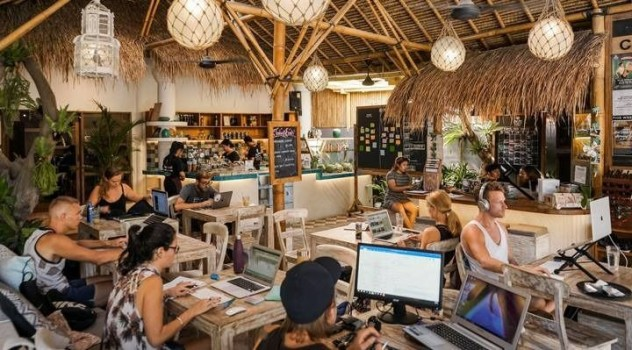
Working from Bali sounds great until you actually need somewhere reliable to take a video call, finish a deadline, or spend a full day getting work done. A beach café might be great for an hour, but it is not always practical when you need fast Wi-Fi, a comfortable desk, and a quiet place to focus.
With more than 50 coworking spaces across Bali, you have plenty of options. Canggu, Ubud, Seminyak, and Sanur all have spaces designed for remote workers, freelancers, entrepreneurs, and digital nomads. Prices can range from around IDR 50,000 per day for a basic hot desk to IDR 2,500,000 per month for a dedicated desk at a premium space.
For most digital nomads, Canggu and Ubud are the first places to look because they have some of the island’s largest remote-working communities. But the right coworking space in Bali depends on where you are staying, how long you plan to work, and whether you need meeting rooms, community events, or simply a quiet desk and reliable internet.
What should you check before choosing a coworking space in Bali?
The first coworking space you find may look great in photos, but your priorities become clearer once you are sitting there trying to finish a deadline. A beautiful view means little when the Wi-Fi drops during a client call or your desk is too noisy to concentrate.
Check the internet
For regular video calls, aim for at least 50 Mbps and ask whether the space has a backup connection in case the main network goes down. Anything below 30 Mbps will frustrate you if you have to screen-share and upload large files. Test at the time of day you'll actually be working, not at 6 am when the space is empty and the bandwidth is uncontested.
Air conditioning
Open-air spaces look beautiful on Instagram, but working in 32 °C heat with 80% humidity can be miserable for laptop-intensive work. If you run hot, choose an air-conditioned space. Your laptop’s fan will thank you, too. Overheating laptops throttle their processors, which makes everything slower.
Time zone compatibility
Bali is GMT+8. If your clients are in New York (GMT-5), your overlap is 7 am to 11 am Bali time. If they're in London (GMT+0/+1), the overlap is 3 pm to 8pm Bali time. Check that the coworking space opens early enough (or stays open late enough) for your schedule. Some spaces don’t open until 8 am or 9 am, which cuts into your US overlap window.
Think about where you are staying
A 30-minute commute can become frustrating when you are working every day. Canggu works well if you want a social beach scene, while Ubud suits a quieter, nature-based environment.
Compare the actual price
Check whether you are paying daily or monthly and what comes with the membership. Some spaces include coffee, meeting rooms, or events, while others charge separately.
Look beyond the desk
Meeting rooms, phone booths, printers, comfortable seating, and reliable power can make a big difference. Community events matter too if you want to meet other founders, freelancers, and remote workers.
These factors also matter when exploring the best cities in Indonesia for digital nomads, because where you stay can shape both your workday and your experience outside work.
The 11 best coworking spaces in Bali
Whether you’re spending a few weeks in Bali or making the island your new base, you’ll find coworking spaces to suit different ways of working. From quiet spaces where you can focus to lively hubs where you can meet other remote workers, here are 11 places to consider for your next workday.
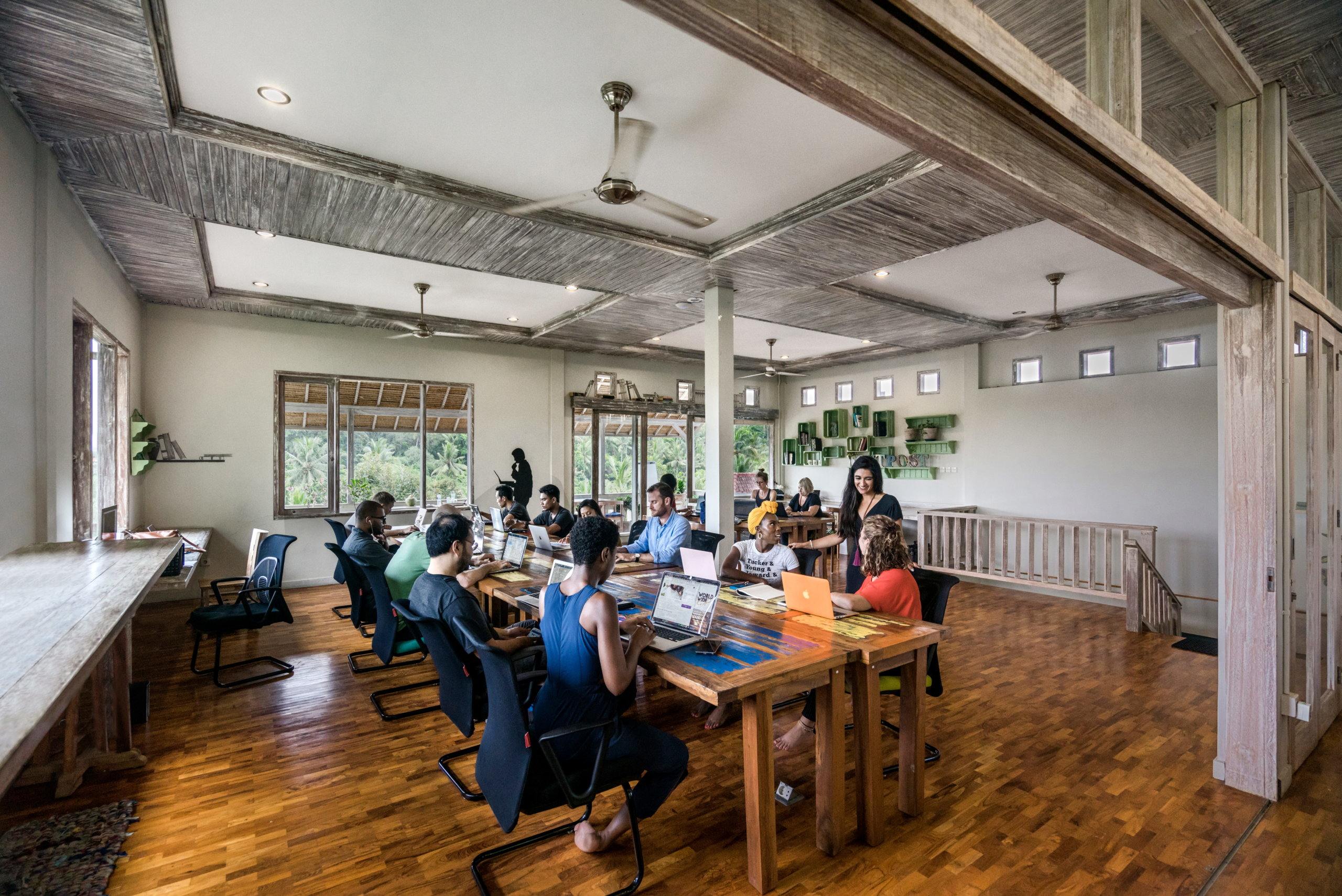
Outpost
Location: Ubud and Canggu
Daily rate: Around IDR 225,000 USD(15–16)
Monthly rate: Around IDR 2,935,000 USD(195–210)
Internet: Up to 200 Mbps with load-balanced connections
Best for: Remote professionals who need reliable Wi-Fi, quiet spaces and access to more than one location. The phone booths are the key differentiator. If you're on Zoom 3 hours a day, Outpost handles that better than any open-air space in Bali. The downside? It feels like a nice office, not like Bali. That's either a feature or a bug, depending on what you're here for.
Bali
Location: Legian/Kuta, Dewi Sri
Daily rate: Around IDR 150,000 ($10)
Monthly rate: Around IDR 2,000,000 ($133) for a hot desk pass
Internet: Around 30–60 Mbps
Best for: Expats and digital nomads who want a convenient live-and-work setup.
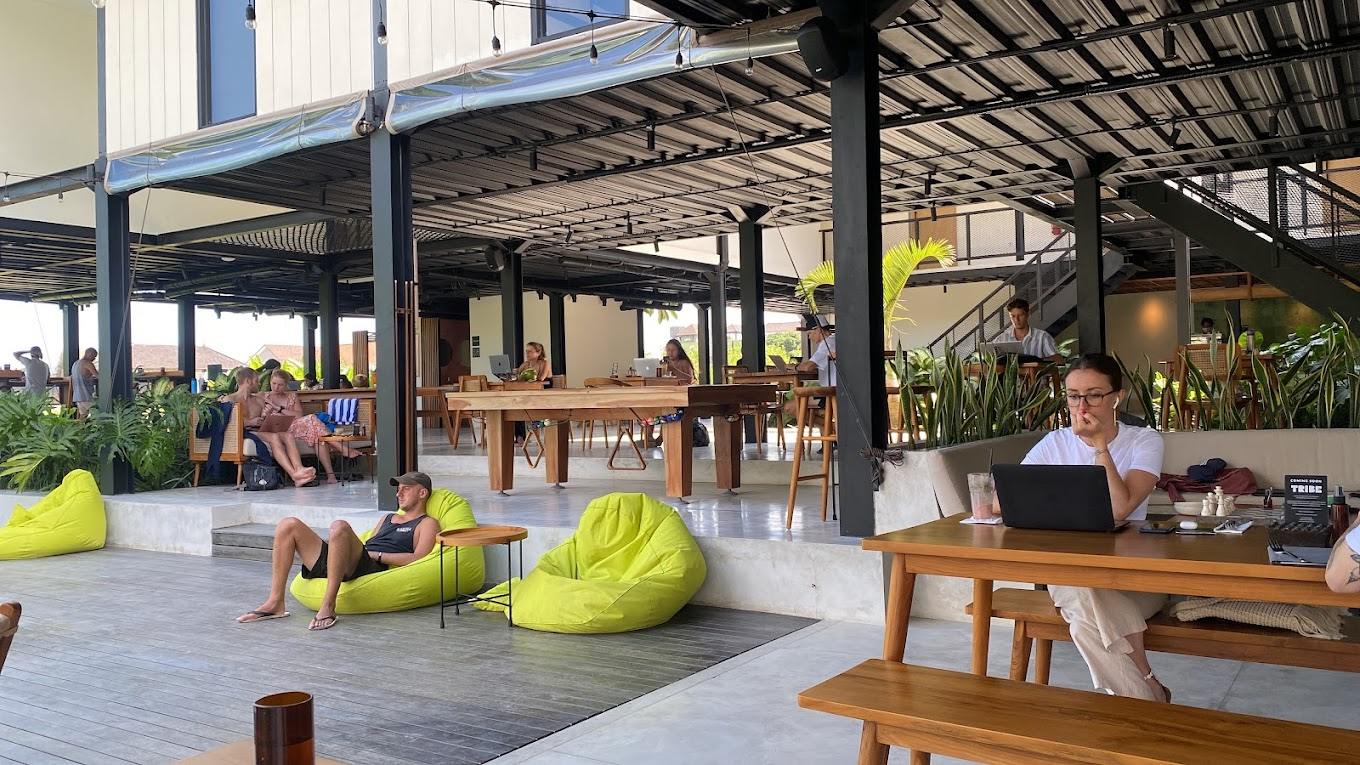
Tribal Bali
Location: Canggu, Pererenan
Daily rate: Free entry, with an expected café spend of around IDR 100,000
Monthly rate: No monthly membership
Internet: Around 100 Mbps fibre
Best for: Social digital nomads, creatives and people who enjoy meeting others while they work.
Livit Hub
Location: Sanur
Daily rate: Around IDR 275,000 ($18)
Monthly rate: Around IDR 4,875,000 ($325) for unlimited access
Internet: Up to 150 Mbps backup fibre
Best for: Startup teams, developers and remote professionals who want a professional workspace.
Workmates Canggu
Location: Canggu
Daily rate: No fixed coworking fee; café spending applies
Monthly rate: Not available
Internet: Around 50–70 Mbps
Best for: Digital nomads who prefer a relaxed café atmosphere over a conventional coworking office.
Kumpul
Location: Multiple locations, including Denpasar and Kuta
Daily rate: Around IDR 200,000 ($13)
Monthly rate: Around IDR 2,500,000 ($165)
Internet: Around 50 Mbps
Best for: Entrepreneurs who want to build connections with local businesses and founders.
The Office Bali
Location: Seminyak
Daily rate: Available on request
Monthly rate: From around IDR 3,500,000 ($230), depending on the desk
Internet: Around 100 Mbps dedicated fibre
Best for: Corporate professionals, consultants and independent professionals who prefer a structured office.
BWork Bali
Location: Canggu, Berawa
Daily rate: Around IDR 150,000–200,000 (10–13)
Monthly rate: Around IDR 2,300,000 ($150)
Internet: Around 150 Mbps dual fibre
Best for: Developers, content creators and remote professionals who need a quieter place to focus.
Dojo Bali
Location: Canggu, Echo Beach
Daily rate: N/A — permanently closed
Monthly rate: N/A — permanently closed
Best for: Understanding the history of Bali's digital nomad community.
Hubud
Location: Ubud, Monkey Forest
Daily rate: N/A — permanently closed
Monthly rate: N/A — permanently closed
Best for: Exploring the history and evolution of coworking in Bali.
Komunitas Co
Location: Ubud
Daily rate: Not available as a standard coworking rate
Monthly rate: Not available
Best for: Travellers interested in local creative communities and cultural experiences.
Best coworking spaces in Ubud for focused work
If you need a quiet place to work in Ubud, these three coworking spaces offer a mix of peaceful surroundings, reliable workspaces and meeting facilities.
Outpost Ubud (Penestanan & Nyuh Kunin)
Atmosphere: A tropical workspace with open-air areas, greenery, ravine views and a jungle pool.
Typical clientele: Remote executives, tech founders and long-term expats.
Distance: Around 7 minutes by scooter from central Ubud.
Meeting rooms: Yes, with private booths, conference rooms and whiteboards**.**
Ubud Co-Working
Atmosphere: A peaceful workspace overlooking green rice fields, designed for focused work.
Typical clientele: Writers, software engineers and digital nomads.
Distance: Around 6 minutes northeast of central Ubud.
Meeting rooms: Yes, including private rooms and dedicated meeting spaces.
The Hidden Space Ubud Cafe
Atmosphere: A quiet, plant-filled café with a garden setting away from the busy centre.
Typical clientele: Creative freelancers, slow-travelling nomads, and professionals.
Distance: Around 13 minutes by scooter from central Ubud.
Meeting rooms: Yes, with space for small workshops and private events.
How much does Coworking in Bali cost?
Your coworking budget depends largely on how long you plan to work from Bali. If you’re only staying for a few days, a day pass usually costs IDR 50,000–200,000.
A weekly pass can give you better value. For a longer stay, expect to pay around IDR 1,000,000–3,000,000 (56–167) a month for a hot desk. Dedicated desks cost more and often include extras such as storage and meeting-room access.
Before choosing a space, check the payment options. Some places offer better rates when you pay in cash, so keeping some IDR with you can help. You can keep your larger travel budget in your Grey account and use your multi-currency card when you need to pay by card.
For data on the go, grab a travel eSIM instead of buying a local SIM at the airport (where you'll overpay by 30-50% compared to ordering one online before you arrive). And if you're earning in USD while living in Bali, hold your dollars in a Grey account and convert to rupiah only when you need local currency. The rupiah fluctuates against the dollar, so converting in smaller amounts as needed often gets you a better average rate than converting a lump sum on arrival.
ATM fees can add up quickly, especially when you’re withdrawing regularly. A Grey card can help you manage your spending abroad by letting you pay by card without foreign transaction fees and withdraw cash at a fair exchange rate, depending on the ATM and applicable charges.
If you’re planning to work and spend more time in Indonesia, having a simple way to manage your money can make everyday payments easier. You can open a Grey account for Indonesia and manage your international spending from one place.
Frequently asked questions
What is the best area in Bali for digital nomads?
Canggu is popular with digital nomads because you’ll find plenty of coworking spaces, cafés, accommodation and a large remote-work community. Ubud is a better fit if you prefer a quieter environment surrounded by nature. Your choice ultimately depends on whether you prioritise social connections, convenience or a slower pace.
How fast is the internet at Bali coworking spaces?
Internet speeds vary between spaces, but many established coworking spaces offer reliable fibre connections suitable for video calls, cloud-based work and large file transfers. Some advertise speeds of 100 Mbps or more. Before choosing a space, check whether it has backup internet if reliable connectivity is essential to your work.
How much does a day pass cost at a Bali coworking space?
A day pass typically costs between IDR 50,000 and IDR 200,000, depending on the location and facilities. Some cafés and coworking spaces offer free entry with a minimum spend, while premium spaces charge more for access to meeting rooms, private areas, pools and other facilities.
Can I legally work remotely in Bali?
You need to check Indonesia’s current visa and immigration rules before working remotely from Bali. The rules depend on your nationality, visa type and the nature of your work. If you’re earning from overseas clients or an employer, confirm that your planned activities are permitted under the visa you intend to use.
Which is better for digital nomads: Canggu or Ubud?
Canggu may suit you if you want a lively digital nomad community, more coworking options and easy access to cafés and social activities. Ubud offers a quieter setting with more greenery and a slower pace. Neither is universally better; the right choice depends on how you prefer to work and live.
Do Bali coworking spaces offer accommodation?
Some coworking spaces in Bali are connected to coliving properties, so you can combine your accommodation and workspace in one place. Others only provide workspace access. If you want both, look specifically for coworking and coliving packages, and check whether accommodation, workspace access and other amenities are included.