


<script type="application/ld+json" data-schema-version="grey-blog-v4"> [{"@context":"https://schema.org","@type":"BlogPosting","@id":"https://grey.co/blog/how-freelancers-in-senegal-can-receive-payments-from-the-us-uk-eu-clients#article","headline":"How freelancers in Senegal can receive payments from the US, UK & EU clients","description":"Discover how freelancers in Senegal can receive payments from the US, UK & EU clients effortlessly.","inLanguage":"en","url":"https://grey.co/blog/how-freelancers-in-senegal-can-receive-payments-from-the-us-uk-eu-clients","mainEntityOfPage":{"@id":"https://grey.co/blog/how-freelancers-in-senegal-can-receive-payments-from-the-us-uk-eu-clients#webpage"},"datePublished":"2025-02-08T20:32:47.584Z","dateModified":"2026-06-17T09:31:14.950Z","author":{"@type":"Person","@id":"https://grey.co/authors/adeolu-titus-adekunle#person","name":"Adeolu Titus Adekunle","url":"https://grey.co/authors/adeolu-titus-adekunle","jobTitle":"Content Writer","sameAs":["https://www.linkedin.com/in/titusadeoluadekunle/"]},"publisher":{"@type":"Organization","@id":"https://grey.co/#organization","name":"Grey","url":"https://grey.co","logo":{"@type":"ImageObject","url":"https://cdn.prod.website-files.com/6360022338a81bd6fdbb1145/6564ae1077a67e39d3c491a6_Grey%20Logo%20Lockup%20Black.svg"}},"image":{"@type":"ImageObject","@id":"https://grey.co/blog/how-freelancers-in-senegal-can-receive-payments-from-the-us-uk-eu-clients#primaryimage","url":"https://cdn.prod.website-files.com/636a85d290ee58e70c17e1c0/6a3015b7290dac557602aea0_6a3015b7eb742ba6b5eb72fb_how-freelancers-in-senegal-can-receive-payments-from-the-us-uk-eu-clients__header-image.webp","contentUrl":"https://cdn.prod.website-files.com/636a85d290ee58e70c17e1c0/6a3015b7290dac557602aea0_6a3015b7eb742ba6b5eb72fb_how-freelancers-in-senegal-can-receive-payments-from-the-us-uk-eu-clients__header-image.webp","width":1200,"height":675}},{"@context":"https://schema.org","@type":"WebPage","@id":"https://grey.co/blog/how-freelancers-in-senegal-can-receive-payments-from-the-us-uk-eu-clients#webpage","url":"https://grey.co/blog/how-freelancers-in-senegal-can-receive-payments-from-the-us-uk-eu-clients","name":"How freelancers in Senegal can receive payments from the US, UK & EU clients","description":"Discover how freelancers in Senegal can receive payments from the US, UK & EU clients effortlessly.","inLanguage":"en","primaryImageOfPage":{"@id":"https://grey.co/blog/how-freelancers-in-senegal-can-receive-payments-from-the-us-uk-eu-clients#primaryimage"},"breadcrumb":{"@id":"https://grey.co/blog/how-freelancers-in-senegal-can-receive-payments-from-the-us-uk-eu-clients#breadcrumb"}},{"@context":"https://schema.org","@type":"BreadcrumbList","@id":"https://grey.co/blog/how-freelancers-in-senegal-can-receive-payments-from-the-us-uk-eu-clients#breadcrumb","itemListElement":[{"@type":"ListItem","position":1,"name":"Home","item":"https://grey.co/"},{"@type":"ListItem","position":2,"name":"Blog","item":"https://grey.co/blog"},{"@type":"ListItem","position":3,"name":"How freelancers in Senegal can receive payments from the US, UK & EU clients","item":"https://grey.co/blog/how-freelancers-in-senegal-can-receive-payments-from-the-us-uk-eu-clients"}]}] </script>

How freelancers in Senegal can receive payments from the US, UK & EU clients

Adeolu Titus Adekunle

TABLE OF CONTENT

SHARE THIS POST

Freelancing is gaining momentum in Senegal, with more professionals turning to online platforms like Upwork, Fiverr, and Toptal to secure international work opportunities. Its largely multilingual population makes it easy to collaborate with clients across continents. This has opened many freelancers to earning in foreign currencies.

However, receiving payments from international clients remains challenging due to traditional banking restrictions. Some other hurdles to cross-border payments in Senegal include:

  • Delayed transactions: Payments can take days or weeks to process, sometimes leaving freelancers stranded.
  • Failed transactions: Local banking regulations and unsupported platforms can lead to unsuccessful transfers.
  • Limited withdrawal options: Some freelancing platforms impose restrictions, preventing full access to earnings.
  • High transfer fees: Unfavourable exchange rates and excessive charges reduce freelancers' income.

Fortunately, Grey provides a simple, fast, and cost-effective solution for freelancers in Senegal to receive international payments seamlessly.

Why Grey is the best solution for freelancers in Senegal

Grey offers a reliable and affordable way for freelancers in Senegal to receive payments from international clients. Here's why it stands out:

  • Competitive conversion rate – Avoid excessive transaction charges and keep more of your earnings. Users can monitor the real-time exchange rate and convert earnings at the best possible rates.
  • Fast payments – Receive funds without unnecessary delays.
  • Multi-currency accounts – Get USD, GBP, and EUR accounts to receive payments directly.
  • Transparent pricing – Grey has no hidden fee. You'll always know how much you're paying.
  • Works well with freelancing platforms – Grey integrates seamlessly with the payment channel on many freelancing platforms like Upwork, Fiverr, and Toptal.

How freelancers in Senegal can receive payments from the US, UK & EU clients with Grey

Setting up Grey for freelancing payments is quick and hassle-free.

1. Create a Grey account

Sign up on the Grey website or download the mobile app to register.

How freelancers in Senegal can receive payments from the US, UK & EU clients with Grey

Read also: How to open US bank accounts in Senegal

2. Verify your identity

Complete Grey's Know Your Customer (KYC) verification by uploading a valid ID, proof of address, and a selfie. This process is secure and ensures smooth transactions.

Read also: Top reasons your KYC verification is failing and how to fix them

3. Request your foreign bank accounts

Once verified, navigate to the 'Accounts' section to generate your USD, GBP, and EUR accounts to start receiving payments from international clients.

4. Link your account to freelancing platforms or share details with clients

If you use freelancing platforms like Upwork or Fiverr, add your bank details to receive payments directly. If you work with direct clients, share your Grey account information for seamless transfers. Convert your earnings to West African CFA francs (XOF) and withdraw in minutes.

Receive international payments effortlessly with Grey

As Senegal's freelancing industry grows, a reliable cross-border payment solution is essential. Grey makes it easy for freelancers to receive international payments quickly and securely. Sign up today and start getting paid with ease!

‍

Last updated:

October 13, 2026

Open a free Grey account to get startedJoin 1 million digital nomads
IF YOU ENJOYED THIS, CHECK THESE OUT

How to invoice international clients from Lagos

•

•

2 min read

Even if you enjoy what you do, the sweetest part of working is getting paid. But we can all agree that the administrative side of being a freelancer or business owner can be a thorn in the flesh. Invoicing in naira is stressful, but not as bad as when you are working with international clients. Now you are managing currency differences, exchange rate volatility, tax wahala, payment delays, and currency conversion costs. Yet invoicing is important because it helps you look professional and avoid payment issues.

One of the most amazing parts of being a Lagos freelancer is that we will always find an easier way to get the job done. This guide covers every step of invoicing international clients from Lagos: how to set up your payment accounts, which currency to bill in, what belongs on a professional invoice, how to protect yourself from late payments, which tools to use, and what the 2026 NRS tax rules mean for your foreign income.

Set up to receive international payments before you invoice

Before you send your first invoice, you need somewhere for the money to land. The payment details on your invoice are only as good as the account behind them. Here are the real options available to you from Lagos, with an honest look at the trade-offs.

Nigerian bank account (SWIFT transfer)

Your regular bank account can receive international payments via SWIFT. The problem is that SWIFT transfers are slow (3 to 5 business days), expensive (intermediary bank fees of $15 to $50 per transaction), and the conversion from USD to naira happens at your bank's rate, which you have no control over. For a $500 freelance payment, you could lose $30 to $50 in fees and unfavourable conversion before the money hits your account. This works in a pinch, but it is the most expensive option for regular freelance payments.

Domiciliary account

A domiciliary account is a USD-denominated account at a Nigerian commercial bank. It lets you hold dollars without automatic conversion to naira, which gives you control over when and at what rate you convert. The downsides are the setup process (branch visit, paperwork, sometimes minimum balance requirements) and the fact that spending from a dom account is clunky. The debit cards linked to dom accounts often have poor online acceptance and high fees. Domiciliary accounts are better suited for receiving large, infrequent payments than for regular freelance invoicing.

PayPal

PayPal is the payment method most international clients recognise. The challenge for Nigerian freelancers is on the receiving end. PayPal's withdrawal options in Nigeria are limited, conversion rates include a margin, and fees on received payments (typically 2.9% plus a fixed fee) add up quickly. PayPal works well when a client insists on it, but it should not be your primary invoicing method if you have better alternatives.

Payoneer

Payoneer is popular with freelancers who receive payments through platforms like Upwork, Fiverr, and Toptal. It provides a USD receiving account and allows withdrawal to Nigerian bank accounts. The conversion spread is reasonable but not the best in the market, and withdrawals can take 2 to 5 business days. Payoneer is a strong option if most of your work comes through freelancing platforms that integrate with it natively.

Multi-currency fintech accounts (Grey, Wise, Geegpay)

These platforms give you USD, EUR, and GBP account details that you can put directly on your invoices. When your client pays, the funds are deposited into your foreign currency wallet. You can hold the balance, convert to naira when the rate suits you, or spend directly using a virtual card. The key advantages are speed (payments often arrive same-day for ACH), transparency (you see the exchange rate before converting), and flexibility (you control when to convert). The cost primarily comes from the exchange rate margin when you convert, which varies by provider.

The practical recommendation: Most Lagos-based freelancers doing regular international work will get the best combination of speed, cost, and convenience from a multi-currency fintech account. Keep a domiciliary account as a backup for larger transfers if needed, and maintain PayPal for the occasional client who will only pay that way. The key is to have your payment method decided and set up before you start discussing terms with a client, not after you have already done the work.

Also read: Setting up payment terms and timelines with international clients

Choose your invoicing currency

The currency you bill in affects your earnings more than most freelancers realise. There are three options, and each carries different risks.

Invoice in USD, EUR, or GBP. This is the standard approach for most international freelancing from Nigeria. You bill in a major international currency, typically whichever your client is most comfortable paying in. US clients pay in USD, European clients in EUR, UK clients in GBP. This gives you a stable, internationally recognised currency, avoids the client having to deal with naira conversion on their end, and lets you hold the foreign currency until you choose to convert.

Invoice in the client's local currency. If your client is in a country with a different local currency (say, Australian dollars or Japanese yen), you could invoice in their currency. This removes friction for the client but creates exchange rate risk for you, since you are now exposed to a currency you might not hold or track. This approach can make sense for a long-term retainer client, but for one-off projects, stick to USD, EUR, or GBP.

Invoice in naira. Technically possible, but rarely practical. Most international clients cannot easily send naira, and even if they can, the conversion from their currency to NGN will be unfavourable on their end, meaning they are effectively paying more. This creates friction and can cost you the client relationship. The only scenario in which naira invoicing makes sense is if the client has a Nigerian entity or already holds naira.

A note on long projects: If a project spans several weeks or months, the exchange rate can move significantly between the date you send the invoice and the date you receive payment. There are two ways to handle this. You can lock in the rate by specifying in your contract that the invoice amount is final in the invoiced currency, regardless of rate movements. Or you can add a clause that allows for rate adjustment if the currency moves more than a certain percentage. Most freelancers go with the first approach because it is simpler, and clients prefer certainty.

What goes on your invoice

A professional invoice is a document that prevents disputes, speeds up processing, and keeps your records clean. Here is what every invoice to an international client should include.

Your details. Full name or registered business name, address, email, and phone number in international format. If you have a business registration number (CAC number in Nigeria), include it.

Client details. The client's full legal business name and billing address. This is important because some companies require the invoice to match their internal records exactly. Ask for the correct billing entity name before you send the first invoice.

Invoice number. A unique, sequential number for tracking. Use a format that is easy to sort: GREY-2026-001, GREY-2026-002, and so on. This also makes it easier to reference specific invoices in follow-up emails.

Date of issue and due date. State both explicitly. The due date should match the payment terms you agreed to in your contract. Never leave the due date blank or say "upon receipt" unless you enjoy chasing payments.

Description of services. Be specific enough that the client's accounts team knows exactly what they are paying for. "Design services" is too vague. The "Brand identity package for Project Atlas: logo, brand guidelines, business card design, and social media kit (delivered March 2026)" provides the client with everything they need to process the invoice without asking follow-up questions. For milestone-based projects, reference the milestone or deliverable phase.

Currency and amount. State the currency code explicitly (USD, EUR, GBP) alongside the amount. Do not assume the client will know which currency you mean from context.

Payment details. This is where your account information goes. For US clients paying via ACH, include your routing number and account number. For European clients, include your IBAN and SWIFT/BIC code. If you accept multiple payment methods, list your preferred method first. Example: "Payment via ACH preferred. Wire transfer also accepted."

Payment method preferences. If there are methods you do not accept (e.g., cheques, cryptocurrency), state that. If your client's payment will incur fees on your end, you can note that the client is responsible for the transfer fees, so the full invoice amount is credited to your account.

Tax information. Some countries require invoices to include the recipient's or sender's tax identification number. US clients may ask for a W-8BEN form to confirm you are not subject to US withholding tax. Have this ready before they ask.

Late payment terms. A sentence stating the consequence of late payment: "Invoices unpaid after 14 days past the due date will incur a 2% monthly late fee." Even if you never enforce it, having it on the invoice encourages timely payment.

Also read: Invoice like a pro: Tools African freelancers are using to get paid faster

Set payment terms that protect you

Payment terms should be agreed in your contract or scope document before the first invoice is sent, not decided on the fly. Here is how to think about them.

Net 14 (payment due within 14 days). Best for new clients, smaller projects, and one-off engagements. Shorter terms reduce your exposure to non-payment and keep your cash flow healthy.

Net 21 to Net 30 (payment due within 21 or 30 days). Standard for established client relationships, larger companies (which often have longer internal payment processing cycles), and retainer arrangements. If a client asks for Net 30, that is normal. If they ask for Net 60 or longer, negotiate or build the cost of waiting into your rate.

Deposits and milestones. For larger projects, a deposit is required before starting work. A common structure is 30% upfront, 40% at the midpoint of delivery, and 30% at final delivery. This protects you from doing significant work without compensation and gives the client checkpoints to review progress. Never start a project worth more than $500 without at least a 25% deposit, especially with a new client.

Who covers transfer fees? This is a detail many freelancers forget to address. If a wire transfer incurs $25 in intermediary fees and you are invoiced $500, you receive $475. Specify in your terms whether the client covers transfer fees or whether you absorb them. The cleanest approach is to state: "Client is responsible for any bank or transfer fees so that the full invoiced amount is received."

How to handle late payments

Late payments are a reality of freelancing, and they are harder to chase across borders. Prevention is better than collection, which is why deposits, clear terms, and professional invoicing matter so much. But when a payment is late, here is how to handle it.

Day 1 overdue: Send a polite reminder. Keep it simple: "Hi [name], just a quick note that invoice #[number] was due on [date]. Could you let me know the status? Happy to resend if needed." Most late payments are administrative delays, not intentional non-payment.

Day 7 overdue: Follow up with a slightly firmer tone. Reference the invoice number, amount, and original due date. Attach the invoice again. Ask for a specific expected payment date.

Day 14 overdue: Send a formal notice stating that the payment is now overdue, referencing any late payment clause in your contract. If you have a late fee clause, note that it will apply. This is also the point where you should pause any ongoing work for the client and communicate that clearly: "I have paused work on [project] pending resolution of the outstanding invoice."

Beyond 30 days: At this point, your options narrow. You can escalate to a collections service (though cross-border collections are difficult and expensive), pursue small claims in the client's jurisdiction (impractical for most freelancers), or write it off and move on. The lesson is almost always the same: the deposit and milestone structure you set up at the beginning is your real protection. Chasing money across borders is expensive and stressful. Prevention is the strategy.

Choose the right invoicing tool

The tool you use should align with your workflow and payment setup. Here is how the main options compare.

Grey Invoice. Built into the Grey platform, so your invoice is directly linked to your Grey USD, EUR, or GBP account. The client sees your payment details on the invoice and pays into your Grey wallet. You can track invoice status in the same app where you manage your money. The main advantage is that invoicing and payment receipt are in one place, eliminating the disconnect between sending an invoice in one tool and checking for payment in another.

Wave. Free, widely used, and supports multi-currency invoicing. Good for freelancers just starting out who want a professional-looking invoice without paying for a subscription. The limitation is that Wave's payment processing has geographic restrictions, so you may need to add your payment details manually rather than relying on Wave's built-in payment gateway.

FreshBooks. A paid tool that goes beyond invoicing into time tracking, expense management, and recurring invoices. If you bill hourly or need to track project time against invoices, FreshBooks is worth the subscription. It supports multi-currency invoicing and sends automatic reminders for overdue payments.

Zoho Invoice. Part of the Zoho ecosystem, which means it integrates with Zoho Books, Zoho CRM, and other tools. Multi-currency support, automated recurring invoices, and location-based tax application. A good choice if you are scaling beyond solo freelancing into a small consultancy.

PayPal Invoicing. The simplest option is if your client already uses PayPal. You create the invoice in PayPal, the client pays via PayPal, and the funds land in your PayPal balance. The downside is PayPal's fees on received payments (approximately 2.9% plus a fixed fee) and the limited withdrawal options in Nigeria. Use this when a client specifically requests PayPal, not as your default.

Choosing: If you use Grey for receiving payments, Grey Invoice is the path of least friction. If you need a standalone invoicing tool with accounting features, FreshBooks or Zoho are the strongest options. If you are just starting out and want something free, Wave does the job. The most important thing is consistency: pick a tool, use it for every invoice, and keep all your records in one place.

Understand your tax obligations under the 2026 NRS rules

This is the section most invoicing guides skip, and it is the one that matters most for Nigerian freelancers right now. The Nigeria Tax Act, signed in June 2025 and effective from January 1, 2026, changes how foreign income is taxed. If you are a freelancer earning from international clients, these rules apply to you.

The basics

If you are a Nigerian tax resident (you live in Nigeria for 183 days or more in a year, or you have strong economic and family ties to Nigeria), the NRS taxes you on your worldwide income. That includes every dollar, euro, and pound you earn from international clients, whether or not you bring the money into Nigeria.

You are required to register for a Tax Identification Number (TIN) with the Nigeria Revenue Service, self-declare your annual income, and file your tax return by March 31 of the following year.

How your income is calculated

Foreign income must be converted to naira at the official CBN exchange rate on the date you received the payment, not the parallel market rate. If you received $1,000 on March 15 and the CBN rate that day was N1,550 to $1, your taxable income for that transaction is N1,550,000.

Tax bands (2026)

The first N800,000 of annual income is tax-free. Above that, progressive rates apply. Income from N800,001 to N2,400,000 is taxed at 15%. From N2,400,001 to N4,800,000 at 20%. Above N4,800,000, the rate is 25%. These rates are lower than many other African countries. South Africa's top rate is 45%, Kenya's is 35%.

What you can deduct

As a self-employed person, you can deduct legitimate business expenses before calculating your taxable income. This includes software subscriptions (Adobe, Figma, hosting), internet costs, coworking space or home office expenses, equipment (laptop, phone, peripherals), and professional development (courses, certifications). Keep receipts and records for everything you claim.

Double taxation agreements

Nigeria has double taxation agreements with 16 countries, including the UK, Canada, and South Africa. If your income has already been taxed in one of these countries, you can claim a credit against your Nigerian tax liability. For countries without a DTA (including the US), Nigeria offers unilateral relief, meaning you can still claim credit for tax paid abroad, but you need to provide documentation.

Penalties for non-compliance

Failure to register for a TIN attracts a fine of N50,000 in the first month and N25,000 for each subsequent month. Failure to file returns attracts a fine of N100,000 in the first month and N50,000 per month thereafter. False declarations can result in fines up to N1,000,000 or three years' imprisonment. The NRS has stated it will use data analytics to cross-check bank transactions and foreign inflows, so the era of flying under the radar is effectively over.

The practical takeaway: Track every payment you receive, record the CBN rate on the date of receipt, keep records of all deductible expenses, and file on time. If your tax situation is complex (multiple income streams, income from DTA countries, significant deductions), consult a certified tax professional. The cost of a tax advisor is far less than the cost of penalties.

Disclaimer: This section provides general information about Nigerian tax obligations for freelancers. It is not professional tax advice. Tax rules are subject to change, and individual circumstances vary. Consult a qualified tax professional for advice specific to your situation.

Invoice and get paid with Grey

Grey brings invoicing and payment reception into one platform. You create your account at grey.co or on the Grey app, complete KYC verification, and receive USD, EUR, and GBP account details. These are the details you put on your invoices.

When your client pays, the funds are deposited into your Grey wallet. For US clients paying via ACH, the transfer is typically same-day. For European clients paying via SEPA, payments are usually processed within 1 business day. You can hold the foreign currency in your wallet, convert to naira when the rate suits you, or spend directly using your Grey virtual card on tools, subscriptions, or advertising.

Grey Invoice lets you create and send professional invoices directly from the app, with your Grey account details pre-filled. The client receives a clean invoice, pays into your account, and you can track the payment status without switching between platforms.

For freelancers who also need to make international payments (buying software, paying subcontractors, running ads), Grey's virtual card and money transfer features mean you can handle both incoming and outgoing international transactions from one account.

Note: Exchange rates on Grey are variable and include a margin over the mid-market rate. Grey does not charge transfer fees on incoming payments; the cost is in the exchange rate when you convert. Always review the rate before confirming a conversion.

Frequently asked questions

Should I charge VAT on international invoices from Nigeria?

Generally, services exported from Nigeria (i.e., services performed for a client outside Nigeria) are zero-rated for VAT purposes. However, VAT rules can be complex, and the NRS may update guidance. If you are unsure, consult a tax professional.

What happens if my client pays in a currency other than the one I invoiced?

If you invoice in USD and the client pays in EUR, a currency conversion will happen somewhere in the chain, either at the client's bank or at your payment provider. This conversion may not be favourable, and you may receive less than the invoiced amount. To avoid this, state the invoicing currency clearly and specify that payment should be made in the same currency.

How long do international payments take to arrive?

It depends on the method. ACH transfers to a US-based account (like a Grey USD wallet) are typically same-day. SEPA transfers for EUR are usually 1 business day. SWIFT wire transfers take 3 to 5 business days. PayPal transfers are instant, but withdrawal to a Nigerian bank adds 1 to 3 days.

Can I invoice in naira for international clients?

You can, but most international clients cannot easily pay in naira. The conversion on their end will be unfavourable, and it creates unnecessary friction. Invoicing in USD, EUR, or GBP is almost always the better approach.

Do I need a business registration to invoice internationally from Nigeria?

No. You can invoice as an individual freelancer using your personal name. However, having a CAC-registered business name or limited company adds credibility, may be required by some clients for their internal compliance, and allows you to claim business expense deductions more cleanly at tax time.

Should I ask for a deposit from new international clients?

Yes. A 25% to 50% deposit before starting work is standard practice in freelancing. It protects you from non-payment and demonstrates the client's commitment. Frame it as standard terms, not as a sign of distrust: "My standard terms include a 30% deposit before project kickoff, with the balance due on delivery."

What if my client asks for a W-8BEN form?

A W-8BEN is a US tax form that certifies you are not a US person for tax purposes. US clients may request this to confirm they do not need to withhold tax from your payments. You can fill it out using your Nigerian address and TIN. It is a standard process, not a cause for concern.

‍

Ready to start invoicing international clients? Sign up at grey.co to get your USD, EUR, and GBP account details and start sending invoices today.
What is a domiciliary account? How it works in Nigeria and better alternatives

•

•

2 min read

For a long time, a domiciliary account was the go-to answer for Nigerians who needed to hold or receive foreign currency. If you had reasons to manage USD, GBP, or EUR, you would need to visit a Nigerian bank and complete the rigorous paperwork to open a domiciliary account at a local bank. Despite the transaction delays and restricted access to foreign currency, it seemed like the best thing since sliced bread. Dom accounts were all we had, and we had to make do with them.

Things have now changed. We have better options for managing foreign currency and many Nigerians are looking away from dom accounts. This article explores the alternatives, what each offers, and helps you pick the right one for how you earn and spend.

What is a domiciliary account?

A domiciliary account is a foreign currency account offered by Nigerian commercial banks. It lets you hold USD, GBP, or EUR without immediate conversion to naira, and receive international transfers directly into a local account.

On paper, that sounds like a reasonable way to manage international payments. In practice, the experience rarely matches the description.

Opening a dom account typically requires a visit to a physical branch, a referee who already holds an account at the bank, a utility bill, a passport photograph, and, depending on the bank, an opening deposit of $100 to $200. The process can take days or longer. If you need to start receiving international payments urgently, going the dom account route means you are standing on a long thing.

Then there are the costs. SWIFT transfers to a domiciliary account incur charges on both the sending and receiving ends. The sender's bank charges a fee, intermediary banks take their cut ($15 to $50 is common), and your own bank charges a receiving fee on top. By the time the money settles, you could be looking at $30 to $70 less than what was sent, with no clear line-item breakdown of why. Some banks also impose monthly maintenance fees, withdrawal limits (both cash and transfers), and minimum balance requirements, which add friction to every interaction.

Despite the downsides, dom accounts still make sense for certain situations. If you are receiving large, infrequent wire transfers, or you want to hold a significant USD balance long-term under the regulation and deposit protection of a licensed Nigerian bank, a dom account serves that purpose. But for freelancers, remote workers, and entrepreneurs managing regular international income, the costs and friction add up quickly. That is where the alternatives come in.

Also read: Managing foreign currency earnings as a remote worker in Nigeria

What are the alternatives to dom accounts in Nigeria?

Here are the real options, with enough detail on each to make a decision.

Virtual foreign currency accounts

This is where most Nigerians who have moved away from dom accounts have landed, and the reasons are straightforward.

Platforms like Grey give you real USD, EUR, and GBP account details, including routing numbers, account numbers, and IBANs. These work the same way as foreign bank accounts from the sender's perspective. When your client in New York pays you via ACH using your Grey USD account details, it looks like a standard domestic transfer on their end. There is no SWIFT involved, which means no intermediary bank fees eat into your payment. The funds arrive in your Grey wallet, typically the same day for ACH transfers, and you can see the balance in the app immediately.

From there, you have options. You can hold the dollars in your wallet and convert to naira when the rate works for you, rather than being forced to convert at your bank's rate on the day the transfer arrives. You can spend the dollars directly using a Grey virtual card on subscriptions, software, advertising, or anything else that charges in USD. The card works everywhere Visa is accepted and supports Apple Pay and Google Pay, so you can tap to pay at physical stores in supported regions. Or you can withdraw to your Nigerian bank account when you need naira.

Virtual foreign currency accounts open in minutes, completely online. There is no branch visit, no referee, and no minimum deposit. You see the exchange rate before you confirm a conversion, so you know exactly what you are paying. This is the biggest contrast with dom accounts, where SWIFT fees and conversion costs are often opaque until after the transaction has settled.

Grey is the platform on which this article is published, so take that into account. Other platforms in this category include Geegpay (popular with freelancers, offers USD/GBP/EUR wallets and a virtual dollar card), Eversend (multi-currency wallets across several African countries), and Cleva (US-based USD account with FinCEN registration). Each has a slightly different fee structure, supported currencies, and feature set. Compare them based on the currencies you need, the exchange rate spread, and how quickly you can access your funds.

Best for: Freelancers, remote workers, consultants, and anyone receiving regular international payments from clients or employers. This is the most direct replacement for a dom account for day-to-day use.

Also read: How Nigerian freelancers scale income beyond one platform

Wise

Wise (formerly TransferWise) is one of the most well-known names in international money movement, and many Nigerians use it. You can open a Wise account from Nigeria and get USD, GBP, and EUR account details for receiving payments. Wise's biggest selling point is that it uses the mid-market exchange rate with a transparent fee on top, rather than hiding the cost in the rate spread. For outbound transfers, this is genuinely cheaper than most alternatives.

However, Wise has significant limitations for Nigerian residents that are worth understanding before you rely on it as your primary account.

No physical card in Nigeria. The Wise multi-currency card is not available for Nigerian residents, which limits your spending options to transfers and online payments.

Service disruptions. Wise has periodically adjusted its operations in Nigeria. In 2022, it suspended USD transfers to Nigeria due to infrastructure constraints. These disruptions can be disruptive if Wise is your only receiving option.

Strict anti-crypto policy. Wise prohibits transactions related to cryptocurrency. If the platform detects a transfer to or from a crypto exchange, it may permanently close your account. For Nigerian professionals who also deal in stablecoins, this is a real risk.

Not a bank. Wise is an Electronic Money Institution, not a bank. Your funds are held in safeguarding accounts, not in a bank account in your name. This is a technical distinction, but it matters if you are considering where to hold a large balance in the long term.

Best for: One-off or occasional international transfers where you want the best exchange rate. Less suitable as a primary account for Nigerian residents who need a card, regular access, or crypto flexibility.

Payoneer

Payoneer is an option many Nigerian freelancers encounter first, largely because of its strong integration with major international platforms. Upwork, Fiverr, Amazon, and dozens of other marketplaces offer Payoneer as a payout option. If your income comes primarily through those platforms, Payoneer remains a viable option.

However, Payoneer's conversion rates are not as transparent as those of newer platforms. There are also annual fees for accounts that do not meet certain activity thresholds, relatively high transaction charges compared to fintech alternatives, and an occasionally frustrating customer support experience. The NGN withdrawal rate is not always the best either; you may find better naira conversion rates on platforms like Grey or Geegpay.

Payoneer works best when your income flows through freelancing platforms that have native Payoneer integration. For direct client payments where you control the payment method, a virtual foreign currency account is typically a better option.

Best for: Freelancers receiving payouts from Upwork, Fiverr, Amazon, and other marketplaces that integrate Payoneer natively.

Also read: Top PayPal and Payoneer alternatives for African freelancers

Stablecoins and crypto

Despite the evolving regulatory landscape around crypto in Nigeria, stablecoins remain a practical option for professionals who know how to use them. Some Nigerian freelancers and entrepreneurs receive payments in USDT or USDC because they retain their dollar value, transactions settle in minutes, and fees are low.

The challenge is not in holding stablecoins. It is in the off-ramp: converting USDC or USDT back to naira. Peer-to-peer conversions are popular but carry counterparty risk if the buyer is not trustworthy. Exchange platforms offer more structure but may have their own fees and verification requirements. Some fintech platforms, including Grey, support USDC alongside their multi-currency offering, which bridges the gap between the crypto and traditional banking worlds.

One important note for 2026: under the new Nigeria Tax Act, stablecoin payments are treated as foreign income. If you receive $1,000 in USDC on a given date, that income must be converted to naira at the CBN exchange rate on the date of receipt for tax purposes. The same self-declaration and filing obligations that apply to USD bank transfers apply to crypto income. This does not make stablecoins impractical, but it means you need to track your receipts the same way you would track any other foreign income.

Best for: Crypto-native professionals, developers in the Web3 space, and anyone whose clients or platforms pay in stablecoins. Not a replacement for a bank account or virtual foreign account for most people, but a useful complement.

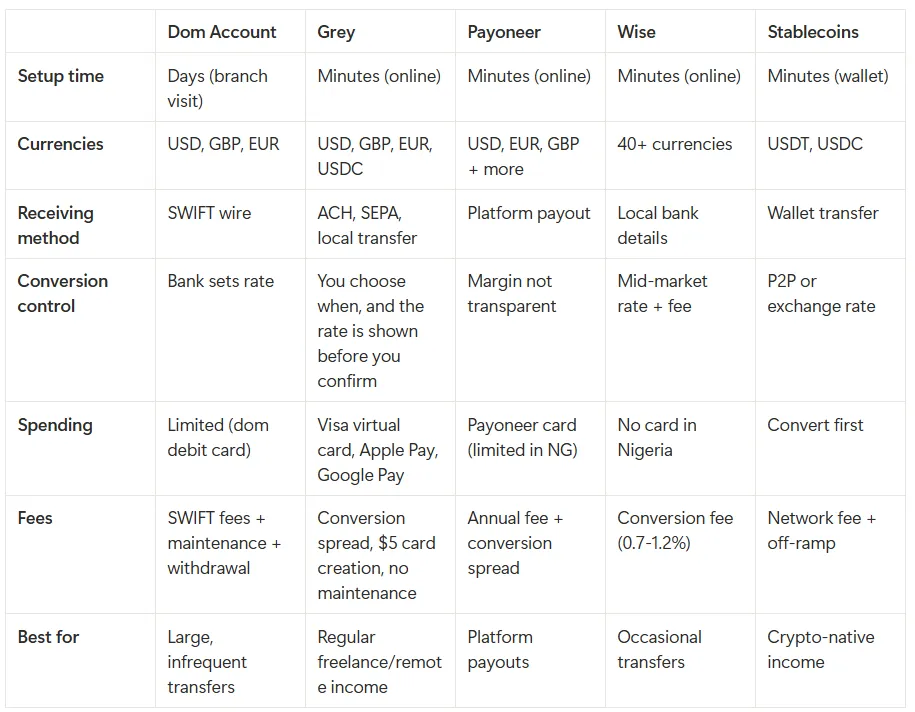
How the alternatives compare

Here is a side-by-side comparison of the key factors that matter when choosing how to manage foreign currency in Nigeria.

Table comparing domiciliary accounts, Grey, Payoneer, Wise and stablecoins

Which is right for you?

You earn regularly from international clients or an employer. A virtual foreign currency account is your best option. You get foreign bank details to share with clients, control over when you convert, and a card to spend directly in USD. This replaces a dom account for most day-to-day use cases.

Your income comes through Upwork, Fiverr, or Amazon. Start with Payoneer since these platforms integrate it natively. If you find the conversion rates eating into your earnings, consider adding a Grey or similar account and routing future direct client payments there instead.

You need to send a one-off international transfer and want the best rate. Wise is hard to beat on exchange rates for single transactions. Just be aware of its limitations as a full-time financial tool for Nigerian residents.

You receive large, infrequent transfers and want to hold USD for the long term. A dom account at a reputable Nigerian bank still works for this. The setup friction is a one-time cost, and the banking regulation provides a level of institutional protection that fintech platforms do not.

You are paid in crypto or stablecoins. Hold your stablecoins and use a platform that supports USDC conversion to naira when you need to spend locally. Track your receipts for tax purposes under the 2026 NRS rules.

Most Nigerians managing regular international income end up using a combination of methods. A virtual foreign account for the majority of their income, Payoneer for platform payouts, and occasionally a dom account or Wise for specific transactions. The key is to stop defaulting to the dom account for everything, because for regular use, the alternatives are faster, cheaper, and more flexible.

Manage your international income with Grey

Grey gives you USD, EUR, GBP, and USDC account details to receive international payments, a virtual Visa card with Apple Pay and Google Pay support for spending, a built-in invoicing tool for billing clients, and naira withdrawals to your Nigerian bank account. Sign up at grey.co or download the app to get started.

Note: Exchange rates on Grey are variable and include a margin over the mid-market rate. Always review the rate before confirming a conversion.

Frequently asked questions

Is a domiciliary account still worth it in 2026?

For specific use cases, yes. If you receive large wire transfers infrequently, want to hold a significant USD balance under banking regulation, or need the institutional credibility of a commercial bank account, a dom account still serves those purposes. For regular freelance income and everyday USD spending, virtual foreign accounts are more practical.

Can I receive USD in Nigeria without a domiciliary account?

Yes. Virtual foreign currency accounts from platforms like Grey, Geegpay, and Cleva give you USD account details that work as US bank accounts from the sender's perspective. Your client pays via ACH or wire, and the funds are deposited into your wallet without ever touching a Nigerian bank.

What is the cheapest way to receive dollars in Nigeria?

Virtual foreign currency accounts that support ACH transfers are typically the cheapest because they avoid SWIFT intermediary fees entirely. The main cost is the exchange rate spread when you convert to naira, which varies by provider (typically 1% to 3%).

Is Wise or Grey better for Nigerian freelancers?

They serve different needs. Wise offers the mid-market exchange rate, which is excellent for occasional transfers, but it has no card in Nigeria and has periodically disrupted its services in Nigeria. Grey offers a virtual card, Apple Pay/Google Pay, USDC support, and an invoicing tool, making it more practical for Nigerian residents managing regular international income. Many freelancers use both.

Are stablecoins legal in Nigeria?

The regulatory landscape around crypto in Nigeria is evolving. Holding stablecoins is not illegal, and many professionals use them for international payments. Under the 2026 Nigeria Tax Act, stablecoin income is treated as foreign income and must be declared. The main risk is in the off-ramp: converting to naira through unregulated channels can expose you to fraud or compliance issues.

Do I need a Dom account to receive a wire transfer?

Not necessarily. A virtual foreign currency account with SWIFT or wire receiving capability can also receive wire transfers. However, some senders (particularly corporate treasury departments) may prefer to send to a traditional bank account. Check with your payment source whether they accept fintech account details.

Ready to move beyond the dom account? Sign up at grey.co and get your USD, EUR, and GBP account details in minutes.

How to receive Stripe payments in Nigeria with a free USD account

•

•

2 min read

Stripe is one of the most widely used payment platforms in the world. It serves as the checkout option for many platforms, and many international clients and businesses use it to pay vendors, contractors, and service providers. But Nigerians cannot create a Stripe account to receive payments directly. It is a frustrating reality for many Nigerian freelancers and entrepreneurs who must resort to workarounds or lose money.

But while you might not be able to create a Stripe account, you can still receive money from clients who pay through Stripe. This article shows you how, with four different approaches depending on your situation.

How Stripe payouts actually work

Before jumping into the workarounds, it helps to understand what Stripe is actually doing with your money. This makes the solutions below make a lot more sense.

Stripe sits between your customer (or your client's customer) and your bank account. When someone pays via Stripe, the money is deposited into a Stripe-held balance. Stripe then pays out that balance to a connected bank account on a schedule, typically every 2 to 7 business days depending on the country and account history.

The problem for Nigerians is at that last step. Stripe requires you to connect a bank account in a country where it operates. Nigeria is listed as an "Extended Network" country through Paystack, which means you can accept payments from Nigerian customers through Stripe, but you cannot receive Stripe payouts to a Nigerian bank account. Your options are to either give Stripe a foreign bank account to pay into, use a platform that handles Stripe on your behalf, or register a business in a country where Stripe fully operates.

Also read: Receiving foreign income as a solo founder

Receive payment into a foreign currency account

This is the most straightforward method and works best for freelancers and contractors whose clients pay them via Stripe.

The idea is simple: you get USD, GBP, or EUR account details from a fintech platform and either share them directly with your client or add them as your Stripe payout bank account. When the client initiates the payment through Stripe, the funds land in your foreign currency wallet. From there, you choose when to convert to naira and at what rate.

Here is how it works step by step:

1. Sign up with a platform that gives you foreign currency account details. Platforms like Grey provide USD, EUR, and GBP accounts with routing numbers, account numbers, and SWIFT/IBAN details.

2. Share your USD account details with your client, or if you have access to a Stripe dashboard (through a client's connected account), add these details as the payout bank account.

3. When the client pays, or Stripe processes the payout, the funds arrive in your foreign currency wallet. To the client or to Stripe, it looks like a standard domestic transfer in their country.

4. Hold the foreign currency in your wallet, convert to naira when the rate is right, or spend directly using a virtual dollar card on tools and subscriptions.

Best for: Freelancers, contractors, and remote workers who receive payments from clients that use Stripe. This method does not require you to have your own Stripe account.

Limitations: This does not give you your own Stripe checkout. If you need to accept payments from customers through a Stripe-powered checkout page (for a SaaS product, e-commerce store, or subscription service), you will need one of the other options below.

Use a platform that integrates with Stripe

Another popular option is to use platforms that already integrate Stripe on your behalf or work like Stripe. These platforms act as intermediaries, enabling users in countries without full Stripe access to receive payments through their infrastructure. The right choice depends on what you are building.

For freelancers and contractors: Payoneer

Payoneer integrates with a wide range of international platforms and supports Nigerian users. If your client's platform supports Payoneer as a payout option alongside Stripe, this is a reasonable route. The major downsides are the conversion rates and transaction costs, which can eat into your earnings. Payoneer works best when your income comes from freelancing platforms (Upwork, Fiverr, Toptal) that have native Payoneer integration, rather than from direct client payments.

For SaaS and digital product businesses: Paddle and Lemon Squeezy

If you are selling a software product, digital download, or subscription service, you do not necessarily need your own Stripe account. Merchant of Record (MoR) platforms like Paddle and Lemon Squeezy handle the entire checkout process, collect payment from your customers, manage taxes and compliance, and then pay you.

Paddle is established and widely used in the SaaS world. It handles everything from payment processing to sales tax collection across jurisdictions, thereby removing a significant administrative burden. Paddle pays you directly, so you never touch Stripe yourself.

Lemon Squeezy is a more recent alternative that has gained traction, particularly among indie developers and creators. Interestingly, Stripe acquired Lemon Squeezy in 2024, but the two platforms still operate separately. Lemon Squeezy uses Stripe as its underlying payment processor but handles the merchant relationship, so Nigerian creators can sell through it without needing their own Stripe account.

Also read: Managing foreign currency earnings as a remote worker in Nigeria

For businesses accepting local Nigerian payments: Paystack

Stripe acquired Paystack in 2020 specifically to serve the African market. If you are a Nigerian business that needs to accept payments from Nigerian customers (in naira), Paystack is the natural choice. It supports card payments, bank transfers, USSD, and mobile money.

The important caveat: even if you accept payments in USD through Paystack, payouts are only in naira. This means Paystack converts your USD earnings to naira at their rate, on their schedule. You lose control over the timing and the rate of conversion, which is the same problem you would have with a Nigerian bank SWIFT transfer. For businesses with primarily Nigerian customers, this is fine. For businesses earning in USD and wanting to hold dollars, this is a significant limitation.

Register a business in a country where Stripe works

If you are a startup founder or business owner who genuinely needs your own Stripe account, with your own checkout, your own dashboard, and your own payout controls, the most direct path is to register a business in a country that Stripe fully supports.

This is much more expensive and administratively tedious than the other options. It is like using a mallet to kill a mosquito. But for the right use case, it makes sense.

Stripe Atlas

Stripe Atlas is Stripe's own product for this exact situation. For a one-time fee of $500, Atlas will incorporate a Delaware LLC or C-Corporation for you, obtain an Employer Identification Number (EIN), set up a US bank account (typically with Mercury), and give you immediate access to a full Stripe account. The entire process takes about 2 weeks, though Stripe claims most founders can start accepting payments within 2 business days of application.

Before you jump in, understand the ongoing costs and obligations:

US tax filing: A foreign-owned single-member LLC must file Form 5472 with the IRS annually. The penalty for not filing is $25,000. This is not optional, and you cannot ignore it because you live in Nigeria.

Delaware franchise tax: Approximately $175 per year for an LLC, more for a C-Corp, depending on structure.

Registered agent fee: $100 to $300 per year, after the first year (included in the Atlas fee).

Accounting: You will likely need a US-based CPA or accountant familiar with foreign-owned LLCs. Budget: $500- $2,000 per year, depending on complexity.

Best for: SaaS founders, marketplace operators, and subscription businesses that genuinely need the full Stripe product, including Stripe Checkout, Stripe Billing, Stripe Connect, or Stripe's fraud detection tools. If your business model requires Stripe as your payment processor, not just as a method for clients to pay you, Atlas is the right path.

Not worth it for: Freelancers who just need to receive client payments. The foreign account option (Option 1) solves that problem at a fraction of the cost and complexity.

Receive Stripe payments with Grey

If you are a freelancer, contractor, or remote worker whose clients pay via Stripe, Grey gives you the simplest path to receiving those payments. Sign up at grey.co or on the Grey app, complete verification, and you will have USD, EUR, and GBP account details within minutes.

Share your Grey USD account details with your client. When they process your payment through Stripe, the funds are routed to your Grey wallet as a standard US bank transfer. You can hold the dollars, convert to naira when the rate works for you, or spend directly using your Grey virtual card on subscriptions, software, or advertising. You can also add the card to Apple Pay or Google Pay for contactless payments in supported regions.

For Nigerian founders who went the Stripe Atlas route, Grey can also serve as your secondary account for holding and managing your USD earnings. Transfer from your Stripe-connected US bank account to your Grey wallet when you want to convert or send funds to Nigeria.

Note: Exchange rates on Grey are variable and include a margin over the mid-market rate. Always review the rate before confirming a conversion.

Which option is right for you?

The right approach depends on what you are trying to do. Here is the quick version:

You are a freelancer or contractor receiving client payments. Your client uses Stripe to pay you. You do not need your own Stripe account. Get a foreign currency account (Grey, Wise, or similar), share the details with your client, and receive payments directly. This is Option 1.

You sell a digital product or SaaS and need a checkout page. Use a Merchant of Record platform like Paddle or Lemon Squeezy. They handle checkout, tax collection, and payouts without you needing a Stripe account. This is Option 2.

You are building a startup and need the full Stripe product. Register a US LLC through Stripe Atlas. Be prepared for $500 upfront plus $500 to $2,000 per year in ongoing compliance costs. Only worth it if your business genuinely requires Stripe's infrastructure. This is Option 3.

You need to accept payments from Nigerian customers in naira. Use Paystack. It is purpose-built for this. Just know that payouts are naira-only, so you lose control over USD conversion timing.

Frequently asked questions

Does Stripe work in Nigeria?

Partially. Nigeria is listed as an "Extended Network" country, which means businesses can accept payments from Nigerian customers through Stripe via Paystack. However, Nigerians cannot create a standard Stripe account to receive payouts directly.

Can I create a Stripe account from Nigeria?

Not directly. You need a business registered in a country where Stripe operates fully (like the US, UK, or Canada), along with a bank account in that country. Stripe Atlas can help you set this up, but it comes with ongoing costs and tax obligations.

Is Paystack the same as Stripe?

Paystack is a Stripe subsidiary (acquired in 2020) that serves the African market. It shares some underlying technology but operates as a separate platform with its own dashboard, pricing, and payout structure. The biggest difference for Nigerians is that Paystack only pays out in naira.

How long do Stripe payouts take?

Stripe payouts to a US bank account typically take 2 business days for established accounts. New accounts may have a 7 to 14-day holding period. If you are receiving funds into a foreign currency account (like Grey), the Stripe payout lands as a standard bank transfer, and arrival time depends on the transfer method (ACH is usually same-day to next-day).

Do I need a US LLC to use Stripe?

Only if you need your own Stripe account with checkout, billing, and dashboard access. If you are a freelancer receiving payments from clients who use Stripe, you do not need an LLC. A foreign currency account where clients can send their payment is sufficient.

Can I receive Stripe payments into a Nigerian bank account?

Not directly through Stripe's payout system. Stripe does not support Nigerian bank accounts as payout destinations. You need an intermediary: a foreign currency account, a Merchant of Record platform, or a US-registered business with a US bank account.

Need a place to receive your Stripe payments? Sign up at grey.co and get your USD account details in minutes.

7 top apps to open a USD account in Nigeria

•

•

2 min read

Every eke market day, a new payment platform joins the market, promising Nigerians an efficient way to manage USD. While the healthy competition has helped the Nigerian payment sector grow over the last couple of years, it has also left Nigerians with many questions when choosing a payment platform. Doing 'eeny, meeny, miny, moe' with how you manage your money is never a good idea. It is imperative that you weigh your options, the perks and the drawbacks before choosing.

This article breaks down the best dollar account apps in Nigeria right now, what each does well, where each falls short, and which user type each is best suited for.

What to look for before choosing

Before getting into the individual platforms, here are the factors that actually matter when comparing dollar account apps.

Account details. The goal is to have real US banking details, including a routing number and account number, so clients and platforms can pay into the account directly. Not all apps provide this. Some only offer wallet-to-wallet transfers, which limits who can pay you.

Currencies supported. Some apps are USD-only. If you work with UK or European clients, you may need GBP or EUR accounts as well. Multi-currency support in a single app means fewer platforms to manage.

Fees and conversion rates. This is where most of the differences lie. Consider receiving fees, conversion spreads, card creation fees, monthly maintenance charges, and withdrawal costs. Some platforms have low headline fees but add markups to the exchange rate. Others are transparent upfront but charge for services you might not expect.

Spending options. A virtual dollar card lets you spend your USD directly on subscriptions, software, and online purchases without converting to naira first. Check whether the app offers a card, what it costs, and whether it supports Apple Pay or Google Pay for contactless payments.

With those criteria in mind, here is how the main options compare.

Also read: How Nigerian freelancers get international clients

Best dollar account apps in Nigeria compared

Grey

Grey is one of the most popular apps for Nigerians who regularly receive international payments. It provides multi-currency accounts in USD, GBP, and EUR, with real US banking details (routing number and account number) that you can share with clients or add to freelancing platforms. Grey also supports USDC, which bridges the gap for users who receive payments in stablecoins.

The platform is designed for remote workers and digital professionals who need to manage foreign income without relying on traditional banks. Account setup takes a few minutes with a valid ID, and you get your USD account details immediately. Grey's virtual Visa card costs $5 to create, has no monthly maintenance fee, and supports Apple Pay and Google Pay in supported regions. The card works everywhere Visa is accepted, so you can spend your USD directly on subscriptions, software, and advertising without converting to naira first.

Grey also includes a built-in invoicing tool, which is useful if you bill international clients directly rather than through a platform.

Fees: 0.8% for payments received via ACH, SEPA, and FPS, with a minimum of $2 and a cap of $10. GBP deposits via BACS cost a flat £15, and CHAPS costs £25. Currency conversion is 1%, capped at $6 per transaction. Cross-border card transactions (using your USD card on non-USD websites) incur a 2% + $0.50 fee, which is a standard card network charge. N35 for naira withdrawals. No account maintenance fee. Virtual card creation is $5.

Limitations: The conversion spread, while transparent, is not the lowest in the market for every currency pair. Grey works best when you receive payments regularly and use the card for USD spending. If your only need is a one-off transfer with the absolute lowest conversion cost, Wise may edge it out on rate.

Best for: Freelancers, remote workers, and entrepreneurs who receive regular international payments and want to receive, convert, spend, and invoice in one platform.

Cleva

Cleva is gaining popularity among Nigerian freelancers for its speed and reliability. The platform provides real US account details and supports USD transactions via ACH and wire transfers. Withdrawals to Nigerian bank accounts are typically fast, and the platform has an active, growing user base.

Cleva currently supports only USD, which is a significant limitation if any of your clients are based in the UK or Europe. If a UK client pays you in GBP, you either need a second platform for that currency or you take a conversion hit somewhere in the chain. Cleva offers a virtual USD card with a small creation fee, and the capped withdrawal fees make it cost-effective for higher-value transactions.

Fees: ACH transfers have a minimum fee of $1.50 and a maximum of $20. Card creation is a one-time $3 fee (includes $1 initial deposit). 1% fee to fund the card.

Limitations: USD only. No GBP or EUR support. No built-in invoicing.

Best for: Freelancers who work exclusively with US clients and only need USD.

You may also like: Managing foreign currency earnings as a remote worker in Nigeria

Geegpay (Raenest)

Geegpay (now rebranded as Raenest) is a financial platform designed for freelancers, remote workers, and digital nomads in Africa. It provides multi-currency accounts in USD, GBP, and EUR with real bank details. Users can receive payments from platforms like Upwork, Fiverr, and Deel. The onboarding process is straightforward, the app has a responsive interface, and support is generally well-reviewed. Geegpay is a solid all-rounder and one of the more competitive options in terms of rates.

Fees: 0.8% for USD deposits, capped at $15. Virtual card creation is $3. $0.50 per card transaction. 2% international transaction fee for non-USD transactions. No monthly maintenance fees.

Limitations: The $0.50 per card transaction fee adds up if you use the card frequently for small purchases. The 2% non-USD transaction fee is notable if you spend in currencies other than dollars.

Best for: African freelancers and remote workers who want a multi-currency account with competitive receiving fees and a clean app experience.

Wise

Wise is one of the most recognised names in international money movement globally. Nigerian residents can open a Wise account and get USD, GBP, and EUR account details for receiving payments. Wise's biggest advantage is that it uses the mid-market exchange rate and charges a transparent, low conversion fee of typically 0.7% to 1.2%. For outbound transfers and one-off conversions, this is genuinely cheaper than most alternatives.

However, Wise has significant limitations for Nigerians. The Wise multi-currency card is not available in Nigeria. The platform has periodically disrupted its services in Nigeria (suspended USD transfers to Nigeria in 2022). And Wise has a strict anti-crypto policy; if the platform detects transactions linked to crypto exchanges, it may close your account. Wise is also an Electronic Money Institution, not a bank, which means your funds are held in safeguarding accounts rather than in a bank account in your name.

Fees: Conversion fee of 0.7% to 1.2% depending on the currency pair. Mid-market exchange rate with no markup. Receiving USD or CAD wire transfers costs a fixed $6.11 or $10 CAD, respectively. No monthly fees.

Limitations: No card in Nigeria. Periodic service disruptions. Strict anti-crypto policy. Not ideal as a primary account for Nigerian residents.

Best for: Occasional international transfers where you want the absolute best exchange rate. Less suitable as a primary dollar account for regular use in Nigeria.

Payoneer

If you have been around for some time, you might be familiar with Payoneer. It is a household name in freelancing, thanks to its seamless integration with platforms like Upwork, Fiverr, and Amazon. If your income primarily comes from those platforms, Payoneer is often the default payout option and requires the least additional setup.

Unfortunately, the exchange rates have hidden margins that make them less favourable than newer platforms. The fees are spread across multiple touchpoints, and it is only a matter of time before they add up and significantly erode your earnings.

Fees: Up to 1% for receiving USD. Up to 3% for credit card payments. $3.15 for ATM withdrawals. Annual fee of $29.95 if you receive less than $6,000 in 12 months. 0.5% to 2% for currency conversion. Up to 2.75% for certain bank withdrawals.

Limitations: High cumulative fees. Annual inactivity charge. Conversion margins not transparent. Customer support can be slow.

Best for: Freelancers receiving payouts from Upwork, Fiverr, Amazon, and similar marketplaces where Payoneer is natively integrated.

Also read: Best Payoneer and PayPal alternatives for freelancers in Africa

Chipper Cash

Chipper Cash is best known for peer-to-peer transfers across Africa, but it also offers a virtual dollar card. Nigerians who already use Chipper for local transfers can use the dollar account feature without opening a separate app. It is the most convenient option if you are already in the Chipper ecosystem.

Fees: $5 to create a USD card. $1 monthly maintenance fee per card. $0.90 flat fee on USD card transactions. 1% fee for original credit transactions (receiving money from external sources).

Limitations: The $1 monthly maintenance fee is charged whether you use the card or not. The $0.90 per-transaction flat fee makes it expensive for frequent small purchases. Limited to USD.

Best for: Existing Chipper Cash users who want a simple dollar card for occasional international purchases without switching apps.

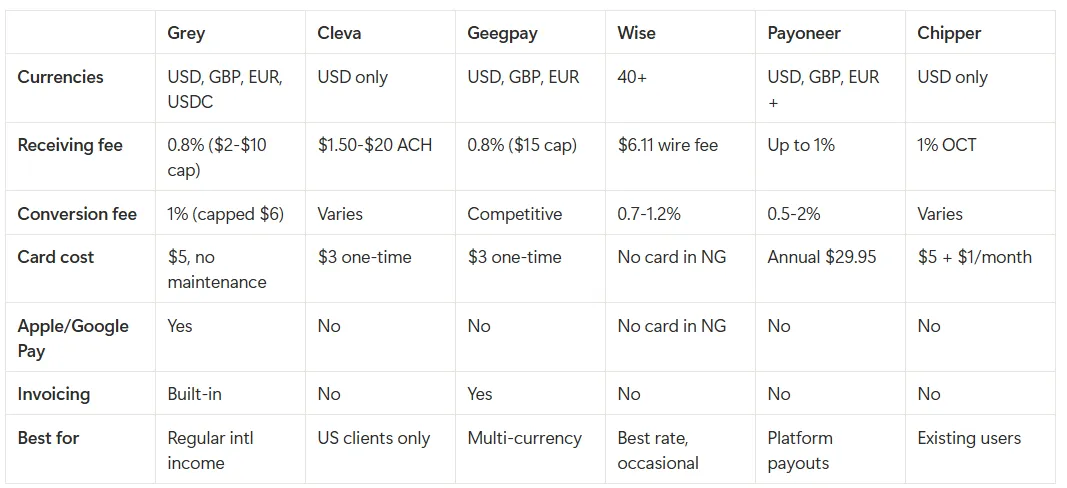
Side-by-side comparison

table comparing best dollar account apps - Grey, Cleva, Geegpay, Wise, Payoneer and Chiper

Which app is right for you?

You earn regularly from international clients in multiple currencies. Grey or Geegpay. Both support USD, GBP, and EUR with competitive fees. Grey adds USDC support, Apple Pay/Google Pay, and built-in invoicing. Geegpay has a slight edge on the receiving fee cap ($15 vs $10 on Grey, but Grey's minimum is lower).

You work exclusively with US clients and only need USD. Cleva. USD-only, but the fee structure is straightforward, and the capped ACH fees are cost-effective for larger transactions.

Your income comes through Upwork, Fiverr, or Amazon. Start with Payoneer for the native integration. But if the fees start eating into your earnings, add Grey or Geegpay for direct client payments and route new income there.

You need the absolute lowest conversion cost per transaction. Wise. The mid-market rate is hard to beat. But without a card in Nigeria or reliable full-service access, it is a transfer tool, not a primary account.

You already use Chipper Cash and just want a dollar card. Chipper's USD card works, but the $1 monthly fee and $0.90 per-transaction fee make it expensive for regular use. Worth it for convenience if you are already in the ecosystem, not worth switching to.

Most Nigerian freelancers managing high international income end up using two platforms: one primary account for receiving and spending (Grey, Geegpay, or Cleva), and Payoneer for marketplace payouts. That combination covers most situations.

Get started with Grey

Grey gives you USD, GBP, EUR, and USDC accounts, a Visa virtual card with Apple Pay and Google Pay, built-in invoicing, and naira withdrawals, all in one app. Sign up at grey.co or download the app to get your account details in minutes.

Note: Exchange rates on Grey are variable and include a margin over the mid-market rate. Fees listed are accurate as of the date of publication and may change. Always check the platform's current pricing before committing.

Frequently asked questions

Which is the cheapest dollar account app in Nigeria?

It depends on your usage pattern. For receiving payments, Grey and Geegpay both charge 0.8% with different caps. Cleva's flat ACH fee ($1.50 to $20) is cheaper for large single transactions. For conversion, Wise offers the lowest rate (0.7% to 1.2% at mid-market) but has no card in Nigeria. For overall value, including a card and multi-currency support, Grey and Geegpay are the most cost-effective for regular use.

Is Grey or Cleva better?

Grey supports USD, GBP, EUR, and USDC. Cleva supports USD only. If you only work with US clients and only need dollars, Cleva's simpler fee structure may work. If you need multiple currencies, a card with Apple Pay support, or an invoicing tool, Grey covers more ground.

Is Payoneer still worth it in 2026?

For marketplace payouts (Upwork, Fiverr, Amazon), yes, because the native integration is hard to replace. For direct client payments, newer platforms like Grey and Geegpay offer better rates and more features. Many freelancers keep Payoneer for platform payouts and use a separate app for everything else.

Do I need a dollar account app or a domiciliary account?

For regular freelance income and online USD spending, a dollar account app is faster, cheaper, and more flexible. A domiciliary account at a Nigerian bank makes more sense for large, infrequent wire transfers or long-term USD storage under banking regulation. Many people use both.

Can I use these apps for business payments?

Most of these platforms are designed for individuals and sole proprietors. If you run a registered business with multiple team members, check whether the platform offers a business tier. Grey offers Grey Business for companies that need multi-user access and business-level features.

Ready to compare for yourself? Sign up at grey.co and get your USD account details in minutes.

‍

Stripe alternatives for African freelancers

•

•

2 min read

What happens if Stripe suddenly stops working? Or your client can’t send money across, and you’re left staring at an empty account, wondering how bills will get paid? It’s a nightmare every African freelancer knows too well. One moment you’re working confidently, the next, your income is stuck in limbo.

Freelancing across Africa comes with its own challenges: banking limits, cross-border restrictions, and delayed transfers can make getting paid stressful and unpredictable. It can even affect your relationship with clients when payments take too long to clear.

In this guide, we’ll look at Stripe alternatives. It’s always good to have options so you can get paid reliably, reduce stress, and focus on the work you love.

Also read: The best payment platforms for freelancers in Africa right now

Why African freelancers should have Stripe alternatives

Managing payments as a freelancer can be tricky, especially if you rely on a single platform. Here’s why having alternatives matters:

1. Access and inclusion

Not being able to open a Stripe account shouldn’t stop you from getting paid. Platforms like Grey give you ways to receive international payments smoothly, bypassing country restrictions or regulatory hurdles, so your income keeps flowing without unnecessary obstacles.

2. Currency flexibility and control

With Stripe, you might be limited in the currencies you can hold or withdraw. Alternatives let you manage multiple currencies, convert when rates are best, and hold foreign income safely, helping you keep more of what you earn.

3. Seamless client payments

Clients may prefer certain payment methods, or Stripe might not integrate with local banks. Using alternatives ensures you can accept payments easily, maintain strong client relationships, and get your money on time, every time.

Also read: How to get paid in USD as a freelancer in Africa

Payment platforms African freelancers can use instead of Stripe

When Stripe isn’t an option, African freelancers still have reliable ways to get paid. Here are some of the best alternatives worth considering.

1. Grey (recommended)

Grey is a modern cross-border payment platform built for freelancers and remote workers. It allows you to receive, hold, and manage multiple currencies such as USD, EUR, and GBP. With virtual bank details, clients can pay you directly, while you hold funds or convert them at favourable rates. Withdrawals to local accounts are fast, and virtual debit cards let you pay for global subscriptions and services with ease. Grey simplifies international payments, giving you control and flexibility without the need for complex paperwork or traditional bank accounts.

2. Payoneer

Payoneer allows you to receive international payments directly into your account and withdraw to local banks. It integrates well with freelance platforms, making it easy to accept recurring payments from clients worldwide. You can hold balances in foreign currencies and convert when rates are favourable, giving you control over your income and helping you manage funds efficiently.

Also read: Best Payoneer and PayPal alternatives for freelancers in Africa

3. Wise

Wise provides a multi-currency account that allows you to receive payments in USD, EUR, GBP, and other currencies. You get local bank details for clients to pay easily, avoiding expensive international transfers. Funds can be converted at mid-market rates and withdrawn to your local account, offering transparency and flexibility for freelancers handling multiple clients.

4. Skrill

Skrill is a digital wallet built for freelancers who handle international work frequently. It allows you to receive payments, hold balances in multiple currencies, and withdraw directly to your local bank account. You can also use the funds for online subscriptions or business expenses, making it a flexible alternative when traditional banking slows you down. With Skrill, managing your international income becomes straightforward and reliable.

5. Paysera

Paysera gives you European IBAN accounts, so you can accept payments from international clients like a local. Funds can be held in different currencies, converted when rates are favourable, or withdrawn to your local account. If your work involves European clients or recurring projects, Paysera provides transparency and convenience, letting you focus on delivering quality work rather than worrying about complicated transfers.

6. WebMoney

WebMoney is a long-established digital wallet that works well in regions where other platforms are limited. Freelancers can receive payments, store funds in multiple currencies, and move money to local banks or other wallets. It’s especially useful if you deal with clients in different countries and need a reliable backup for receiving international payments, giving you more control over how and when your money arrives.

7. Remitly

Remitly focuses on speed and convenience for freelancers receiving money from abroad. You can have funds deposited straight into your local bank account or picked up as cash. Supporting multiple countries and currencies, it works well for African freelancers who need quick access to client payments. Remitly makes it easier to stay on top of your finances and keep projects moving without worrying about payment delays.

LDMAG1

Receive freelance payments easily with Grey

For African freelancers looking for reliable alternatives to Stripe, Grey stands out as a strong option for receiving international payments. Grey provides foreign currency accounts, smooth cross-border transfers, and easy withdrawals to local bank accounts, helping freelancers get paid by clients around the world with fewer complications. You can sign up on the Grey website or download the Grey mobile app to start receiving payments easily from anywhere.

Receive ACH payments in Nigeria without a US bank

•

•

2 min read

If you have worked with American clients or platforms, you have probably encountered ACH payments. It’s the local, straightforward, and preferred payment option for many US clients, and significantly cheaper than an international wire. Think of it like making a GTB-to-Wema bank transfer. Unfortunately, unlike international wire transfers, ACH only works between US bank accounts, and you need a US address and a physical visit to open an account. This explains why many Nigerians end up with the more expensive, slower, and forced-conversion option at unfair rates (Wire transfer via SWIFT).

The good news is that this doesn’t have to be the case. Nigerians can now receive ACH payments without a traditional US bank account, a US address, or ever travelling to the United States. This article explains how it works, why it matters, and what to look for when setting it up.

Also read: Managing foreign currency earnings as a remote worker in Nigeria

What is ACH and how does it work?

ACH stands for Automated Clearing House. It is the electronic network that facilitates most transfers between US banks. It also supports direct deposits, payroll, bill payments, and a significant portion of business-to-contractor payments.

ACH transfers are typically free or very cheap for the sender, and are usually completed within a couple of days. They do not require a SWIFT code or any of the other details associated with international wires. It is simply a domestic bank transfer.

That simplicity is exactly why so many US clients and platforms prefer it. So, it hurts a lot that many Nigerian freelancers and remote workers trying to get paid by American businesses can’t use it.

LDMAG1

How Nigerians receive ACH payments

The advent of virtual US bank accounts has offered Nigerians great respite in managing international payments. It bypasses the hurdles that prevent Nigerians from using ACH by providing a US routing number and an account number. These details are issued to you through a fintech platform, without requiring US residency, a US address, or a Social Security Number.

When you share these details with a US client or platform, they make what appears to them to be a standard domestic ACH transfer. The money moves through the ACH network as it normally would, arrives in your virtual US account, and from there, you convert and withdraw to your Nigerian bank account.

Also read: Virtual US accounts explained: who they work for

Which platforms help Nigerians receive ACH payments without a US bank

Not every fintech platform that claims to offer dollar accounts actually supports ACH inflows properly. Here is a quick overview of the main options:

  • Grey: Provides multi-currency accounts supporting USD, EUR, and GBP transactions. Users can get US banking details that support ACH payments within minutes. Setting up a Grey account takes only a few minutes, requiring a valid ID and proof of address.
  • Cleva: An emerging payment platform offering USD accounts for receiving ACH payments  has built a reputation among Nigerian freelancers for fast ACH settlement.
  • Geegpay: A payment product by Raenest that supports ACH payments with a 0.35% deposit fee, capped at $30.
  • Payoneer: This OG payment service for freelancers supports ACH payouts from platforms that offer it. However, Payoneer might be too expensive for a Payoneer account number is less straightforward and depends on the client's payment method.

Receiving ACH payments with Grey

Managing USD payments is gradually becoming a walk in the park for Nigerian freelancers. And with platforms like Grey frontlining this transition, freelancers can now maximise their earnings and avoid the drama of wire transfers. Grey gives Nigerians USD accounts with real US banking details that support ACH transfers from US clients, employers, and platforms. You can open an account online without visiting the US.  The transaction fees are low and transparent, and withdrawals to Nigerian bank accounts are processed quickly at competitive exchange rates. For seamless online purchases and subscriiptions, Grey virtual cards help you pay directly in USD to avoid conversion charges.

Sign up on Grey and download the app to open your account today.

‍

Arrow (up)

Back to top

