
If your business earns money from international clients, pays for foreign software, or is in conversations with investors outside Africa, then you’ve definitely experienced the difficulty involved in sending and receiving payments.
Most African business owners respond to this by pushing through, accepting the delays and losses as the cost of doing international business. However, this infrastructure problem has a straightforward solution.
Having a foreign bank account, specifically, one that gives your business actual local banking details in a foreign currency, changes how your business moves money internationally.
This article covers four concrete reasons why that matters, what it actually costs you not to have one, and what to look for when you’re ready to set one up.
Before getting into the reasons, it’s worth being precise, because “foreign bank account” means different things to different people, and some of those meanings can be unnecessarily complex.
The traditional route involves forming a business entity in a foreign country, such as a US LLC, a UK Ltd, a Netherlands BV, and then opening a local bank account for that entity. This works, but it’s expensive and slow.
Entity formation in the US costs between $1,000 and $3,000, plus ongoing compliance costs: registered agent fees, annual state filings, and tax returns, even if the entity earns no local income. Most founders who go this route for purely banking reasons find that the cost and administrative burden outweigh the benefit.
Domiciliary accounts, which most African commercial banks offer, are often mistaken for one another. They’re not. A domiciliary account holds foreign currency, usually USD, at your local Nigerian, Kenyan, or South African bank.
The key limitation is that it doesn’t come with local banking details for that currency. There’s no US routing number, no ACH capability, no EUR IBAN. The only way to receive money into a domiciliary account is via international wire transfer, which is exactly the slow, expensive method this article is about avoiding.
Modern foreign business accounts provide your business with actual local banking details for foreign currencies, without requiring a foreign entity or a trip abroad. A USD account includes a US routing number and an account number. An EUR account comes with an IBAN.
These details connect your business directly to foreign payment networks, such as ACH in the US,, so clients can pay you the same way they pay any local vendor.
That’s what this article is about. Now, here are four major reasons it matters.
Also read: Alternatives to domiciliary accounts in Nigeria
This is the most important reason, and it’s the one most business owners don’t fully appreciate until they’ve lost a deal or a client relationship over it.
When a US company pays a vendor, the default payment method is ACH (Automated Clearing House). It’s domestic, cheap (sometimes free for the sender), and processes in one to two business days. When a European company pays a vendor, it uses a SEPA transfer to an IBAN. When a UK company pays, they send GBP via Faster Payments using a sort code and account number.
When you can’t provide these details, when all you have is a local Nigerian account or a domiciliary account that can only receive SWIFT wires, you’re asking your client to go off their standard process. Here’s what that actually triggers on their end:
Their finance team flags your payment as an international transaction, which may require manual processing and additional approvals. The client’s bank charges a wire transfer fee of between $30 and $50, which some clients deduct from your invoice or use as justification to delay payment. The wire travels through one or more correspondent banks, each of which may deduct an intermediary fee. Your receiving bank charges an inbound wire fee. And then there’s the exchange rate markup on conversion.
Now consider what happens when you provide US ACH details to that same client. From their perspective, they’re making a domestic payment, and their accounting software processes it automatically.
Beyond the cost, there’s a subtle effect on client relationships. Enterprise procurement teams and finance departments at large companies treat banking friction as a signal. If paying you requires a special process, an extra approval chain, and a fee their CFO will ask about, some of them will quietly factor that into renewal conversations. Having local payment details removes the question entirely.
Also read: Open a USD business account without a US address
Every time you convert foreign currency to naira, shillings, or rand at a traditional bank, you lose money.
The mid-market rate is the “real” exchange rate. It’s the midpoint between what buyers are paying and what sellers are accepting in the global currency market at any given moment. Banks usually don’t give you this rate. They apply a markup, typically 3 - 5% at most African commercial banks, and the difference between the mid-market rate and what you actually receive is their margin on the transaction.
Here’s what that looks like in practice. If the mid-market rate for USD/NGN is ₦1,600 per dollar and your bank applies a 4% markup, you receive ₦1,536 per dollar instead. On a $50,000 conversion, that’s ₦3,200,000, which is roughly $2,000 that stays with the bank rather than reaching your account.
A foreign bank account changes this in two ways. First, it lets you hold foreign currency balances rather than forcing you to convert immediately on receipt. When $30,000 arrives from a US client, it is added to your USD balance. You convert only what you need for naira-denominated expenses, such as staff salaries or local rent, and leave the rest in USD.
Second, it gives you control over conversion timing. Exchange rates fluctuate, sometimes over days and weeks. If the USD/NGN rate is unfavourable this week, you can wait. That optionality is worth real money over the course of a year.
Modern business accounts, unlike traditional banks, also tend to apply tighter conversion margins.
There’s a third layer to this that most people miss: double conversion. If your business pays for international software and services like AWS, Figma, Notion, ChatGPT Plus or Facebook Ads using a local naira card, you’re buying foreign currency at retail rates every single time. You’ve already converted your USD revenue to naira at whatever rate your bank offered. Now you’re converting naira back to USD to pay for your dollar-denominated tools. Every round-trip through that exchange costs you money in both directions.
Holding USD in a foreign business account and paying USD expenses directly from that balance eliminates the double conversion.
Also read: Grey Business vs Grey personal banking
This reason is less about cost and more about what your banking setup communicates to the people you’re trying to do business with.
On the investor side: When a US or UK venture fund wires seed funding to an African startup, they typically send USD. Many funds have compliance requirements that prevent them from processing payments through currency conversion or third-party accounts. They need to wire directly to a USD-denominated business account with proper banking details.
A startup that can provide a US routing number and account number at term sheet signing moves faster than one that needs two weeks to sort out its banking infrastructure.
Beyond logistics, the quality of your financial infrastructure signals operational maturity. Investors conducting due diligence examine how a business manages its finances. Clean USD records, proper multi-currency accounting, and banking details that work seamlessly with standard transfer methods tell a different story than a collection of workarounds.
Some founders try to solve this by providing personal accounts or routing investment through informal channels. This creates problems: it complicates cap table clarity, raises flags in due diligence, and can create tax complications that become expensive to unwind later. A proper foreign business account handles this cleanly from the start.
On the enterprise sales side: Procurement teams at large companies in the US, Europe, and the UK have vendor onboarding processes. Part of that process involves verifying that a vendor can receive payment cleanly and in compliance with their internal controls.
When you provide a US routing number and account number, the process is simpler. If you provide a SWIFT code and ask them to send an international wire, you’re an exception case that needs manual handling.
The previous three reasons are mostly about receiving money. This one is about spending it.
Most African businesses operating internationally have a significant portion of their operating expenses denominated in foreign currency and that proportion grows as the business scales. Consider a typical technology startup’s monthly foreign currency expenses:
If you’re paying all of these from a naira account or a local card that converts at the point of transaction, you’re buying USD at retail rates every single time a bill comes due. Your bank applies its spread on every transaction. You have no control over the rate, no ability to time the conversion, and no visibility into exactly what you’re paying until the statement arrives.
A foreign business account with a USD balance changes this completely. You receive USD from clients, hold the balance, and pay USD expenses directly. The money never touches the Naira conversion system for those transactions. You’re not buying USD since you already have it.
Beyond cost, there’s an operational efficiency argument. Managing expenses across currencies from a single platform, seeing your USD balance, knowing what’s available and paying bills directly is simply cleaner than routing everything through local currency and reconciling conversion costs across dozens of transactions. Your accountant will appreciate it.
Also read: Open a multi-currency account for a startup in Africa
Before choosing a foreign account provider, verify these specific things:
Actual local banking details, not just currency holding
Confirm that you’ll receive a US routing number and account number for USD. Currency holding without these details is just a domiciliary account.
Transparent fee structure
Ask specifically about the conversion the margin applied over the mid-market rate. Providers that advertise “no fees” often recover costs through the spread. A provider charging 1 - 2% over mid-market rate is meaningfully cheaper than one charging 3 - 5%, even if neither charges a “transaction fee.” Also check for account maintenance fees, inbound transfer fees, and withdrawal fees to local accounts.
Regulatory legitimacy
Look for licences from recognised regulators — FINTRAC in Canada, FinCEN in the US, or the FCA in the UK.
Both inbound and outbound capability
Some accounts only let you receive money. If you need to pay international contractors, vendors, or service providers, confirm the account supports outbound transfers to your required destinations.
Business-grade features
A business account should support team access with different permission levels, transaction records exportable for accounting software, and proper documentation for tax and audit purposes. Individual-focused accounts often lack these.
Geographic availability
Confirm your specific country is supported before beginning the application.
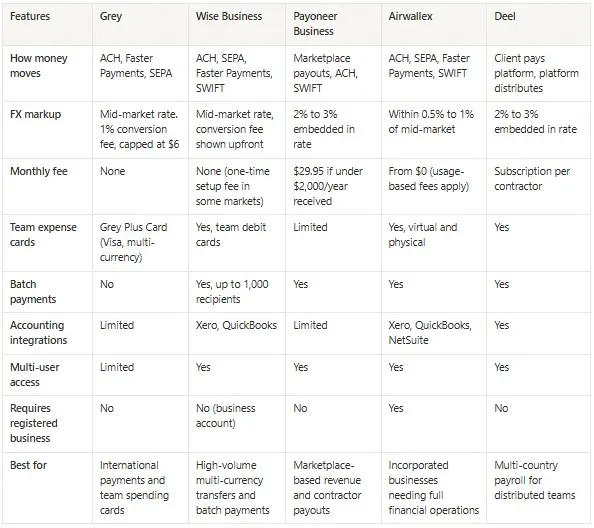
Grey Business provides businesses with a US bank account, complete with a routing number and account number, without requiring a US entity or physical presence in the United States.
When you open a Grey Business account, you receive USD banking details that function exactly like a traditional US business account from a payer’s perspective as your US clients pay via ACH as they would any domestic vendor. Funds clear in one to two business days and arrive in full in your USD balance, no intermediary deductions, no inbound wire fees.
Account opening goes through KYB verification, where we check incorporation records, Ultimate Beneficial Owner identity, AML compliance, and document authenticity. Verification typically takes one to three business days after you submit your business registration documents for example CAC certificate in Nigeria, business registration certificate in Kenya, and company registration documents in South Africa.
Beyond the USD account, Grey Business includes local currency payouts to several supported markets, with real-time FX rates displayed before you confirm each transaction. Fees and estimated processing times are shown upfront.
The platform also supports virtual USD cards for business spend for paying recurring SaaS subscriptions, cloud hosting, and advertising bills directly from your USD balance without conversion.
For businesses managing payroll or contractor payments at volume, the bulk payout functionality lets you upload a CSV file and process multiple transactions simultaneously, with a dashboard to track status and handle any failures.
Grey Business charges no monthly maintenance fees. The primary cost is the conversion margin when you move between currencies, typically 1 - 2% over mid-market rate, compared to the 3 - 5% spread at most traditional African banks.
Grey is regulated by FINTRAC and FinCEN, and customer funds are held in segregated accounts at licensed US partner banks.
To get started, visit grey.co/business, submit your business registration documents and director identification, and complete KYB verification.
Can an African business open a US bank account without forming a US company?
Yes. Platforms like Grey Business provide African businesses with US routing numbers and account numbers without requiring a US LLC or corporation. You apply as an African-registered business, complete KYB verification, and receive USD account details within one to three business days.
What’s the difference between a domiciliary account and a foreign business account?
A domiciliary account holds foreign currency at your local bank but doesn’t come with local banking details for that currency. It can only receive international wire transfers. A foreign business account provides actual local banking details and connects to local payment networks like ACH and SEPA, allowing clients to pay you as they would a local vendor.
How much does it cost to maintain a Grey Business account?
Grey Business charges no monthly maintenance fees. The primary cost is the conversion margin which is typically 1–2% above the mid-market rate when converting currencies. Confirm current rates before transacting.
What documents do I need to open a Grey Business account?
Typically: your business registration certificate (CAC in Nigeria, equivalent in other countries), identification documents for directors and beneficial owners, proof of business address, and information about your business activities. Specific requirements may vary.
Does having a foreign business account change my tax obligations?
No. A foreign business account is operational infrastructure, not a tax structure. All foreign income must still be declared and taxed in your country of incorporation and operation. Consult an accountant familiar with international income for your specific jurisdiction.


Back to top