
<script type="application/ld+json" data-schema-version="grey-blog-v4"> [{"@context":"https://schema.org","@type":"BlogPosting","@id":"https://grey.co/blog/unlocking-non-tech-careers-insights-from-peace-obinani#article","headline":"Unlocking non-tech careers: Insights from Peace Obinani","description":"Discover secrets to succeeding in tech without coding skills, and get valuable insights into marketing in Nigeria's fintech sector.","inLanguage":"en","url":"https://grey.co/blog/unlocking-non-tech-careers-insights-from-peace-obinani","mainEntityOfPage":{"@id":"https://grey.co/blog/unlocking-non-tech-careers-insights-from-peace-obinani#webpage"},"datePublished":"2023-10-16T15:06:51.737Z","dateModified":"2026-06-15T15:34:24.294Z","author":{"@type":"Person","@id":"https://grey.co/authors/toluwani-omotesho#person","name":"Toluwani Omotesho","url":"https://grey.co/authors/toluwani-omotesho"},"publisher":{"@type":"Organization","@id":"https://grey.co/#organization","name":"Grey","url":"https://grey.co","logo":{"@type":"ImageObject","url":"https://cdn.prod.website-files.com/6360022338a81bd6fdbb1145/6564ae1077a67e39d3c491a6_Grey%20Logo%20Lockup%20Black.svg"}},"image":{"@type":"ImageObject","@id":"https://grey.co/blog/unlocking-non-tech-careers-insights-from-peace-obinani#primaryimage","url":"https://cdn.prod.website-files.com/636a85d290ee58e70c17e1c0/6a301b7f4a4855103a71a7f3_6a301b7e290dac557604201f_unlocking-non-tech-careers-insights-from-peace-obinani__header-image.webp","contentUrl":"https://cdn.prod.website-files.com/636a85d290ee58e70c17e1c0/6a301b7f4a4855103a71a7f3_6a301b7e290dac557604201f_unlocking-non-tech-careers-insights-from-peace-obinani__header-image.webp","width":1200,"height":675}},{"@context":"https://schema.org","@type":"WebPage","@id":"https://grey.co/blog/unlocking-non-tech-careers-insights-from-peace-obinani#webpage","url":"https://grey.co/blog/unlocking-non-tech-careers-insights-from-peace-obinani","name":"Unlocking non-tech careers: Insights from Peace Obinani","description":"Discover secrets to succeeding in tech without coding skills, and get valuable insights into marketing in Nigeria's fintech sector.","inLanguage":"en","primaryImageOfPage":{"@id":"https://grey.co/blog/unlocking-non-tech-careers-insights-from-peace-obinani#primaryimage"},"breadcrumb":{"@id":"https://grey.co/blog/unlocking-non-tech-careers-insights-from-peace-obinani#breadcrumb"}},{"@context":"https://schema.org","@type":"BreadcrumbList","@id":"https://grey.co/blog/unlocking-non-tech-careers-insights-from-peace-obinani#breadcrumb","itemListElement":[{"@type":"ListItem","position":1,"name":"Home","item":"https://grey.co/"},{"@type":"ListItem","position":2,"name":"Blog","item":"https://grey.co/blog"},{"@type":"ListItem","position":3,"name":"Unlocking non-tech careers: Insights from Peace Obinani","item":"https://grey.co/blog/unlocking-non-tech-careers-insights-from-peace-obinani"}]}] </script>

Unlocking non-tech careers: Insights from Peace Obinani

Toluwani Omotesho

TABLE OF CONTENT

SHARE THIS POST

The importance of non-tech roles in the tech industry is gaining more popularity. From marketing to customer support and finance, these roles act as the backbone and are essential to the growth and success of any tech company.

In our recent Limitless podcast, we spoke with our first female guest, Peace Obinani. She’s the head of online marketing at PiggyTech and the founder of Non-tech in Tech.

How did you find yourself in tech with your background in Microbiology?

I literally just found myself here. I knew I wouldn’t continue in microbiology, but tech was also nowhere on the list. I always figured I’d do something relating to events or event management because I was gathering experience.

But after I got my first tech job, I realized that it wasn’t what you’d call a typical 9-5, which I’ve never been particularly keen on. This was more flexible and relaxed, so I decided to stay and see how it panned out.

My driving force, however, for remaining in tech is my curiosity. I’m a naturally curious and passionate person. So, as long as there’s something new or challenging, I’m going to give my 100 percent to it.

Can you tell us more about Non-Tech in Tech?

The idea came up from seeing that many people still think that you need to code to work in tech. So, I started to dispel those myths by creating a community of people who work in tech without coding skills. This community provides an opportunity for people who have non-tech tech careers to connect.

Where do you see Non-Tech in Tech in the next five years?

I see us doing what we’re currently doing but on a much larger scale. We already organize local tech summits, partnerships, and annual events for non-tech people – we have an edition coming up this year – and in the next five years, we can replicate these events across different countries. We’re generally just concerned about advocating for no-code tech rules and professionals, educating people about non-tech tech roles, giving them a chance to upskill and get better jobs, and learning new things in the local tech space.

What are you most proud of with everything you’ve achieved with Non-Tech in Tech?

I’m proud of how far I’ve come in a relatively short time and the impact I’m making in my little way. Because people now understand that you don’t need to learn coding to work in tech, you can be a product marketer. Also, there are people, some fresh graduates, who are getting their first jobs or getting international offers from our community. So, I’m just really happy to be part of this.

Returning to marketing, what are the biggest marketing challenges in fintech?

I think the most challenging part about marketing in fintech, especially in Nigeria, is dealing with many uncertainties and variables. I like to say that every day is unique, coming with its own set of problems that need solving. When you juxtapose this with the level of mistrust Nigerians have regarding their money, it can be quite a lot to handle. For example, if there’s a minute of network lag, everybody starts talking about how you’re a thief and scammed them of their money, so you’re not just dealing with marketing your product but with people’s emotions and trying to gain their trust.

What advice would you give to anyone looking to succeed in marketing?

  1. It’s all about your audience: It’s all about your customers and never about you. I’m sorry. Yes, you can try to infuse certain parts of yourself, but you should always put the wants and needs of your customers first. For instance, there might be specific ideas you might want to implement, but they might not resonate with the people you’re trying to sell your product to. We try to live by this at PiggyTech; when it comes to marketing our products, we’re very customer-centric.
  2. Be empathetic: You should always put yourself in the customer’s shoes, especially during the creative process. Always look at different perspectives when approaching issues to ensure you’re not just shooting blanks.
  3. Document everything: it’s easy to get carried away, especially when you’re in the marketing space. You can reflect on the month and feel like you’ve achieved nothing. A lot of unfulfillment comes with not documenting, which can lead to a creative block or even feelings of depression. But documenting helps you build your confidence, keep track of your successes, and protect your interests in situations where you might negotiate for a raise.

Wrapping Up

If you’re interested in having a career in the tech industry, you no longer have to worry about not having a technical background. There are many great non-tech roles you can pursue. By investing in self-development, gathering the right skills and experience, and connecting with people with similar interests, you can have a successful and rewarding career in tech.

‍

Last updated:

October 2, 2026

Open a free Grey account to get startedJoin 1 million digital nomads
IF YOU ENJOYED THIS, CHECK THESE OUT

How creators receive payouts from YouTube, TikTok, Patreon and other platforms

•

•

2 min read

Creators outside the US get paid in one of three ways, and the platform decides which. YouTube (through AdSense) and Gumroad pay into a local bank account in your own country, while Patreon lets you pick the bank country, including the US. Substack, Twitch, TikTok and Meta pay through their own payout systems or processors, with options that depend on where you live.

Brand deals and direct clients are the exception: they pay however you agree, which is where your own USD, GBP or EUR account details matter.

I learned this the slow way. My first YouTube payout arrived after months of work, and somewhere between California and my bank account, part of it simply vanished. This guide is what I wish I had read first: every major platform's payout methods, minimums and timing in one table, the reasons payouts fail, and an honest view of where a Grey account helps and where it can't.

Creator payouts by platform at a glance

PlatformHow it pays creators outside the USMinimum payoutWhen it paysCan it pay a Grey USD, GBP or EUR account?
YouTube (AdSense)EFT to a local bank in local currency where available; otherwise wire transfer, SEPA, cheque or PayPal Hyperwallet, depending on your payment address$100 (£60, €70)Issued between the 21st and 26th of the month; EFT arrives within 7 business days, wire within 15No. Your bank must be in the same country as your AdSense payment address
PatreonBank transfer in local currency or USD, PayPal or Payoneer Wallet$10 (Payoneer Wallet: $25)Automatic on the 5th if you opt in, or manual once every 24 hours; usually 1 to 5 days to arriveYes, for USD. Patreon lets you choose the US as your bank country
TwitchACH or direct deposit, eCheck or local bank, PayPal, cheque or wire$50 ($100 for wire)Automatic once you pass the minimum (Partners and Affiliates only)Not confirmed. Use the options Twitch shows for your country
TikTokBank account or another method TikTok supports in your region; Creator Rewards is open in selected countries onlyShown in the appOn request outside Europe and Canada for TikTok One brand campaignsDepends on your region's options
Facebook and Instagram (Meta)The payout account you set up in Meta's monetisation settings; methods vary by country$25 for US creators on Stars and Subscriptions; others see payout settingsShown in your payout settingsNot confirmed
SubstackStripe only, to a bank account in a country Stripe supportsNone statedUsually within 48 hours of each payment; first payout 7 to 14 daysNo. You need Stripe in your own country
GumroadLocal bank in local currency where supported; PayPal (in USD) everywhere else$100Daily, weekly, monthly or quarterly; sales up to the previous Friday; 7-day hold on most schedulesNo. Gumroad pays only a local bank account in your local currency
Brand deals and direct clientsWhatever you agree: bank transfer, PayPal or an invoicing platformNoneOn your invoice termsYes. USD by ACH, FedNow or Fedwire; GBP by Faster Payments, BACS or CHAPS; EUR by SEPA

Checked 27 November 2026 on each platform's own help pages, linked in the sections below. Platforms change these rules, so check your payout settings before you rely on a figure.

LDMAG1

The one rule that decides where your money can land

Every platform above answers one question differently: does the bank account have to be in your country? That single rule explains most of the confusion online.

  • Local-bank platforms (YouTube, Gumroad) pay only a bank in your own country, usually in your local currency. No foreign account can change that.
  • Choose-your-bank platforms (Patreon) let you set the bank country separately from where you live, so a USD account in your name works.
  • Processor platforms (Substack, and in places Twitch, TikTok and Meta) pay through Stripe, PayPal, Payoneer or their own systems, so what you get depends on what that processor supports in your country.
  • Direct payers (brands, agencies, clients) send money wherever you tell them, so this is where you have the most control over fees.

When I first wrote this guide, I lumped YouTube in with every other platform and suggested pointing it at a foreign account. That was wrong, and the next section explains why.

Platform by platform: what each one actually requires

YouTube and Google AdSense

YouTube pays through AdSense, and Google is strict about location: your bank or branch must be in the same country as the address in your payment settings, or your SWIFT code won't be accepted. Where it's offered, EFT pays you in local currency. Elsewhere you get a wire transfer, which can arrive with intermediary bank deductions.

Earnings are finalised early in the month, and if your balance on the 20th has passed the $100 threshold, Google issues the payment between the 21st and the 26th. If you're below the threshold, the balance simply rolls over.

So a US or virtual USD account does not work for AdSense if you live outside the US, and that includes Grey. If your problem is the cost of the wire into your local bank, the fix is choosing the right local account to receive it, which our guide for Nigerian creators covers in detail.

Patreon

Patreon is the most flexible platform here. Its payout guide for creators outside the US says your bank country is separate from your country of residence, and you can choose the US to receive USD bank transfers.

Fees per payout are $0.50 for a local-currency or USD bank transfer, $0.25 plus 1.55% if Patreon converts USD into your local currency, 1% for PayPal (minimum $0.25, capped at $20) and $1 to a Payoneer Wallet. Adding or changing a payout method triggers a 5-day hold, so don't switch accounts the week rent is due. Our Patreon payout guide walks through the setup screen by screen.

Twitch

Twitch pays Partners and Affiliates automatically once earnings reach the $50 minimum. The $50 threshold covers ACH or direct deposit, eCheck or local bank, PayPal and cheque, while wire transfers still need $100 because of transfer fees, according to Twitch.

TikTok

TikTok's Creator Rewards Program is only open in selected countries, so many creators earn from LIVE gifts and brand campaigns instead. For TikTok One brand work, creators registered outside Europe and Canada can request a payout at any time to a bank account or another supported method, and TikTok says wrong or unverified details are a common reason payments fail.

The options differ a lot by country. If you're in Egypt, read our guide for TikTok creators in Egypt.

Facebook and Instagram

Meta pays into the payout account you add in its monetisation settings, and the methods offered depend on your country. In the US, Meta has cut the payout threshold for Stars and Subscriptions from $100 to $25. Outside the US, your payout settings show the methods and threshold that apply to you.

Substack

Substack uses Stripe as its only payment provider, so you can only take paid subscriptions if Stripe works in your country. Payments usually reach your bank within 48 hours of each transaction, and the first payout takes 7 to 14 days, according to Substack's help centre.

Gumroad

Gumroad's payout page is blunt: it pays only to a local bank account, in your local currency, and needs a $100 balance. Where bank payouts aren't available, PayPal is the only option and costs 2% per payout. Payoneer, Wise and wire transfers aren't supported, and new accounts go through a review of 1 to 3 weeks.

Brand deals and direct clients

Brand deals are the payments you control. You send an invoice with your payment details, and the brand pays by bank transfer. If those details are a USD, GBP or EUR account, the brand pays a domestic transfer in its own currency instead of an international wire.

Why creator payouts fail, and how to fix each one

The platforms' own help pages point to five causes of failed or frozen payouts. All of them are fixable, but some cost you a month.

  • The bank is in the wrong country. AdSense rejects banks outside the country on your payment address, and Gumroad needs a local account. Match the bank to the platform's rule before you add it.
  • The name doesn't match. Use the account holder's name exactly as your bank holds it. Patreon asks for the name on the account and doesn't accept special characters, so drop accents and symbols.
  • Your country isn't supported. TikTok Creator Rewards and Substack's Stripe payouts only work in certain countries. If yours isn't one of them, focus on the platforms that pay you directly.
  • Tax information is missing. If an individual YouTube creator hasn't submitted US tax info, Google may withhold 24% of total earnings worldwide. With tax info submitted, only earnings from US viewers face withholding, at 0% to 30% depending on your country's tax treaty.
  • A hold or review is running. Patreon holds payouts for 5 days after a new payout method, and Gumroad reviews new accounts for 1 to 3 weeks. A balance below the minimum also rolls over rather than paying out.

Sort out tax forms before your first payout, not after. Our guide to creator taxes explains the W-8BEN and treaty claims.

Where Grey fits, and where it doesn't

Grey gives you foreign accounts with USD, GBP and EUR account details, so payers who send bank transfers can pay you like a local. Grey is a financial technology company, not a bank.

It fits brand deals, agency payments, direct clients and Patreon USD payouts. It does not fit AdSense, Gumroad or Substack, because those platforms decide where they pay, not you.

Here is what Grey charges to receive money into each account.

AccountHow the payer sends itGrey deposit fee
USDACH or FedNow0.8% (minimum $2, maximum $10)
USDFedwire$20 flat
GBPFaster Payments0.8% (minimum £2, maximum £10)
GBPBACS / CHAPS£15 flat / £25 flat
EURSEPA or SEPA Instant0.8% (minimum €2, maximum €10)
AnyConverting to another currency1%, capped at $6

Checked 27 November 2026 against Grey's deposit fee page on support.grey.co.

Worked example: a $1,000 brand deal

Say a US brand pays you $1,000 by ACH. Grey's deposit fee is 0.8%, so $8, leaving $992 in your USD account. If you convert all of it to your local currency, the 1% fee would be $9.92, but the cap brings it down to $6.

That's $14 in Grey fees on $1,000, plus your local withdrawal fee (in Nigeria, for example, a flat ₦35). If the brand insists on Fedwire instead, the deposit fee is $20, so the total is $26.

Compare that with my early wires: I once received $2,000 by international wire and lost nearly $90 to the sender's fee, an intermediary bank, my bank's receiving fee and a poor exchange rate. The domestic transfer is what makes the difference, because no intermediary bank touches it.

How I'd set up my creator payouts today

  1. Map each platform to its rule. Write down which of your platforms pay a local bank only, which let you choose and which pay through a processor.
  2. Keep a local bank account for the strict ones. AdSense and Gumroad need it, so make sure the name and address match your payout profile exactly.
  3. Give direct payers USD, GBP or EUR details. Put them on every invoice, and a free tool like Grey invoicing adds your account details automatically.
  4. Submit tax forms before your first payout. On YouTube, that is what stops 24% withholding on your worldwide earnings.
  5. Convert when you need local currency. Keeping earnings in USD, GBP or EUR until you need them avoids converting every small payout, and you can check rates on the currency converter first.

Frequently asked questions

Can I receive YouTube AdSense payments in a Grey USD account?

No, not if you live outside the US. AdSense requires your bank to be in the same country as the address in your payment settings, so it pays a local bank in your country.

Which creator platforms pay into a USD account outside the US?

Patreon lets you choose the US as your bank country, so it can pay a USD account in your name. Brands, agencies and clients who pay by bank transfer can also pay a USD, GBP or EUR account.

Why was my creator payout returned or put on hold?

The usual causes are a bank in the wrong country, a name that doesn't match, an unsupported country, missing tax information or a hold after you changed payout details. Check your payout settings for the exact reason before you add a new account.

What is the minimum payout on YouTube, Twitch, Patreon and Gumroad?

YouTube (AdSense) pays from $100, Twitch from $50 ($100 by wire), Patreon from $10 and Gumroad from $100, as of 27 November 2026.

Getting paid is part of the job

Platforms decide how they pay you; you decide everything else. Set up each platform the way its rules require, and send brands and clients account details that save them a wire.

Open your free Grey account or download the app to get USD, GBP and EUR account details for your next brand deal.
How Nigerian creators can get USD payouts without a US address

•

•

2 min read

So, the dollars have started coming in, and then a payout form asks for a US bank account and a US address. Good news: you can get a US account number and routing numbers from Nigeria without either, through a fintech account such as Grey. Where a form insists on a US address, Grey's help centre says you can use the bank address that comes with your account details.

The catch is that a US account only helps on platforms willing to pay a non-US creator into one. Upwork, Patreon and US brands paying you directly will. YouTube and Gumroad pay Nigerian creators into a Nigerian bank instead, and Substack and TikTok's Creator Rewards Program are mostly closed to Nigerian accounts.

Below is the platform-by-platform picture, what a Grey USD account can and can't receive, what turning dollars into naira really costs, and the US tax form platforms will ask you to sign.

Which platforms pay a Nigerian creator into a US account?

Here is the short version. The sections further down explain each row and link to the platform's own rules.

PlatformHow it pays creators in NigeriaInto a Grey USD account?
UpworkDirect to U.S. Bank (ACH), local bank, wire, Payoneer or PayPalYes, with Direct to U.S. Bank (ACH)
PatreonUSD bank transfer (you can choose the US as your bank country), PayPal or PayoneerYes, with the US as your bank country
US brands and clients paying you directlyACH, FedNow or a domestic wire from their US bankYes
YouTube (AdSense)A bank in the same country as your payment address, so a Nigerian bankNo
GumroadNaira deposit to a Nigerian bank accountNo
SubstackNeeds a Stripe account in a country Stripe supportsNo, the blocker is the Stripe account
TikTokCreator Rewards is not open in Nigeria; LIVE rewards go out by the methods TikTok shows your accountNot directly

Checked 27 November 2026 against each platform's help pages and Grey's help centre.

What a Grey USD account can and can't receive

Once your account is approved, you get a US account number, an ACH routing number and a wire routing number. It is a checking account, and Grey's receiving guidelines list three ways money can arrive: ACH, FedNow and Fedwire. All three are US domestic payment networks.

That one fact tells you which platforms fit. If a platform pays by ACH or direct deposit and lets non-US creators use a US bank, your Grey details work. If it only pays to a bank in your home country, or sends an international SWIFT wire, which Grey's guidelines don't list, it isn't a fit.

How the money arrivesTypical speedGrey fee (USD)
ACH1 to 2 business days0.8%, minimum $2, maximum $10
FedNowSeconds, including weekends0.8%, minimum $2, maximum $10
Fedwire (domestic wire)Same business day if sent before the cut-off, typically 5pm ET$20 flat
Converting USD to NGNShown in the app before you confirm1%, capped at $6

Checked 27 November 2026, from Grey's USD deposit fees page and its guide to ACH, FedNow and wire.

Two rules are worth knowing before you share your details. A payment from another individual must be under $4,000 each time, while payments from business accounts have no limit. And the account can't receive payments for crypto, P2P, betting or forex trading.

Grey is a financial technology company, not a bank.

Platform by platform: where your US details go

Upwork

Upwork is the cleanest fit. Grey's help centre walks through the Upwork setup: go to Settings, then Get paid, then Add method, pick the direct US bank (USD) option, choose Individual Checking and enter your ACH routing number and account number.

The name on Upwork must match your Grey account name exactly. Our Upwork guide compares this route with Upwork's other withdrawal options for Nigeria.

Patreon

Patreon's payout guide for creators outside the US is clear on the key point: "You may select the United States as your bank country, even if you reside outside the U.S." Choose the US, then enter your Grey USD details.

Patreon charges $0.50 for a USD bank transfer to a USD account, with a $10 minimum payout.

Adding a new payout method puts a 5-day hold on payouts, so don't switch the week money is due.

PayPal (1%, minimum $0.25, capped at $20) and Payoneer ($1) remain as fallbacks. Our Patreon payout guide covers the setup screens.

US brand deals and direct clients

When a US brand or agency pays you directly, it is just a US bank transfer. Send them your account number, the right routing number (ACH for ACH or FedNow, the wire routing number for a wire) and your name as it appears on your Grey account. If their payment form wants an address, use the bank address shown with your details.

Ask for ACH on smaller invoices. A wire costs a flat $20 to receive, which is 10% of a $200 payment and less than 1% of a $5,000 one.

YouTube (AdSense)

YouTube is the exception that matters most. Google's AdSense payment rules say "Your bank (or branch) must be located in the same country as the address in your payments settings." For a creator living in Nigeria, that means a Nigerian bank account.

So a Grey USD account, or any other US account you hold from Nigeria, can't receive your AdSense payments. Google also says that if a method doesn't appear on your "Add payment method" page, it isn't available in your country.

Gumroad

Gumroad's payout rules list Nigeria as a bank-payout country, paid in naira to a local account. It doesn't support Payoneer, Wise or wire transfers, and if you sell as a business, the bank account must be in the country where the business is registered.

In practice, your Gumroad money reaches your Nigerian bank in naira once you clear the $100 minimum for weekly, monthly or quarterly payouts. You don't need a US account for it, and Gumroad's rules point a Nigeria-based individual to a local naira account, not a US one.

Substack

Substack's help centre says paid subscriptions need a Stripe account in a country Stripe supports. On Stripe's availability page, Nigeria sits under its "extended network" and points to Paystack rather than a standard Stripe sign-up.

That makes paid subscriptions hard to switch on from Nigeria today, and a US bank account doesn't change it. The missing piece is the Stripe account, not somewhere for the money to land.

TikTok

TikTok's Creator Rewards Program, which pays for views, runs only in selected countries, and Nigeria isn't one of them as of 27 November 2026. Nigerian creators aged 18 and over can still earn from LIVE gifts and withdraw rewards using the methods TikTok offers their account, often PayPal or Payoneer.

The bigger dollar opportunity is usually brand deals, which brands pay outside TikTok. That is exactly where your US account details fit. Our TikTok earnings guide covers every TikTok income stream open to Nigerian creators.

How to get your Grey USD account details

  1. Sign up on Grey or in the Grey app with your email address and phone number.
  2. Verify your identity with a valid ID, such as a national ID card, international passport or driver's licence. The name must match the one you signed up with.
  3. Request your USD account, then copy your account number and routing numbers from the app into each platform's payout settings.

Copy and paste rather than retyping. One wrong digit is enough to send a payout back.

What it costs to turn your dollars into naira

Say a $300 payout and a $1,500 payout each arrive by ACH, and you convert all of it to naira in the app. Here is what Grey's published fees come to.

Step$300 payout (USD)$1,500 payout (USD)
ACH deposit fee (0.8%, minimum $2, maximum $10)$2.40$10.00
Balance after deposit$297.60$1,490.00
Conversion fee (1%, capped at $6)$2.98$6.00
Dollars converted to naira, after fees$294.62$1,484.00
Grey fees as a share of the payout1.8%1.1%

Checked 27 November 2026, from Grey's USD deposit fees and its 1% conversion fee capped at $6. Platform fees, such as Patreon's $0.50, come off before the money reaches you.

The caps are the useful part. The conversion fee stops growing at $600 and the ACH fee at $1,250, so from $1,250 upwards your Grey fees stay at $16 per payout, however large it is. If you don't need the naira today, let a few payouts build up and convert once.

Your naira amount is the dollars converted multiplied by the rate the app shows before you confirm. You can check today's USD to NGN rate before you decide when to convert.

The W-8BEN form, in plain terms

US platforms usually ask non-US creators for a W-8BEN before they pay. According to the IRS, you give it "to the withholding agent or payer if you are a foreign person", meaning the platform, not the IRS, and you submit it when they ask. It confirms your foreign status for US tax withholding and reporting.

Nigeria isn't on the IRS's list of US income tax treaty countries, so there is no Nigeria treaty rate to claim on the form. Our W-8BEN walkthrough goes line by line. This is general information, not tax advice.

Four mistakes that bounce a payout

  • A name that doesn't match. Use your name exactly as it appears on your Grey account, with no nicknames or initials the account doesn't have.
  • The wrong routing number. ACH and FedNow use the ACH routing number. Wires use the wire routing number.
  • A large payment from a friend. Money from another individual must be under $4,000 per payment. Ask a business client to pay from its business account instead.
  • Switching payout methods on payday. Patreon holds payouts for 5 days after you add a method, and other platforms run their own checks. Set up early.

Frequently asked questions

Can I get a US bank account from Nigeria without a US address?

Yes. A Grey USD account gives you a US account number and routing numbers, opened online with a valid ID. When a payout form asks for a US address, Grey's help centre says you can use the bank address shown with your account details.

Can YouTube pay into my Grey USD account?

No. AdSense requires your bank to be in the same country as the address in your payments settings, so creators in Nigeria are paid into a Nigerian bank account.

Is TikTok's Creator Rewards Program available in Nigeria?

Not as of 27 November 2026. Nigerian creators can still earn from LIVE gifts and from brand deals paid outside TikTok.

How long does a USD payout take to reach my Grey account?

ACH takes 1 to 2 business days, FedNow takes seconds and a domestic wire arrives the same business day if it is sent before the cut-off. The platform's own processing time comes first.

Set it up where it works

A US account fixes the "add a US bank" step, not every platform. Use it for Upwork, Patreon and US brands, keep your Nigerian bank for YouTube and Gumroad, and convert in fewer, bigger batches so the fee caps work for you.

If you are still choosing an app, see how the dollar account apps in Nigeria compare. For money from family or clients rather than platforms, read our guide to receiving US dollars, and creators outside Nigeria can check platform payouts by country. Create a Grey account to get your USD details and see how it works.

Beyond the basics: how to grow as a digital nomad after year one

•

•

2 min read

Most people picture nomad life as Wi-Fi cafés, sunrise meetings and Slack messages sent from a beachside hammock. That's year one. Growing as a digital nomad after that means three things: earning more for each hour you work, losing less of each payment on its way to you, and sorting the visa and tax paperwork that lets you stay somewhere long enough to build.

Every move below serves one of those three goals. If you haven't left home yet, start with how to become a digital nomad and come back after a few months on the road.

Nomad life isn't a phase for most people who try it. MBO Partners' 2025 Digital Nomads report counts 18.5 million American workers as digital nomads, and 93% say they will definitely or maybe keep going. But the same report found that self-employed nomads fell 7% in a year, to 7.3 million, while nomads with traditional jobs grew by about 10%.

Plenty of freelancers make it through the first year. Fewer build a setup that still works in year five. Here's your roadmap to being one of them.

Where are you stuck? A quick self-check

Growth looks different depending on what's holding you back. Find the line that sounds most like you and start with that move.

If this sounds like youWhat's really holding you backStart with
"I'm busy, but my income hasn't moved in a year."Your rate, not your hours1. Specialise, then raise your rates
"Every month starts from zero."One-off projects2. Swap one-off gigs for retainers
"Losing one client would sink me."A single source of income3. Add one income stream that doesn't need your hours
"All my work comes from platforms or one referral."Nobody knows your name yet4. Build a reputation that travels with you
"I'm never sure what I actually earned this month."No money system5. Run your money like a business
"I'm always counting days until my next border run."Short-stay entries and no plan7. Put your visa and tax position on paper

1. Specialise, then raise your rates

Most nomads start with one broad skill: copywriting, coding, design or translation. Broad skills compete on price, because a client can find a hundred people who do the same thing. A specialism lets you charge for the problem you solve instead of the hours you log.

  • Narrow your offer. Be "the web developer for eco startups" or "the travel copywriter for boutique hotels", not just a developer or a writer.
  • Upskill into the part clients value most. A content writer can add SEO strategy; an engineer can add DevOps. Both move you from doing the task to owning the result.
  • Review your rates on a schedule. Put a date in your calendar every six months. New clients get the new rate straight away; existing clients get notice before it applies to them.

Our guide on how to negotiate freelance rates covers what to say in that conversation. The key? Your income grows when your rate does, not when your calendar fills up.

2. Swap one-off gigs for retainers

One-off projects mean you spend part of every month hunting for the next one, often from a new time zone. A retainer turns a good client into predictable monthly income. That predictability is what lets you sign a longer lease, plan your next move or show the steady earnings many nomad visas ask for.

  • Package what clients already buy. Four articles, ten design requests or a set number of support hours a month becomes one monthly fee.
  • Put the terms in writing. Agree the scope, what happens to unused hours and the notice period before work starts.
  • Automate the onboarding. Keep one template for contracts, payment details, FAQs and timelines, so a new retainer client is set up in an afternoon.

Check our list of what goes in a retainer agreement before you send the offer.

3. Add one income stream that doesn't need your hours

Retainers steady your income. A second stream protects it when a big client leaves. Turn what you already know into something you can sell more than once.

  • Products: eBooks, Notion templates, short courses or paid workshops.
  • Coaching: a few calls a month with people one or two steps behind you.
  • Affiliate links and sponsorships: worth it if you already have a blog, newsletter or small social audience.

Pick one and give it six months before adding another. Three half-built side projects rarely beat one finished one. Our list of passive income ideas shows what each takes to set up.

4. Build a reputation that travels with you

People hire people they trust, and trust builds faster when clients can see your work before they meet you. When you change cities every few months, your reputation is the one thing you don't have to rebuild each time.

  • Own your niche in public. Write about the problems your ideal client has, on LinkedIn, a newsletter, YouTube or your own site.
  • Show results, not just samples. A short case study with the before and after beats a folder of screenshots.
  • Stay consistent. Use the same photo, name, bio and tone across every platform and pitch deck.

Our guide to building a personal brand as a remote worker goes step by step. And don't wait to be discovered: pitch agencies, past clients and collaborators directly. You'd be surprised what doors open when you just ask.

5. Run your money like a business

You are the business, so give it a finance department, even if that department is you and a spreadsheet on Sunday evening.

  • Know your burn rate. Track what a month really costs you, city by city. It tells you which bases are worth going back to.
  • Set tax aside as you earn. Move a fixed share of every payment into a separate pot the day it lands, so a tax bill never catches you out.
  • Build a buffer for slow months. Work won't always be consistent. Keep that safety net in the currency you spend most, as our guide on where to keep your emergency fund explains.
  • Get paid in your client's currency. Every conversion between your client's bank and yours is a chance to lose a few per cent.

That last point is where many nomads leak money without noticing. With a Grey foreign currency account, you get your own USD, GBP and EUR account details, so a US client pays you in dollars and a client in Europe pays you in euros.

Which accounts you can open depends on your country of residence. Grey is a financial technology company, not a bank.

Worked example: a $3,000 retainer, spent in euros

Say a US client pays your $3,000 monthly retainer into your Grey USD account by ACH, and you convert it to euros for a few months in Lisbon. Here's what Grey's published fees add up to on that payment.

StepGrey's fee ruleFee on this payment (USD)
Receive $3,000 by ACH0.8%, minimum $2, maximum $10$10
Convert the remaining $2,990 to EUR1%, capped at $6$6
Known fees in totalPlus the exchange rate on the day$16 (about 0.5% of the invoice)

Checked 27 November 2026, from Grey's help centre articles on USD deposit fees and conversion fees.

The exchange rate still matters, so compare Grey's quote with today's USD to EUR rate before you convert. To make sure the money lands in the right account first time, send the invoice from Grey's free invoicing tool, which adds your Grey account details for the client.

6. Choose your bases for a reason

Not every nomad hub fits every goal. Some cities are great for meeting people, others for saving money or for months of deep focus. Decide what this season is for, then pick the city.

  • To grow your network: social, creative hubs with busy meetup and co-working scenes, such as Lisbon, Mexico City or Tbilisi.
  • To save: a base where your monthly costs sit well below your income, so the gap goes into your buffer. Medellín, Bangkok and Cape Town are popular, budget-friendly picks.
  • To focus: a quieter city where you can sign a three-month lease and protect your deep-work hours with a "quiet mode" routine.

Moving less often is a growth move in itself. Every travel day is a day you're not working on the business.

7. Put your visa and tax position on paper

Plenty of nomads spend years on tourist entries, counting days and hoping nobody asks what they do for work. Growth means swapping that for a position you can explain to a border officer, a landlord or a tax office.

  • Get a long-stay visa. Dozens of countries, including Portugal and Spain, now run digital nomad or remote work visas; see our list of 50+ countries that offer one. Most ask for proof of a steady income, which is one more reason retainers matter.
  • Know where you owe tax. Moving around doesn't make tax disappear. What you owe depends on your citizenship, your tax residence and where you spend your time. Our digital nomad tax guide covers the main rules, and a qualified tax adviser can confirm your position.
  • Cover your health. Nomad life is unpredictable. Protect your body as carefully as your income, with insurance that works in the countries you actually live in.
  • Invest the surplus. Once your buffer is full, put extra income into long-term investments that suit your risk level instead of leaving it idle.

The more stable your foundation, the more adventurous your journey can be.

Your next 90 days

You don't need to do all seven at once. Here's a simple order that works for most nomads who are already earning.

WhenFocusOne concrete action
Month 1Rates and moneySet a higher rate for new clients, work out your burn rate and start a separate tax pot.
Month 2Steady incomeOffer your two best clients a monthly retainer, and ask them to pay in their own currency.
Month 3Reputation and paperworkPublish one case study, and shortlist two long-stay visas whose income rules you already meet.

Frequently asked questions

How do digital nomads make money?

Most earn through freelancing, remote employment or running an online business, in fields such as writing, design, software development, marketing and teaching. Once you're established, income usually grows by charging more for a specialism and adding retainers, not by working more hours.

How much do digital nomads earn?

It varies widely. In MBO Partners' 2024 survey of 1,178 American digital nomads (June 2024), 46% reported household income of $75,000 or more a year, while 17% reported less than $25,000.

Is being a digital nomad worth it long term?

Most people who do it think so: 93% of American nomads in MBO Partners' 2025 report said they would definitely or maybe carry on. It stays worth it when your income is steady, your visa status is legal and you have a buffer for slow months.

Do digital nomads have to pay tax?

Almost always, yes. Where you pay depends on your citizenship, your tax residence and how long you spend in each country, so check your situation with a qualified tax adviser.

A plane ticket and a laptop get you started. A higher rate, steady clients and paperwork that lets you stay are what keep you going. Pick the move from the self-check that matches where you're stuck, and start it this month.

Open a Grey account to get USD, GBP and EUR account details your clients can pay into, with no account opening fee.

Egypt visa requirements for US citizens

•

•

2 min read

From the Great Pyramid of Giza and the Nile River to the temples of Luxor and the beaches of Sharm El Sheikh, Egypt remains one of the world’s most visited destinations. Every year, thousands of US citizens, all drawn by the country’s rich history and growing hospitality sector, travel to Egypt for tourism, business, study, and cultural experiences.

However, before booking your flight, it is important to understand Egypt’s visa requirements for US citizens. Entry rules vary depending on the purpose and duration of your stay, and travellers may need an e-visa, visa on arrival, or other supporting travel documents before entering the country.

Understanding the process early helps you avoid airport delays, rejected applications, or unexpected immigration issues. This guide explains Egypt visa requirements for US citizens, including documents, visa options, processing times, fees, and other important travel considerations before your trip.

Also read: How to get an instant USD debit card in Egypt

Why do US citizens need visas for Egypt?

Egypt requires visas from US citizens as part of its national security and immigration control policies. Like many countries, Egypt monitors who enters and exits its borders to reduce security risks, track foreign visitors, and ensure travellers meet legal entry requirements before arrival.

Visa systems also help Egyptian authorities manage immigration records, prevent overstays, and verify the purpose of travel, whether for tourism, business, study, or work. During the application process, travellers may be required to provide passport details, travel plans, accommodation information, or supporting documents to confirm their identity and intended stay.

For US citizens, the visa process is generally straightforward, with options including e-visas, visas on arrival, and embassy applications depending on travel circumstances. Applying correctly before departure helps avoid delays, denied boarding, or entry complications at Egyptian airports and border checkpoints

Also read: Egypt visa requirements for EU citizens

Egypt visa types for US citizens

US citizens travelling to Egypt can choose between short-term tourist visas and long-term visas, depending on the purpose of their stay. While Egypt offers relatively accessible visa options for Americans, understanding the right category before travelling helps avoid delays, overstays, or immigration issues after arrival.

1. Tourist visas

A. Visa on arrival

US citizens can obtain a visa on arrival at major Egyptian international airports, including Cairo International Airport. This remains one of the most convenient options for tourists visiting Egypt for short stays, vacations, or family visits.

Validity: 30 days (single-entry)

Cost: $30, paid in cash at the bank counters before passport control. At Cairo International Airport the visa on arrival is now a QR code costing $36 ($30 plus a $6 processing fee), bought by card at self-service machines in the arrivals hall.

Best for: Short tourism trips and flexible travel plans

Requirements

  • A US passport valid for at least six months from the arrival date
  • At least one blank passport page
  • Proof of onward or return flight ticket
  • Hotel booking or accommodation details may sometimes be requested

Outside Cairo, carry US dollars in cash for the bank counters. At Cairo, bring a card for the QR code machines instead. While the process is generally straightforward, queues can become long during peak tourism seasons.

Also read: Legal alternatives to black market exchange rates in Egypt

B. Egypt e-Visa

The Egypt e-Visa allows US citizens to complete the visa application process online before departure, reducing airport processing time after arrival. Many travellers prefer this option because approval arrives digitally through email before travelling.

Validity:

  • 30-day single-entry visa
  • Multiple-entry options also available

Cost:

  • $30 (single-entry)
  • $65 (multiple-entry)

Fees are listed on the official portal, visa2egypt.gov.eg, and were checked on 27 November 2026. Egypt has also announced a visa fee rise from 1 January 2027, and travel agents expect the single-entry visa to reach $33.

Requirements

  • Passport valid for at least six months
  • Scanned passport bio page
  • Digital passport photograph
  • Valid email address
  • A Visa, Mastercard or other debit card for payment

Processing time

Most e-Visas are approved within 3 to 5 business days, and the portal asks you to apply at least seven days before departure in case additional verification is required.

The e-Visa is often the smoother option for families, business travellers, and first-time visitors who want fewer airport formalities.

Also read: Egypt visa requirements for UK citizens

2. Long-term visas

US citizens planning to stay in Egypt beyond tourism must apply for a long-term visa in a work, study, or residency category.

A. Work visa

Foreign nationals cannot legally work in Egypt using a tourist visa. US citizens intending to work must secure sponsorship from an Egyptian employer before applying.

Requirements

  • Valid employment contract
  • Employer sponsorship
  • Ministry of Labour approval
  • Educational and professional certificates
  • Medical examination
  • Police clearance certificate

Work visa approval may take several weeks because Egyptian authorities carefully review foreign employment applications.

B. Student visa

US citizens studying Arabic, Islamic studies, archaeology, medicine, or other academic programmes in Egypt must apply for a student visa through an accredited institution.

Requirements

  • Official admission letter
  • Proof of tuition payment or financial support
  • Medical examination report
  • Police clearance certificate
  • Valid passport

Many universities assist international students during the visa process after admission is confirmed.

C. Residence visa

Residence visas apply to retirees, dependents, investors, or foreigners joining family members already living in Egypt.

Requirements

  • Proof of financial stability
  • Health insurance coverage
  • Accommodation details
  • Police clearance certificate
  • Valid passport

Approval length varies depending on the residency category and supporting documentation submitted during application.

Also read: Planning a summer trip to Egypt? Avoid currency exchange traps

D. Sinai resort permission

US citizens visiting only the Sinai resort areas of Sharm El Sheikh, Dahab, Nuweiba, or Taba for short stays do not need a full Egyptian tourist visa. Instead, travellers receive a free Sinai entry permission stamp upon arrival.

Validity: Up to 15 days

Cost: Free

Best for: Beach vacations and short resort stays in Sinai

Requirements

  • US passport valid for at least six months
  • Confirmed accommodation within Sinai resort areas
  • Return or onward travel ticket

This permission is valid only within the Sinai Peninsula resort zone. Travellers who plan to visit Cairo, Luxor, Alexandria, or other Egyptian cities outside Sinai must obtain a regular tourist visa or e-Visa before travelling beyond the permitted region

Frequently asked questions

Can US citizens enter Egypt without a visa?

Yes, but only under specific conditions. US citizens visiting Sinai resort areas like Sharm El Sheikh, Dahab, Taba, or Nuweiba for less than 15 days can receive a free Sinai entry stamp. Travelling outside these areas, including Cairo or Luxor, requires a standard Egyptian tourist visa or e-Visa.

Is the Egypt e-Visa better than a visa on arrival?

For many travellers, yes. The e-Visa reduces airport waiting time and provides approval before departure, which lowers the risk of entry issues after landing. Visa on arrival remains convenient, but long queues, payment rules that differ by airport, or documentation checks can slow the process at busy airports.

How long does Egypt visa processing take for US citizens?

Tourist e-Visas are usually processed within 3 to 5 business days, although delays can happen during peak travel periods or additional verification checks. Long-term visas such as work or residence permits may take several weeks because they involve background reviews, sponsorship approvals, and immigration documentation requirements.

Can US citizens extend their stay after arriving in Egypt?

Yes, extensions are possible. Travellers usually need a valid passport, visa copies, passport photos, and proof of accommodation. Approval is not automatic, and overstaying without extension approval may result in fines, departure delays, or future travel restrictions into Egypt.

What happens if my passport expires soon before travelling to Egypt?

Egypt requires US passports to remain valid for at least six months from the arrival date. Airlines may refuse boarding if the passport validity is shorter. Even with an approved visa, immigration officers can deny entry if passport validity requirements are not fully satisfied upon arrival.

Managing travelling funds with Grey

Travelling to Egypt becomes easier when you understand visa rules, entry options, and the documents required before arrival. From e-Visas and visa on arrival to Sinai entry permissions, choosing the right option helps you avoid delays and entry issues at the border. Once in Egypt, managing your money efficiently is just as important as planning your trip.

Grey helps you hold USD and convert to Egyptian pounds when needed, giving you more control over your spending and reducing unnecessary currency loss. Sign up or download the app to get started and manage your money more smoothly while in Egypt.

Grey charges fees on deposits, conversions, and withdrawals. Deposits via ACH, SEPA, or FPS incur a 0.8% fee (minimum $2/€2/£2, maximum $10/€10/£10). Currency conversions are charged at 1%, capped at $6. Withdrawal fees vary by currency: ₦35 for NGN, 0.5% for EUR/GBP (minimum €2/£2, maximum €10/£10), and $2 for Egypt. Cross-border card transactions (non-USD purchases on a USD card) incur a 2% fee plus $0.50. Exchange rates are variable and include a margin over the mid-market rate. Always review fees and the rate before confirming a transaction. Visit our guide to fees and charges on Grey for current rates.

‍

Egypt visa requirements for UK citizens: The complete 2026 guide

•

•

2 min read

Egypt remains one of the most visited destinations for UK travellers, from the Red Sea resorts to Cairo and the Nile. The entry rules are more nuanced than most guides suggest: there is a visa-free route that only applies to part of the country, a visa on arrival that must be paid in cash, an e-Visa, and a consulate route with a little-known free visa for travellers of Egyptian origin.

This guide covers every route for UK citizens in 2026: who genuinely does not need a visa, what each option costs, how to avoid being overcharged at the airport, the border crossing rules from Israel and Jordan, and the money rules that determine how you should carry and spend funds in Egypt.

And because Egypt is a largely cash-based economy with strict limits on its own currency, we also cover the practical side: how a multi-currency account handles GBP to EGP without airport exchange desks.

Do UK citizens need a visa for Egypt?

Yes, in most cases. UK passport holders normally need a visa to enter Egypt. There is one genuine exception: if you arrive by air at Sharm El-Sheikh and stay for less than 15 days within the Sinai resorts of Sharm El Sheikh, Dahab, Nuweiba, or Taba, you receive a free entry permission stamp on arrival and do not need a visa.

The exemption is strictly limited. If you plan to travel outside those resorts, take a Nile cruise, visit Cairo or Luxor, or stay longer than the permitted period, you must get a visa. You can buy one at Sharm El-Sheikh Airport or apply online before travelling.

Your four visa options compared

Route Cost Validity Best for
Sinai free entry stamp Free Up to 15 days, Sinai resorts only Resort-only holidays via Sharm El-Sheikh
e-Visa (online) $30 single / $65 multiple Tourist e-visas valid up to 3 months Most travellers; avoids airport queues
Visa on arrival $30 cash at bank kiosks; $36 QR code by card at Cairo airport Up to 30 days, single entry Last-minute trips; bring exact USD cash
Consulate (London) £32 single / £53 multiple tourist 6 months validity; 30 days stay (single) or 90 days collective (multiple) Long stays, work, study, non-tourist purposes

Two warnings for the airport route. First, outside Cairo the visa on arrival is paid in cash at the bank kiosks before the immigration counters, so bring the exact amount in US dollars. At Cairo International it is now a QR code costing $36 ($30 plus a $6 processing fee), bought by card at self-service machines in arrivals. Second, you do not need to buy your visa from an agent. Agents in arrival halls often charge well above the $30 official price. If an agent harasses you, report it to the tourist police in the terminal.

The e-Visa is paid online in US dollars, which means a UK debit card adds a foreign transaction fee on top of the visa cost. Paying with a Grey virtual card from a USD balance avoids that markup.

Fees are due to rise on 1 January 2027. Egypt has raised a fixed fee built into tourist visas from that date, and travel agents expect the single-entry visa to reach $33 and Cairo's QR code visa $39. Fees in the table were checked on 27 November 2026 on the official e-Visa portal.

Free multiple-entry visa for travellers of Egyptian origin

Applicants of Egyptian origin, or applicants married to an Egyptian national, can obtain a multiple-entry visa free of charge through the consulate by providing official proof: an Egyptian ID if you are of Egyptian origin, or your spouse's Egyptian ID plus your marriage certificate if your spouse is Egyptian.

For the large UK-Egyptian community visiting family, this changes the calculation entirely. A free multiple-entry visa, valid 6 months with up to 90 days of collective stay, makes frequent trips realistic, and it shifts the real planning question from paperwork to money, which we cover below.

Also read: Step-by-step guide to applying for an Egypt visit visa

Applying through the Egyptian Consulate in London

  • A passport valid for at least 6 months on the date the visa is issued
  • Two recent coloured passport photographs (45mm x 35mm) on a white background, with your name written on the back
  • A completed application form per applicant
  • Card payment when applying in person; postal order with a pre-paid return envelope when applying by post
  • Business visa applications: a company letter stating the purpose of the visit and the name and address of the organisation being visited in Egypt

Collection takes 5 to 7 business days once all documents are provided, and passports must be collected in person if you applied in person. One passport covers children under 16 added to it; children with their own passports, including babies, need their own visa.

Visa extensions and overstays

You can apply for an extension at the Egyptian Passport and Immigration Offices in-country. Do not leave it late: if you try to leave Egypt on a visa that has expired by more than 14 days, you will get a fine and face difficulties at departure. If you are hospitalised or delayed, start the extension process before your visa lapses.

Long-term visas: work, study, and residency

Work visa

Working in Egypt requires a job offer from an Egyptian employer, who sponsors the work permit application through the Egyptian Ministry of Labour. Expect background checks and medical tests, and note one requirement that surprises people: you must show HIV test results to apply for a work permit. Work permits can only be obtained from the local authorities in Egypt, not from the consulate in London.

Student visa

Students need an official letter of acceptance from a recognised Egyptian institution, proof of funds for tuition and living costs, and medical clearance. Visas generally run for the duration of the course.

Residency

Retirees, entrepreneurs, and long-stay residents apply for a residence permit, which can only be applied for and obtained within Egypt. Requirements include proof of sufficient income, a rental contract or property ownership, and a UK police clearance certificate.

Also read: Egypt visa requirements for US citizens

Crossing into Egypt by land or sea

If you are combining Egypt with Israel or Jordan, the border arithmetic matters, because everything is paid in US dollars cash.

From Israel at Taba

  • Staying in Taba only: $20 border tax for a 15-day entry stamp
  • Travelling within Sinai (including Sharm El-Sheikh): $120 border tax for a 15-day stamp
  • Travelling beyond Sinai (including flying from Cairo or Hurghada): $120 border tax plus a $30 entry visa plus a letter of guarantee from a travel agent, around $20
  • Crossing by car: an additional charge of around $100, plus parking fees

The FCDO recommends bringing at least 170 US dollars in cash per person, with extra to cover changes, because charges at Taba have been increasing at short notice since March 2026. The ATMs at the crossing are unreliable and frequently empty, so obtain your dollars before travelling. Border officials may also ask travellers to remove hats, coats, or other items of clothing, including religious clothing, as they pass through the terminal.

From Jordan by ferry

Ferries run from Aqaba to Taba Heights and Nuweiba. If you will stay beyond 15 days or travel past Sinai, an entry visa costs $35 at Taba Heights or $30 at Nuweiba, purchased at the port terminal, again usually in cash.

Health and entry conditions

You must show a yellow fever vaccination certificate if arriving from a country listed as a transmission risk; direct arrivals from the UK are not normally affected, but transit routes can trigger it. Check TravelHealthPro's Egypt guide for recommended vaccinations before you travel.

Two further conditions worth knowing. Egypt may deny entry if your gender expression or appearance does not match the sex marker or photograph in your passport. And high-value electronics and recording equipment should be declared on arrival; satellite phones and radio communications equipment are likely to be confiscated without prior clearance from the Ministry of Telecommunications.

Taking money into Egypt: the rules

Egypt's currency rules shape how you should carry funds. You can bring no more than 5,000 Egyptian pounds into or out of the country, which makes it pointless to buy EGP in the UK in any quantity. There is no limit on foreign currency, but you must declare anything worth more than 10,000 US dollars on arrival.

The practical setup for a UK traveller is foreign currency in and digital money throughout. A Grey multi-currency account lets you hold GBP, USD, and EUR and convert as you spend, at rates that beat airport exchange desks, with a virtual card for hotel and flight bookings. Keep some US dollars in cash for visa fees and border charges, and handle the rest digitally.

Sending money from the UK to Egypt before you travel

For the UK-Egyptian community, trips home usually come with money to move: support for parents, contributions to family costs, payments ahead of arrival. Rather than carrying declared cash, you can send money to Egypt before you travel. Grey pays out to banks operating in Egypt and to mobile money, with mobile money arriving same-day.

Combined with the free multiple-entry visa for travellers of Egyptian origin, a standing GBP to EGP setup means each trip starts with the paperwork and the money already handled. Opening an account takes minutes and you can do it before you fly.

Frequently asked questions

Do UK citizens need a visa for Egypt?

Yes, normally. The exception is arriving by air at Sharm El-Sheikh and staying under 15 days within the Sinai resorts of Sharm El Sheikh, Dahab, Nuweiba, or Taba, where you receive a free entry stamp.

Is Sharm El Sheikh visa-free for UK citizens?

Yes, for stays under 15 days within the Sinai resorts, arriving by air at Sharm El-Sheikh. Travelling beyond the resorts, including Cairo, Luxor, or a Nile cruise, requires a visa.

How much is the Egypt visa on arrival for UK citizens?

30 US dollars in cash at the official bank kiosks before immigration, or $36 by card as a QR code at Cairo International. Do not buy from agents in the arrival hall, who often charge more than the official price.

How much does the Egypt e-Visa cost for UK citizens?

$30 for single entry and $65 for multiple entry, paid online by card. Tourist e-visas are valid for up to 3 months. Verify current fees on the official portal before applying.

How long does the Egypt e-Visa take?

Typically 3 to 5 business days. Apply at least a week before travel to allow for delays or additional checks.

Can people of Egyptian origin get a free visa?

Yes. Applicants of Egyptian origin, or those married to an Egyptian national, can obtain a free multiple-entry visa through the consulate with official proof such as an Egyptian ID or a spouse's ID plus marriage certificate.

What happens if I overstay my Egypt visa?

You can apply for an extension at the Egyptian Passport and Immigration Offices. Leaving on a visa expired by more than 14 days risks a fine and difficulties at departure.

How much cash can I take into Egypt?

You can bring a maximum of 5,000 Egyptian pounds in or out. Foreign currency is unlimited but amounts worth over 10,000 US dollars must be declared on arrival.

What is the best way to manage money in Egypt as a UK visitor?

Carry some US dollars in cash for visa fees and border charges, and use a Grey multi-currency account for the rest: hold GBP, convert at competitive rates, and pay with a virtual card.

Understanding Egypt's visa requirements before you travel can help you avoid unnecessary delays and ensure a smoother journey from the UK. Once your travel plans are in place, open a Grey account to pay for visa fees, manage travel expenses in multiple currencies and spend abroad with greater convenience and competitive exchange rates.

‍

This article is for general information purposes only and does not constitute legal or immigration advice. Visa requirements and entry rules change frequently. Always verify current information with the Egyptian Consulate General in the UK or GOV.UK before travelling. Note that the FCDO advises against all travel to some parts of Egypt and against all but essential travel to others; check current travel advisories before booking.

Prohibited items on flights in Nigeria: Full list

•

•

2 min read

A flight can be booked, your bags packed, and your travel documents ready, only for an item in your luggage to cause an unexpected problem at the airport. Sometimes, it is something passengers consider harmless, such as a particular tool, liquid, battery or household product, that attracts attention during security screening. What you can carry also depends on whether the item is going in your hand luggage or checked baggage.

Understanding the prohibited items on flights in Nigeria before leaving home can save you from unnecessary delays, having your belongings confiscated or missing your flight. Some items are banned because they pose fire, explosion or injury risks, while others are restricted under aviation security, customs or airline regulations.

In this guide, we break down the items you cannot take on domestic and international flights departing from Nigeria, including weapons, explosives, flammable products, dangerous chemicals and restricted goods. We also explain the difference between items that are completely prohibited and those you may carry under specific conditions. That way, you can check your luggage properly, avoid airport surprises and know what to leave behind before heading to the airport.

What items are prohibited on flights in Nigeria?

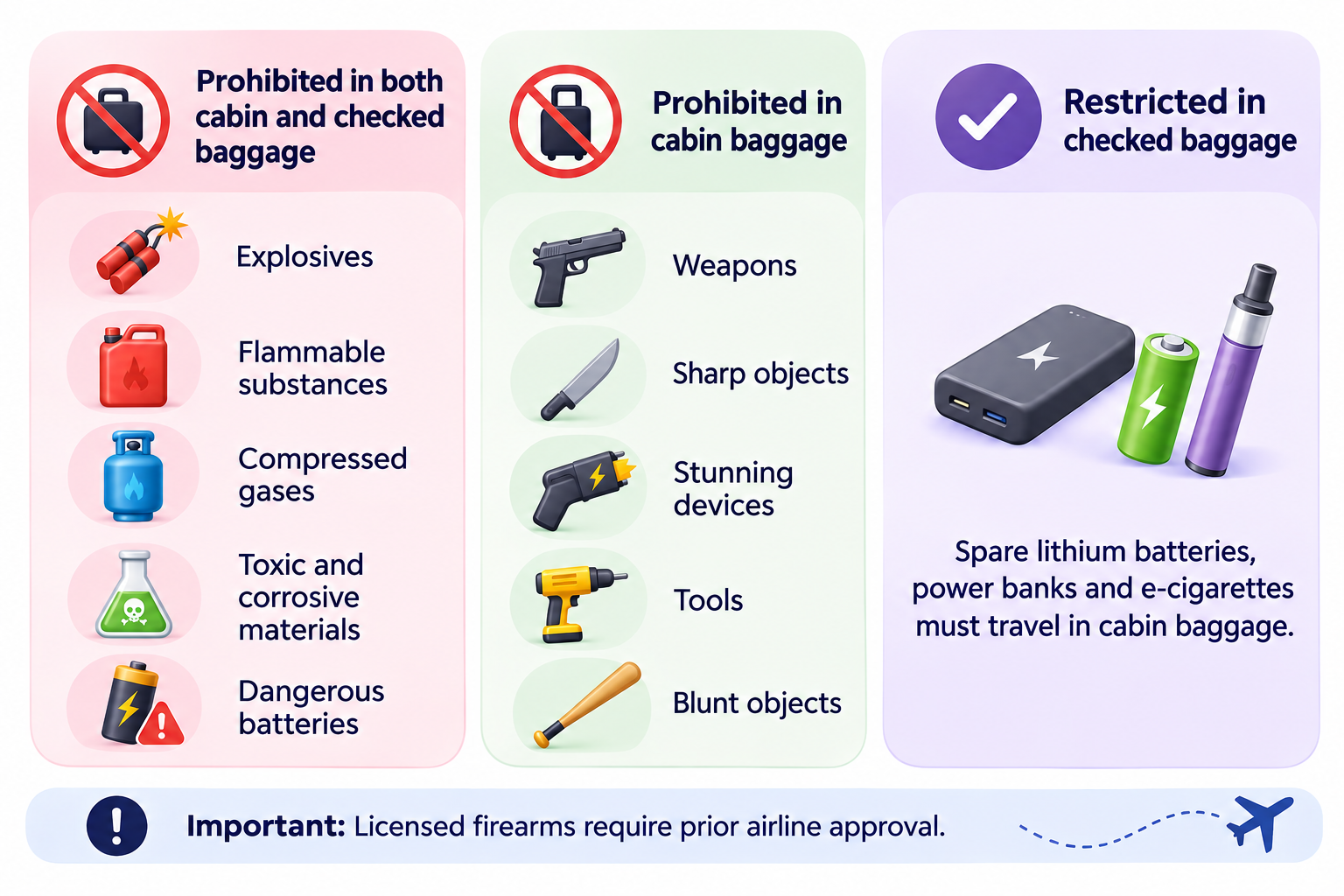
The Nigeria Civil Aviation Authority (NCAA) restricts items that could threaten passenger safety, cause fires or interfere with aircraft security. Some are prohibited in both cabin and checked baggage, while others cannot be carried in hand luggage but may travel in checked baggage under specific conditions. The main categories include:

Graphic of item categories restricted on Nigerian flights.

1. Prohibited in both cabin and checked baggage

  • Explosives: Fireworks, firecrackers, grenades, gunpowder, detonators and flares.
  • Flammable substances: Petrol, diesel, kerosene, lighter fluid, paint thinners and other highly flammable liquids.
  • Compressed gases: Butane, propane, camping gas and certain dangerous aerosols.
  • Toxic and corrosive materials: Acids, poisons, pesticides, bleach, chlorine and radioactive substances.
  • Dangerous batteries: Damaged or recalled lithium batteries and certain high-risk electronic devices.

2. Prohibited in cabin (carry-on) baggage

  • Weapons: Firearms, ammunition, replica guns, bows, arrows and slingshots.
  • Sharp objects: Knives, scissors with blades over permitted limits, razor blades, axes and box cutters.
  • Stunning devices: Tasers, stun guns and incapacitating sprays.
  • Tools: Drills, saws, hammers, crowbars and long-shaft screwdrivers.
  • Blunt objects: Baseball bats, clubs and martial arts equipment.

3. Restricted in checked baggage

Spare lithium batteries, power banks and e-cigarettes must generally travel in cabin baggage, with terminals protected against short circuits.

Important: Licensed firearms require prior airline approval and special handling. Liquid restrictions also vary by route and airport. Check the NCAA's 2023 Civil Aviation Regulations, particularly Parts 15 and 17, and confirm your airline's requirements before travelling.

What can go in hand luggage on Nigerian flights?

Hand luggage is for items you may need during your journey, such as your phone, laptop, medication, and travel documents. However, not everything can go into the cabin. Nigerian aviation security rules place restrictions on liquids, batteries, sharp objects and other potentially dangerous items. Knowing what is allowed helps you pack correctly and avoid having belongings confiscated at security.

1. Liquids, aerosols and gels

You can carry toiletries, creams, perfumes, toothpaste and other liquids in your hand luggage, subject to airport security limits.

  • Each container should hold no more than 100 ml.
  • All containers should fit inside one transparent, resealable plastic bag with a capacity of up to one litre.
  • Prescription medicines and essential baby food may receive special allowances, subject to screening.

These restrictions are particularly important for international flights. For more examples of liquids and other restricted items, see Grey's guide to items banned on a plane.

2. Batteries and electronic devices

Laptops, mobile phones, tablets, digital cameras and other personal electronic devices can generally travel in your cabin bag. Spare lithium batteries and power banks must also go in hand luggage rather than checked baggage.

  • Batteries up to 100Wh are generally permitted.
  • Batteries between 100Wh and 160Wh require airline approval.
  • Batteries above 160Wh are generally prohibited.

Protect spare battery terminals against short circuits. Damaged or swollen batteries should not be carried.

3. Items that must stay in your hand luggage

Some items are permitted on board but cannot be placed in checked baggage due to fire risks or safety concerns. These include:

  • Power banks: Keep them in your cabin bag, with their terminals protected against accidental contact.
  • Spare lithium batteries: Carry them in hand luggage and protect exposed terminals.
  • E-cigarettes and vapes: Keep these in the cabin and never use or charge them during the flight.

What does Nigerian customs restrict on export?

The Nigeria Customs Service (NCS) maintains an export prohibition list covering certain agricultural products, raw materials and cultural items. These restrictions are designed to protect local industries, preserve natural resources, support food security and prevent the illegal removal of Nigeria's cultural heritage.

The main restricted export categories include:

1. Maize

Unprocessed maize grains are restricted from export to help maintain domestic food supply and prevent shortages.

2. Timber

Rough and sawn wood are prohibited under the export restrictions, helping to discourage deforestation and encourage local processing.

3. Raw hides and skins

Unprocessed animal hides and skins, including wet blue leather and other unfinished forms, fall under export restrictions.

4. Scrap metals

Ferrous and non-ferrous metal scraps cannot be freely exported, as the restriction supports local recycling and manufacturing industries.

5. Unprocessed rubber

Raw rubber latex and rubber lumps are restricted to encourage domestic processing and value addition.

6. Artefacts and antiquities

Cultural objects and historical artefacts cannot be exported without the necessary government authorisation and clearance.

How much currency can you carry out of Nigeria?

You can carry foreign currency worth US$10,000 or more (or its equivalent in other currencies) out of Nigeria, but you must declare it to the Nigeria Customs Service (NCS). The declaration threshold applies to cash and relevant negotiable instruments. Declaring your money does not automatically mean you cannot travel with it. However, additional information and supporting documents may be required, particularly for larger amounts.

How to declare foreign currency at the airport

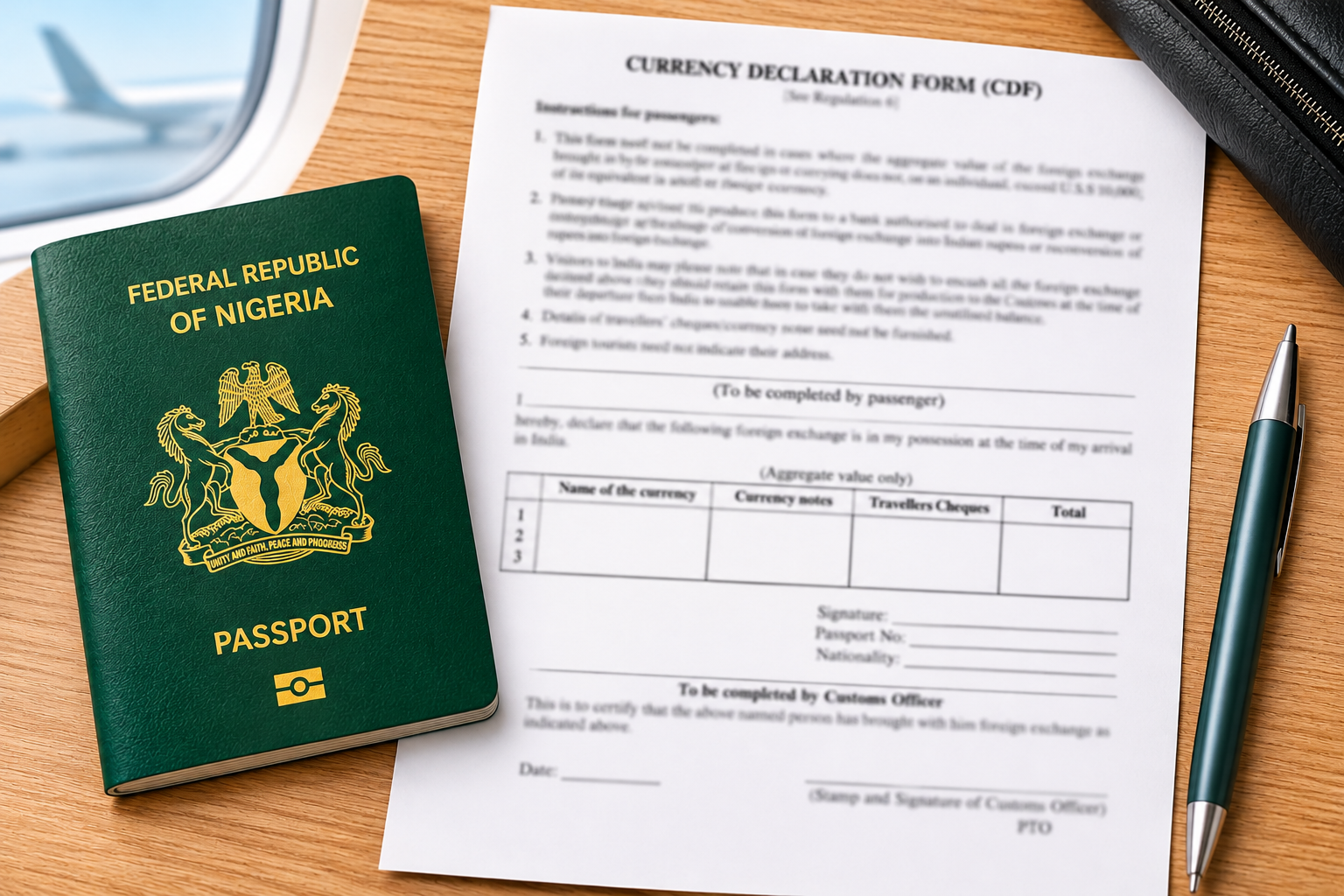
Currency declaration form next to a Nigerian passport.

Nigeria Customs now provides an Electronic Currency Declaration Form (e-CDF) for travellers carrying amounts at or above the reporting threshold.

  1. Complete the online form: Visit the NCS Electronic Currency Declaration portal and enter your travel details, passport information and the amount of each currency you are carrying.
  2. Submit your declaration: Review your information, confirm that it is accurate and submit the form.
  3. Save your acknowledgement: Keep your declaration reference number or acknowledgement slip.
  4. Visit Customs at the airport: Present yourself and your declaration reference to a Customs officer for physical verification. Your declaration remains pending until validated.
  5. Provide supporting documents: Bring relevant bank withdrawal slips, transaction records or other evidence showing the source of the funds, where requested

You can also avoid the inconvenience of travelling with large amounts of physical dollars by using a virtual USD account with Grey. This offers a more convenient way to access your foreign earnings without needing to withdraw and travel with physical currency.

Moving money instead of carrying cash

Carrying large amounts of cash across borders is not the only way to access your money abroad. Bank transfers and digital payment services allow you to move funds internationally without physically transporting banknotes. They also provide transaction records that help establish the source of your money when required.

Traditional SWIFT transfers typically take 1–5 business days, while digital transfers can arrive within minutes or a few business days, depending on the destination and payment method.

Instead of travelling with physical dollars or pounds, you can keep your money in a foreign currency account and transfer it when needed. A traditional domiciliary account lets you receive, hold and send foreign currencies such as USD, GBP and EUR through a Nigerian bank. This means you can keep your earnings in their original currency rather than converting everything to naira immediately.

Grey offers another way to manage foreign currency without the usual bank visits and account-opening processes associated with traditional domiciliary accounts. You can open virtual USD, GBP and EUR accounts online, receive international payments, hold multiple currencies and convert your money when you need it. You can also send money directly from Nigeria to the UK, making it easier to manage international payments without carrying physical cash.

Frequently asked questions about prohibited items on flights in Nigeria

1. What is banned in hand luggage on Nigerian flights?

Firearms, sharp objects, explosives, flammable substances, certain tools, blunt weapons and dangerous chemicals are prohibited in cabin baggage. Liquids, aerosols and gels in containers exceeding 100 ml are generally restricted on international flights. Always check your airline's specific baggage rules before packing, as some items may be allowed in checked baggage instead.

2. How much cash can you take out of Nigeria?

You can carry foreign currency worth US$10,000 or more, or its equivalent, but you must declare it to Nigeria Customs. The declaration threshold does not mean larger amounts are automatically prohibited. You may need supporting documents showing the source of your money, particularly when carrying substantial sums. Confirm the latest requirements before travelling.

3. Can you carry food out of Nigeria on a flight?

Yes, you can carry certain foods, particularly commercially packaged and properly labelled products, subject to airline and destination-country rules. However, fresh fruits, vegetables, meat, seeds and other agricultural products may face restrictions. Some Nigerian agricultural commodities are also subject to export prohibitions. Check the destination country's customs requirements before packing food.

4. Are power banks allowed on Nigerian flights?

Yes. Power banks are generally allowed in hand luggage but must not be placed in checked baggage. Those rated up to 100Wh are generally permitted, while batteries between 100Wh and 160Wh usually require airline approval. Protect their terminals against short circuits and check your airline's capacity limits before departure.

5. What happens if you carry a prohibited item?

Airport security may remove and confiscate prohibited items during baggage screening. Depending on the item and circumstances, you could face additional questioning, missed flights, fines or legal action. Carrying undeclared currency, illegal weapons or dangerous substances can have more serious consequences. Always check your luggage before leaving for the airport.

6. Do domestic and international flights have the same rules?

Both follow core aviation safety restrictions covering weapons, explosives, flammable materials and dangerous goods. However, international flights may have additional requirements involving liquid limits, customs declarations, agricultural exports and destination-country restrictions. Domestic routes may also have airline-specific baggage policies. Check both your airline's rules and applicable customs requirements before travelling.

Arrow (up)

Back to top