How much should I budget for a Dubai trip?
See how much a Dubai trip costs from five regions, with flights, hotels, activities and a budget range for each traveller. Compare.
Tunde Aladeloba
•
November 5, 2026
•
2 min read


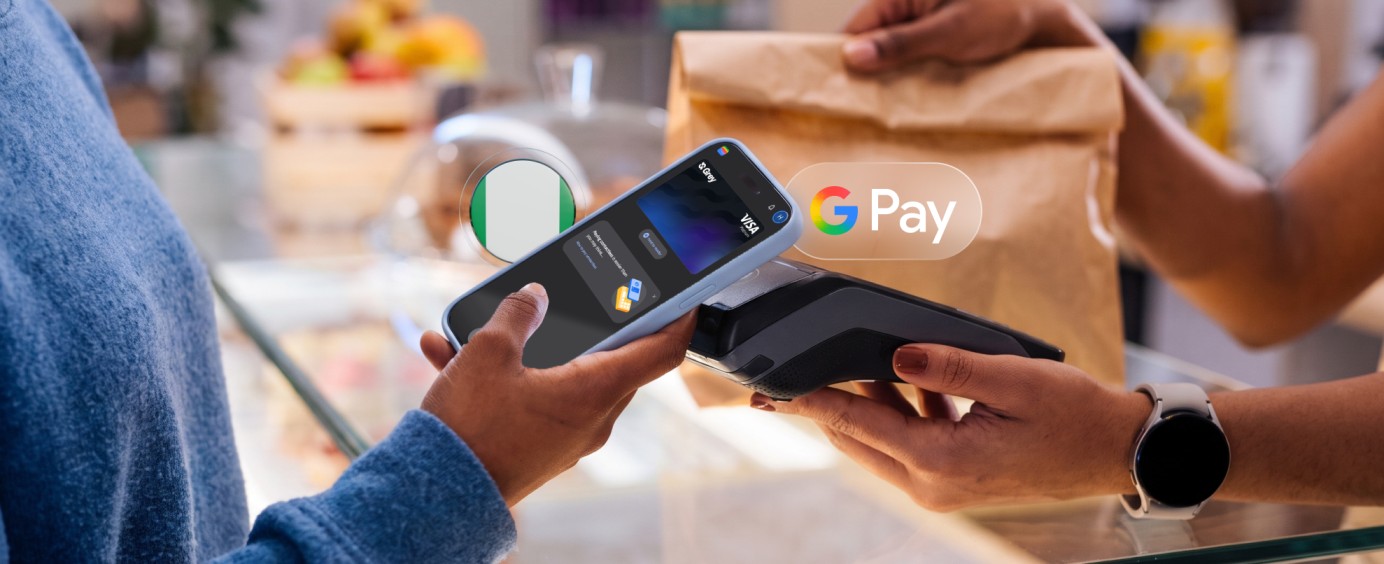
Google Pay is live in Nigeria. See which banks and cards work, how to set it up, and where you can actually pay with it. Get started.

Olayoyin Olorunmota
•
10 min read
Google Pay launched in Nigeria on 28 October 2026, through the Google Wallet app on Android. Google’s current list covers eligible cards from five banks: FirstBank, GTBank, Providus Bank, UBA, and Zenith Bank, mostly Mastercard. Verve, AfriGO, and cards from banks like OPay, Moniepoint, Kuda, and PalmPay are not on it, and contactless terminals remain limited.
Whether tapping works depends on three things: your card, your phone, and the terminal. This guide takes them in that order, then covers what to do if your card is not supported.
Yes. Google launched Google Wallet, including Google Pay, in Nigeria on 28 October 2026 for Android and Wear OS users. Google says it lets you pay by tapping in stores, in apps, and online, using a card stored on your phone.
Both names cause confusion, so here is the difference. Google Wallet is the app that holds all your payment cards and can also store loyalty cards, event tickets, and boarding passes. Google Pay is the payment function inside it, the part that passes your card to a terminal or a checkout page. You install one app, add a card, and pay with Google Pay.
Unfortunately, Google Pay won’t work for everyone. Three things have to line up:
The next section covers the first of these: the banks and cards.
The table below follows Google’s Nigeria payment methods page, as at the time of publishing.
An account at a listed bank is not enough. Google has stressed that your bank decides whether its cards work with Google Wallet. The card network (Mastercard or Visa) and the card type (debit, credit, or prepaid) both count. A bank that issues Mastercard and Verve cards may support one but not the other, so find your bank’s row, then check the network and card type you hold. Both are usually shown on the card itself or in your banking app.
What is not supported:
If your card is not covered, the section below on unsupported cards outlines your options.
You need an Android phone, a screen lock, and a card from the table above. For tapping in stores, the phone also needs NFC. Google Wallet generally requires a recent version of Android, so update your phone first if it is running an older version.
If the verification message does not arrive, or the card is declined, call the number on the back of the card. Google's page says to contact your bank when a card cannot be set up for mobile payments.
Virtual cards go in the same way. Grey's guide on how to add a virtual card to Apple Pay or Google Pay covers it in more detail.
If your bank card is not on Google's list, a Grey virtual dollar card is another card you can try in Google Wallet. Grey's guide says its virtual cards can be added to Google Wallet on Android, and that Google Pay accepts virtual debit cards on the Mastercard and Visa networks as long as the issuer supports it. Google decides which countries and cards Wallet supports, so availability can vary by region.
What you need: an active, funded Grey virtual card and an Android phone with a screen lock. A frozen or expired card, or one with a $0 balance, can fail verification.
Adding a card to Google Pay is free. Any fees come from the card issuer.
What it is good for
A Grey virtual card holds US dollars, so it suits payments priced in dollars:
It is a dollar card, so it does not replace a naira bank card for everyday spending in Nigerian shops. For that, a card on Google's list is the simpler fit.
You can get a Grey virtual card from the app, and fund your card from a USD balance so it is ready when you need to pay.
Fees and rates: a Grey virtual card costs $5 to create, once, with no monthly fee. Payments on non-US websites can carry a cross-border fee of 2% plus $0.50. If you fund the card from a non-USD balance, currency conversion applies, and Grey's exchange rates vary with a margin over the mid-market rate. See grey.co/pricing for current fees.
Online checkout is the realistic use for most people right now. Tapping in stores is possible, but only at terminals that support it, and those are still uncommon.
Online. Paystack has offered Google Pay at checkout for Nigerian merchants since September 2026, and Interswitch's payment gateway supports it too. Each merchant has to switch it on, so you will not see it at every shop. A business turns it on in its Paystack dashboard, and Paystack's help page lists the requirements. Paystack supports Visa and Mastercard for Google Pay, and the option appears only when your device, browser, card, and Wallet setup all support it. If a checkout shows no Google Pay button, the cause is usually one of those four, or the merchant has not enabled it.
In apps. Some apps offer Google Pay at the payment step. The same rule applies: the app has to support it, and your card has to be on Google's list.
In stores. Tapping needs two things: a phone with NFC and a terminal with contactless enabled. Many point-of-sale terminals in use today lack the hardware, and contactless is still a very small share of payments in Nigeria. Even at a terminal that accepts taps, your bank's fraud systems have to recognise the payment, or it may be declined.
How to tell whether a terminal will work:
A practical rule is to use Google Pay online first and treat tapping in stores as a bonus where the terminal supports it. Keep a physical card or cash with you either way.
Your card may not be on Google's list. What you do next depends on what you wanted to pay for.
If you want to use the tap-to-pay feature with your card, you may need to wait for your bank to be added or switch to a supported card type. Google’s list can change, and your bank decides which card types are enabled. If you are trying to pay while shopping online, enter your card details as usual. Google Pay is a quick checkout option. If your transaction is in dollars, a virtual dollar card is a better fit, as it is designed for international dollar payments.
Waiting for your bank. The list was shorter at launch than it is now, so more banks and card types may follow. There is no published timetable, so do not plan around it.
Switching to a supported card type. If you bank with one of the five listed banks but hold a Verve or Visa card, ask whether the bank can issue a Mastercard debit or prepaid card. Then check that exact type against Google's list. This keeps you paying from your naira account.
Using a virtual dollar card. For international online payments, Google Pay is rarely the blocker, because you can type a card's details at any checkout that accepts it. A virtual dollar card gives you a dollar card number for those payments. To compare your choices, read about free virtual dollar cards and how to get a virtual dollar card in Nigeria. A dollar card does not replace a naira bank card at home. If you also need to move money between Nigeria and another country, you can send and receive money in Nigeria with Grey.
Fees apply to Grey virtual cards, including a one-time $5 creation fee, and currency conversion can add cost. See grey.co/pricing for current fees.
Yes. Google launched Google Wallet, including Google Pay, in Nigeria on 28 October 2026 for Android and Wear OS. It works only with cards on Google's list, and only at online shops and terminals that support it.
Google's list currently shows First Bank of Nigeria, GTBank, Providus Bank, UBA, and Zenith Bank. Support depends on the specific card, mostly Mastercard debit, credit, or prepaid. The table in this guide shows the exact types for each bank, and the list can change.
The most likely cause is that the card is not on Google's list, or your bank has not enabled that card type. Verve and AfriGO cards are not supported. Other causes are a missing screen lock, an unfinished verification step, or a bank fraud check that blocked the payment. Call the number on the back of your card and ask the bank.
Only at terminals with contactless enabled, and many terminals in Nigeria lack the hardware. Your phone also needs NFC. Look for the contactless symbol, and keep another way to pay.
Not at the moment. Cards from Kuda, OPay, Moniepoint, and PalmPay are not on Google's list. Check the list again later, because it can change. For dollar payments online, a virtual dollar card is another option.
Not exactly. Google Wallet is the app that stores your cards, tickets, and passes. Google Pay is the payment function inside it. You install Google Wallet, add a card, and pay with Google Pay.
Paying for things abroad? Open a Grey account and get a virtual card for online payments.

See how much a Dubai trip costs from five regions, with flights, hotels, activities and a budget range for each traveller. Compare.
Tunde Aladeloba
•
November 5, 2026
•
2 min read
You’ve been saying “Let’s go to Dubai,” and now you have found the hotel with the skyline view, saved a few desert safari videos, and added the Burj Khalifa to your itinerary. Then you start adding up the costs. How much money do you actually need for a week in Dubai?
One week in Dubai can cost from around $1,500 to $4,000 per person for budget and mid-range travel, while luxury holidays can exceed $6,000. How much you’ll spend depends on how you like to travel, where you stay, when you visit, how you get around, and which experiences make your list.
Accommodation is often one of the biggest expenses, especially during popular travel periods. Activities such as desert safaris, observation decks and theme parks can also add up quickly. You will also need to include the costs of food, getting around, shopping, and airport transfers in your budget.
The good news is that Dubai offers options for different budgets. This guide breaks down the main expenses so you can estimate your Dubai trip cost, decide where to spend and plan a holiday you can enjoy without straining your finances.

For a one-week Dubai holiday, your budget will largely depend on where you stay, what you eat and the activities you choose. You might want to spend your days walking around the city, or you might prefer a healthy mix of day and nightlife. Budget travellers may spend around 1,500–2,200 per person, while a mid-range holiday can cost 2,500–4,000. Luxury trips can exceed $6,000. These estimates exclude or may vary with flights, depending on where you’re travelling from.
Here’s where most of your money goes:
Before booking, decide which experiences matter most and set your spending limits. A guide to planning a trip on a budget can help you organise your expenses before you travel.
A seven-day trip to Dubai from the USA can cost around 2,000–4,000 per person, depending on your hotel, activities and travel dates. For a realistic Dubai trip budget, start by estimating your flights and accommodation, then add daily spending. Return flights from the USA may cost 700–1,400, depending on your departure city and season.
Here’s a mid-range estimate for one person:
These estimates use approximately AED 3.67 to $1. Hotel prices and daily spending vary with your travel style and location. If you are traveling for holidays, you might want to consider moving your budget to accommodate higher prices.
A four-day trip to Dubai from North America can cost around $1,700–$3,400 per person, depending on your departure city, travel dates and choice of accommodation. Return flights from the USA or Canada may cost $800–$1,500, depends on what city you are flying from.
Use this mid-range Dubai trip estimate for one person
These estimates use an approximate exchange rate of AED 3.67 to $1. Your final costs will depend on flight prices, hotel location and the attractions you decide to visit.
If you’re travelling to Dubai from Europe, your total costs will depend on your departure city, travel dates and choice of accommodation, as major cities in Europe offer direct flights. For this estimate, we’re considering a four-day trip for one person traveling from a country like Germany or the Netherlands.
Return flights may cost around €200–€600. A mid-range hotel costing AED 350–500 per night would cost approximately €340–€485 for four nights, while food and transport at AED 150–400 daily would add about €145–€390.
These estimates use an approximate exchange rate of €1 to AED 4.12. Keeping funds in euros can help you plan your spending before converting money for your trip.
For many African travellers, a trip to Dubai offers a different kind of holiday, from seeing the world’s tallest building to shopping at the Dubai Mall to driving out into the desert to see the sand dunes. While cities like Nairobi and Accra have their own beautiful beaches, wildlife safaris and cultural festivals, Dubai offers a mix of modern attractions, desert adventures and luxury experiences in one city.
For this example, we're considering a four-day trip for one person travelling from cities such as Lagos, Nairobi, Accra or Johannesburg. Your final Dubai trip budget will depend on your flight route, hotel and planned activities.
Brazil and the UAE established diplomatic relations in 1974 and have maintained them since; today, direct flights connect São Paulo and Rio de Janeiro to Dubai. The route gives travellers from Brazil easier access to Dubai's shopping districts, gold souks desert safaris, modern architecture and luxury experiences.
For this estimate, we're considering a four-day trip for one person travelling from South America. Your Dubai trip budget will depend on your departure city, flight choice and activities.
Planning a Dubai trip means deciding where to spend and where to save. You could stay in a budget hotel, eat at local cafés and visit the Burj Khalifa's observation decks, or choose luxury accommodation, fine dining and a premium desert safari. The Burj Khalifa offers views across Dubai from levels 124 and 125, while higher-tier experiences include access to level 148.
The table below provides an estimate for three nights of accommodation and food and activities over four days. Prices are indicative and may change by season, provider and ticket availability.

A desert safari, dinner overlooking the Dubai Fountain and a shopping trip to Dubai Mall can quickly stretch your budget. Set aside money for your must-do experiences, then decide how much you can spend on food, transport and shopping each day.
Before you leave, Grey can help you move money before you travel so you can prepare your funds instead of waiting until you arrive to sort out payments.
For shopping, restaurant bills and online bookings, you can spend dirhams on a virtual card wherever the card is accepted. If you're researching your options, this guide to virtual dollar cards in the UAE can help you understand what to consider when choosing a card for international payments.
Finally, stay connected as soon as you arrive by sorting out a travel eSIM before you leave. This will make it easier for you to use maps around the city and search for tours you’d like to join without relying entirely on public Wi-Fi. Don’t forget to check coverage and data limits before buying.
A one-week Dubai trip can cost around 800–1,500 on a budget or 2,000–4,000 for a more comfortable holiday, depending on whether flights are included. Hotels, meals, transport and attractions will shape your final bill.
Dubai can be expensive, especially if you choose luxury hotels, fine dining and premium attractions. However, budget hotels, local eateries, public transport and free beaches can make the city more affordable without missing its main attractions.
For daily spending on food, transport and activities, consider around AED 300–600 on a budget or AED 900–1,600 for a mid-range experience. Keep hotel costs separate if already paid, and allow extra for shopping and unexpected expenses.
May to September often brings lower hotel prices because of the extreme heat. If you prefer cooler weather, consider visiting around the shoulder periods and compare hotel rates before booking. Winter is popular, so accommodation can cost more.
Visa requirements depend on your nationality and passport. Some travellers can enter visa-free or obtain a visa on arrival, while others must apply before travelling. Check the UAE’s official entry requirements before booking your flights.
A Dubai desert safari can cost around AED 150–400 per person for a standard shared experience, depending on the package. Premium tours with private transfers, better dining and VIP seating cost more. You’ll need to compare providers before you pay.

Learn how to send money from Europe to India by app or bank transfer, with EUR to INR fees, speed and limits explained. Find the cheapest route. Send now.
Priscila Marotti
•
November 4, 2026
•
2 min read
Here's a question: if you send €500 from Germany to India today, how much will your family actually receive? You'd think there would be one simple answer, but check a few money transfer apps and you'll probably get three different amounts.
And if you're regularly sending money from Europe to India, those differences matter. Every euro spent on transfer fees or conversion charges is money your family could be receiving instead.
So, if you're wondering how to send money from Europe to India, this guide will help you compare transfer methods, understand the fees, find the cheapest way to send money and make sure more rupees reach your recipient.
Quick answer: The easiest way to send money from Europe to India is usually through a transfer app that supports Indian bank deposits or UPI payouts. Create an account, verify your identity, enter the amount, review the exchange rate and fees, then confirm. Transfers may arrive within minutes or take several working days, depending on the provider.
For most people, a money transfer app offering Indian bank deposits or UPI payouts is a convenient option. You can usually see how many Indian rupees (INR) the recipient will receive before confirming.
Traditional bank wires are another option, particularly for larger payments, but may involve additional charges and longer processing times.
Grey, for example, supports INR payouts to Indian bank accounts and UPI IDs. You can manage supported foreign currencies in your account and review the exchange rate, fees and final amount before sending. Available options depend on your location and account eligibility.
You can also compare the best apps to send money internationally or check how to send money from the UK to India if you're based in Britain.
Also read: What is the best app to send money to India from the US?
You can send money from Europe to India in six steps using a provider that supports Indian bank transfers or UPI payouts.
Check which services operate in your country and support payments to India. Fees and funding methods can differ between Germany, France, Ireland and other European countries.
If you're based in Germany, for example, check the available options to send money from Germany to India.
Sign up and complete the required identity checks. You'll usually need personal details and a valid identity document. Larger transfers may require additional verification.
Choose your sending currency, usually EUR, and enter how much you want to transfer. Check the estimated INR amount alongside the exchange rate and fees.
For an Indian bank transfer, you'll generally need the recipient's name, account number and IFSC code. If UPI is supported, you may be able to use an eligible UPI ID instead.
Grey supports both payout methods for eligible INR transfers. Your recipient doesn't need a Grey account, but their bank details or UPI ID must be correct.
Check the exchange rate, fees, recipient amount and estimated delivery time.
With Grey, you can review these details in the app before authorising the transfer through the required security verification.
Keep the transfer confirmation and follow its status in the app. Some transfers arrive within minutes, while others take longer because of bank processing or verification checks.
If you regularly earn in euros, you can also check whether you're eligible to open a euro account with Grey and receive supported EUR payments through SEPA.
The cost of sending money to India comes down to three things: the transfer fee, the exchange rate and any additional charges.
A service advertising a €0 transfer fee isn't necessarily cheaper than one charging €4. The exchange rate can change how much your recipient actually receives.
Some providers offer a rate below the reference EUR to INR exchange rate. The difference is called the exchange rate margin, and it affects the amount delivered even when the transfer itself is advertised as free.
Imagine the reference rate is €1 = ₹100. This is an illustrative example, not a live exchange rate.
Despite charging €4, Provider B delivers ₹600 more.
That's why the cheapest way to send money from Europe to India is to compare the final INR amount rather than the advertised fee alone.
Grey's published USD-to-INR pricing includes a 1% conversion fee without a percentage-fee cap. Its withdrawal-fee guidance also lists a $1.50 fee for eligible INR bank and UPI payouts.
For example, converting $500 from USD to INR would cost $5 in conversion fees. Including the listed $1.50 payout charge, the combined fees would be $6.50, excluding funding costs and any exchange rate difference.
If you receive euros into Grey through SEPA or SEPA Instant, the published deposit fee is 0.8%, with a €2 minimum and €10 maximum.
These charges apply to different transactions. The USD-to-INR fee shouldn't be treated as the price of a direct EUR-to-INR transfer, so check the available route and final quote in your account.
Grey's published US-to-India information also lists limits of ₹450,000 per bank transfer and ₹100,000 per UPI transfer. Limits for European corridors may differ.
If you're based in the Netherlands, you can check how to send money from the Netherlands to India and compare the available quote.
Sending money home? Send money from Europe to India with Grey and check the available exchange rate, fees and payout options before confirming.
You may find providers offering fee-free transfers, but that doesn't always mean there are no costs.
Some offer introductory promotions, while others include their charges in the exchange rate. A provider offering ₹99 per euro will deliver less than one offering ₹100, even if neither charges a transfer fee.
If you're looking for how to send money from Europe to India without charges, compare the total amount paid with the rupees delivered.
With Grey, for example, check the applicable conversion and payout fees. If you first need to fund your account, include any deposit charges too.
Money sent from Europe can arrive in an eligible Indian bank account or, where supported, through a UPI payout.
For non-resident Indians (NRIs), the type of receiving account can also matter.
A Non-Resident External (NRE) account allows eligible NRIs to hold funds received from abroad in Indian rupees.
Permitted overseas remittances can generally be deposited into an NRE account, and the funds are repatriable under applicable rules. Interest is generally exempt from Indian income tax while the account holder meets the relevant eligibility conditions.
A Non-Resident Ordinary (NRO) account is commonly used to manage income arising in India, including rent, dividends and other eligible payments. It can also receive permitted overseas remittances.
Interest earned on NRO accounts is generally taxable in India. Repatriation is subject to applicable rules, documentation and tax compliance. Certain eligible remittances fall under a USD 1 million annual limit per Indian financial year.
The Reserve Bank of India provides further guidance on NRE and NRO accounts.
UPI allows payments to eligible Indian bank accounts using a linked UPI ID. Some international transfer services, including Grey, support UPI payouts for eligible INR transfers.
This means you may be able to send money without entering the recipient's full bank details. However, the receiving account must be eligible, and provider-specific limits apply.
Grey's published US-to-India corridor information lists a ₹100,000 UPI transfer limit, but you should check the limit applicable to your own sending country and account.
Money received from overseas isn't automatically taxable. The treatment depends on the purpose of the payment, the relationship between sender and recipient, and the recipient's tax circumstances.
Qualifying gifts from specified relatives are generally exempt, while income from work, business or investments may be taxable. Other gifts may also be taxable depending on the amount and circumstances.
For larger transfers or complex situations, consider speaking with a qualified tax professional.
The cheapest option is the provider that delivers the highest INR amount for the same total cost. Compare transfer fees, exchange rates and additional charges. A zero-fee transfer may still cost more through the exchange rate.
Transfers can arrive within minutes or take several working days, depending on the provider, payout method and bank processing. Grey supports eligible INR transfers that may arrive within minutes, although verification and banking delays can affect delivery.
Yes, some international transfer services support UPI payouts to eligible Indian bank accounts. Grey also supports UPI payouts for eligible INR transfers. Check availability for your sending country before confirming.
An NRE account is generally suited to eligible NRIs holding overseas earnings in India. An NRO account is commonly used for income arising in India. Both can receive permitted overseas remittances, but their tax and repatriation rules differ.
Limits depend on the provider, sending country, payout method and verification requirements. Grey's published US-to-India limits are ₹450,000 for bank transfers and ₹100,000 for UPI payouts. European corridor limits may differ, so check your account before sending.
Not necessarily. Qualifying gifts from specified relatives are generally exempt from Indian income tax, while payments for services, business activities or investments may be taxable. The recipient's circumstances determine the treatment.

See the real cost of living in Dubai, from rent and bills to food, transport and school fees. Honest ranges, not single figures. Start budgeting.
Priscila Marotti
•
November 4, 2026
•
2 min read
Dubai attracts people from all over the world with its career opportunities, international lifestyle and tax advantages. For Nigerians considering a move, the possibility of earning in a stronger currency can be particularly appealing. But how much of that salary will actually be left after paying for everyday life?
The cost of living in Dubai varies considerably depending on where you live, how you get around and your family size. Rent is usually the biggest expense, followed by groceries, transport, utilities and, for families, schooling.
A single person might spend AED 5,000 to AED 10,000 per month, including rent, while a family of four could need AED 15,000 to AED 30,000 or more. These are planning estimates rather than fixed costs, and your actual budget will depend heavily on your housing choices and lifestyle.
Here's a closer look at what you can expect to spend each month, from finding an apartment to managing your money and sending some of your earnings back home.
There's no single answer to how much you need to live in Dubai. You could share an apartment, take the metro to work and keep your monthly spending fairly modest. Or you could rent your own place in Dubai Marina, drive everywhere and enjoy the city's restaurant scene. Naturally, those two lifestyles come with very different price tags.
To help you work out where your budget might fall, here's a look at typical monthly expenses for a single person and a family of four.
These are approximate monthly costs converted from AED to USD. Actual expenses vary depending on location, lifestyle and household needs.
For a rough USD comparison, AED 1,000 is approximately $272, based on the UAE dirham's longstanding peg to the US dollar. This is a general conversion guide, not a live exchange rate.
What does this mean for your salary?
If you're moving to Dubai for a job paying AED 8,000 per month, renting a private apartment in an expensive neighbourhood could leave very little room for savings. Sharing accommodation or living farther from the city centre might make that salary more comfortable.
Someone earning AED 15,000 could have greater flexibility, although the amount left over will still depend on rent, lifestyle and financial responsibilities.
For families, the calculation becomes more complicated. School fees, larger homes and additional healthcare costs can quickly change what initially looks like a generous salary.
It's also important to consider the expenses involved in relocating. You may need money for a rental deposit, agency fees, furniture, transport and setting up utilities before receiving your first salary.
The official Dubai government portal provides information about residency, housing and everyday services that can help you prepare.
If you're considering staying in the UAE long term, you may also want to read about the UAE Golden Visa and the residency options available to eligible professionals and investors.
Housing will probably take the largest share of your monthly budget. The difference between renting a studio in an older residential neighbourhood and a waterfront apartment in Dubai Marina can amount to thousands of dirhams every month.
Dubai's rental market offers everything from shared rooms and compact studios to large villas in gated communities. Your choice will depend on your salary, workplace location, family needs and how much you're prepared to spend commuting.
Rent is likely to take up the biggest share of your monthly budget in Dubai, and prices can vary significantly between neighbourhoods. To give you a better idea of what to expect, here's a comparison of typical monthly rents for studios, one-bedroom and three-bedroom apartments in three popular areas, with prices in USD.
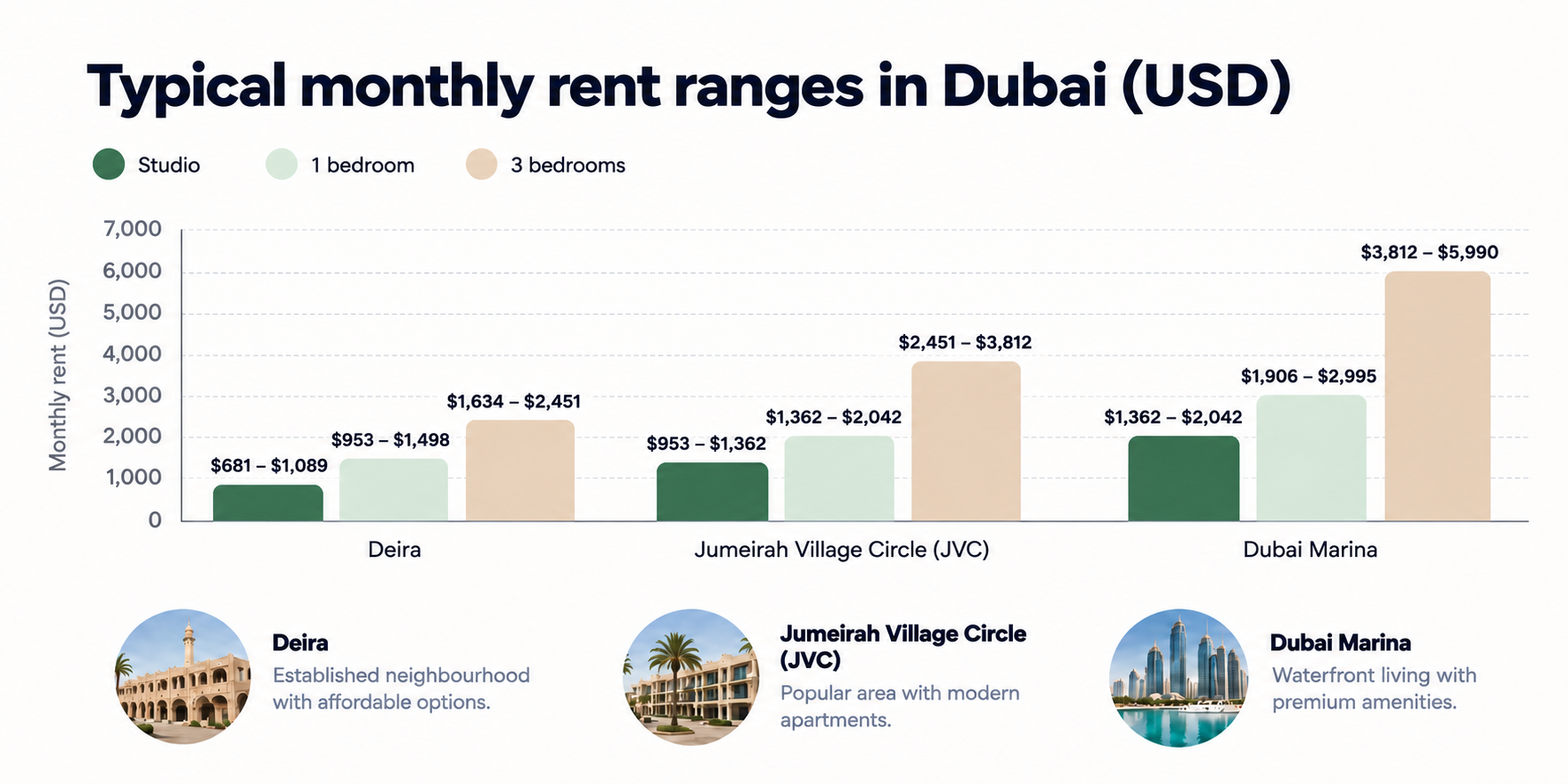
These are general costs for one person and may vary depending on your lifestyle and location.
Deira is one of Dubai's older, more established neighbourhoods. It offers access to shops, public transport and a variety of relatively affordable housing options. For newcomers working in central or older commercial districts, it can be a practical starting point.
Jumeirah Village Circle, commonly called JVC, attracts residents looking for newer apartments at prices that may be lower than those in premium waterfront locations. However, commuting can be less convenient without a car, depending on your building and workplace.
Dubai Marina offers a very different experience, with waterfront restaurants, modern residential towers and access to beaches and entertainment. That lifestyle comes with higher housing costs.
For someone moving to Dubai on a modest salary, shared accommodation can make a significant difference.
Instead of paying AED 5,000 for an entire apartment, you might rent a private room in a shared flat for considerably less. Prices depend on the neighbourhood, room size and facilities.
Before agreeing to share, check that the arrangement complies with local housing and occupancy regulations. You should also confirm exactly which bills are included in the rent.
Another detail worth knowing is that rent in Dubai is often advertised annually, even though people discuss their budgets monthly.
Landlords may request payment through one or several cheques rather than twelve equal monthly payments. That means you could need a substantial amount of money upfront, even if your monthly salary comfortably covers the annual rent.
You should also budget for a security deposit, possible agency fees, Ejari registration and utility connection charges.
For this reason, it's worth having enough savings to cover your first few months before relocating.
Beyond rent, your regular expenses will include electricity, water, internet, groceries and transport. These costs are easier to control than housing, but small lifestyle choices can still make a noticeable difference to your monthly budget.
For example, cooking most meals at home and using public transport could save you hundreds of dirhams compared with ordering food frequently and relying on taxis.
Dubai's climate makes air conditioning essential for much of the year, which means electricity bills can rise considerably during the hotter months.
Electricity and water services are provided by the Dubai Electricity and Water Authority (DEWA). The amount you pay depends on your consumption, property size and applicable housing charges.
Here's a rough guide to common monthly expenses:
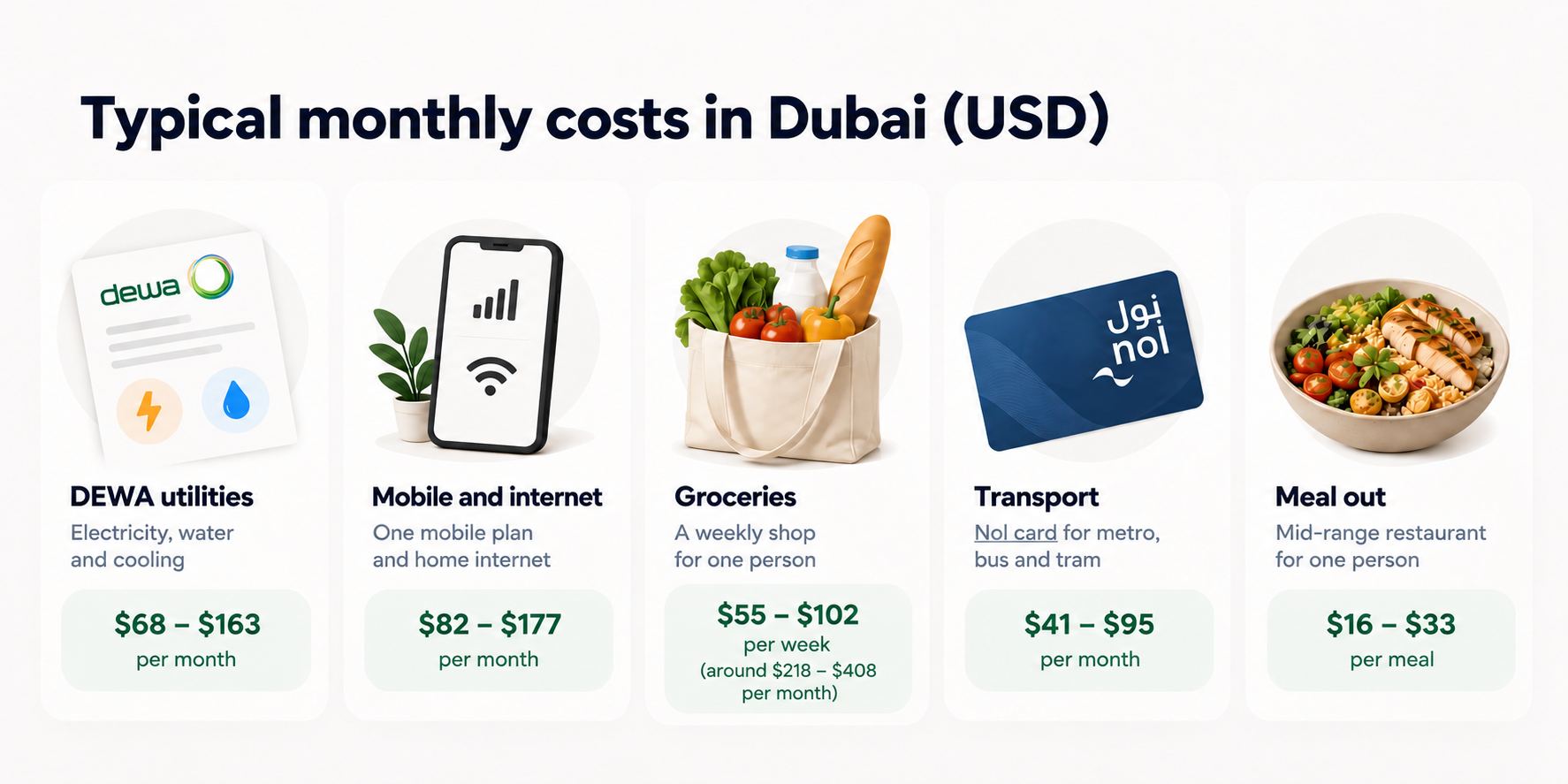
These are general costs for one person and may vary depending on your lifestyle and location.
When comparing apartments, ask whether the building uses a separate district cooling system. Some properties have additional cooling charges that aren't included in the regular DEWA bill.
Groceries in Dubai typically cost around $250 to $450 per month for one person, depending on shopping habits and food preferences. Supermarkets such as Carrefour and Lulu offer affordable everyday essentials, while imported products, including some Nigerian ingredients, can be more expensive. Eating out varies considerably, with simple meals costing around $10 to $15 and mid-range restaurants charging $20 to $40 per person.
Beyond food, entertainment expenses depend on your lifestyle, with cinema trips, beach clubs and other paid activities adding to your monthly budget. Dubai also has plenty of free options, including public beaches, parks and community events. Cooking at home, comparing supermarket prices and choosing affordable activities can help keep your spending under control.
Transport is another important consideration when calculating the living cost in UAE Dubai, particularly if your workplace is far from your accommodation.
Dubai has a public transport network that includes the metro, buses and trams. You can pay for journeys using a Nol card, with fares depending on the zones travelled and ticket type.
If you use public transport for a regular commute, budgeting approximately AED 150 to AED 350 per month is a reasonable starting point, although longer journeys and additional connections may cost more.
Taxis are convenient, especially during the hotter months, but using them daily can increase your transport expenses considerably.
Owning a car introduces additional costs, including fuel, insurance, registration, parking, maintenance and possible financing payments.
For someone living alone, choosing accommodation near a metro station could reduce the need for a car. Families, particularly those living farther from public transport routes, may find driving more practical.
If you regularly make purchases in foreign currencies, it's also worth understanding how to avoid foreign transaction fees when using your card for online purchases, travel or international subscriptions.
If you're moving with children, schooling and healthcare deserve their own place in your budget. These expenses can be substantial, and they aren't always covered by the benefits offered in an employment contract.
Dubai has a large private education sector, with schools offering British, American, Indian, International Baccalaureate and other curricula.
Fees vary significantly depending on the school, curriculum, facilities and year group.
For budgeting purposes, annual tuition might fall into the following broad ranges:
These ranges are indicative rather than official school fee quotations. Some schools charge outside these bands.
For a family with two children, school fees could become the second-largest household expense after rent.
It's also important to remember that tuition isn't the only cost. Uniforms, books, transport, school meals, extracurricular activities and registration fees may be charged separately.
Before accepting a job offer, check whether your employer provides an education allowance. Some companies offer benefits that cover part of their employees' children's school fees.
If you're comparing schools, look at the total annual cost rather than tuition alone. You should also consider the school's location, as a long daily journey could increase transport costs and affect your family's routine.
Health insurance is an essential part of living in Dubai.
Employers are generally responsible for arranging mandatory health insurance for their employees in Dubai. However, the level of coverage can vary, and dependants may need separate arrangements.
Before relocating, ask your employer what the insurance policy includes, particularly regarding hospital visits, specialist consultations, prescription medicines and maternity care.
For families, it's worth checking whether your spouse and children are covered and whether there are additional premiums or out-of-pocket expenses.
Private healthcare can be expensive without suitable insurance. Even with coverage, you may still need to pay consultation fees, deductibles or co-payments.
If you take regular medication or have specific healthcare needs, check whether your prescriptions and preferred healthcare providers are included in the insurance network.
Monthly budgets are useful, but they don't capture every expense involved in relocating.
You may need to pay for document attestation, medical tests, residency processing, flights and temporary accommodation. Depending on your employment arrangement, some of these costs may be covered by your employer.
Setting up your home can also require a substantial initial investment, especially if you're renting an unfurnished apartment.
For Nigerians moving to Dubai, keeping some money available in both AED and NGN can be useful during the transition. You may still have financial responsibilities in Nigeria while paying for your new life in the UAE.
It's worth building an initial relocation budget separately from your regular monthly expenses so you don't underestimate how much money you'll need before settling in.
Moving to Dubai can change how you earn, spend and save money, particularly if you continue supporting family members in Nigeria or working with clients in other countries.
You might receive your salary in AED, pay international subscriptions in USD, save in another currency and send money home regularly.
Keeping track of those transactions matters because exchange rates and transfer fees can affect how much money you actually have available.
If you earn in AED but have expenses in USD, GBP or EUR, converting money every time you need to make an international payment can become costly.
One way to organise your finances is to separate the money you need for everyday expenses from the money you intend to save or use internationally.
For example, you could keep enough AED in your local bank account for rent, groceries and transport while managing eligible foreign-currency payments through a separate account.
Grey offers multi-currency accounts that can help eligible users hold and send multiple currencies, including USD, GBP and EUR.
This can be useful if you work with international clients, receive payments from abroad or regularly manage expenses in different currencies.
However, Grey's available services, funding methods and transfer routes depend on your country of residence and account eligibility. You should confirm which features are supported for UAE residents before relying on them.
If you're supporting family members back home, remittances may be one of your most important monthly expenses.
Imagine you earn AED 12,000 per month and plan to send the equivalent of AED 1,500 to Nigeria.
That transfer should be included in your budget alongside rent, groceries and transport. Otherwise, you might overestimate how much money you can spend or save.
When comparing international transfer services, look beyond the advertised transfer fee.
The exchange rate matters just as much. A service might charge a small upfront fee but offer a less favourable exchange rate, reducing the amount your recipient receives.
It's also worth checking the expected delivery time, supported payout methods and any transfer limits.
Grey provides information about options to send money from the UAE, including its UAE-to-Nigeria money transfer route.
Before initiating a transfer, check the current availability, applicable fees and payout options for your account.
Once you understand your regular expenses, you can start deciding how much of your salary to allocate to spending, savings and financial responsibilities abroad.
For example, someone earning AED 12,000 (approximately $3,300)per month might organise their budget as follows:
This is an illustrative budget, not a recommendation that everyone should follow the same percentages.
Someone sharing accommodation might be able to save more. A person with children, a car or higher rent could have considerably less money available after paying their bills.
The important thing is to calculate your budget using the amount you actually receive, including any applicable deductions, and account for financial commitments in both countries.
You should also leave room for unexpected expenses. Medical costs, travel, family emergencies and annual payments can affect your finances even when your regular monthly spending seems predictable.
Dubai offers plenty of opportunities to earn and build an international career, but the amount you can save depends on how your income compares with your actual living expenses.
Before accepting a job offer, compare the salary with realistic housing costs, transport options, employer benefits and any financial responsibilities you have back home.
That will give you a much clearer picture of the lifestyle you can afford.
Manage money in Dubai with Grey and organise your international finances with access to eligible multi-currency account services.
A single person might need approximately AED 5,000 to AED 10,000 per month, including rent, while a family of four could spend AED 15,000 to AED 30,000 or more. The actual amount depends on accommodation, transport, schooling and lifestyle choices. Sharing accommodation and using public transport can help reduce expenses.
Rent varies considerably by neighbourhood and property size. A studio apartment might cost AED 2,500 to AED 7,500 per month, while a one-bedroom apartment could range from AED 3,500 to AED 11,000 in the areas covered in this guide. Larger family homes can cost considerably more. These are illustrative monthly equivalents, and actual rental prices change over time.
Dubai does not generally impose personal income tax on employment salaries, which is one reason it attracts international workers. However, that doesn't mean everything is tax-free. The UAE applies a 5% VAT to many goods and services, and other taxes or charges can apply depending on the activity. Personal tax obligations in another country may also depend on your tax residency and circumstances.
A family of four might budget AED 15,000 to AED 30,000 or more per month for a reasonably comfortable lifestyle. Housing, school fees and transport are usually among the largest expenses. Families with employer-provided accommodation, education allowances or health insurance may need less income to cover their regular expenses.
Dubai is generally more expensive than many Nigerian cities when comparing rent, schooling and everyday expenses in nominal terms. However, salaries, purchasing power and available benefits can also differ considerably. If you're relocating from Nigeria, compare your expected Dubai salary with your projected monthly expenses rather than looking at prices alone.
You can send money from Dubai through banks and authorised international money transfer providers that support transfers to your destination country. Before choosing a provider, compare exchange rates, fees, delivery times and payout options. If you're sending money to Nigeria, check that the service supports your preferred recipient bank or payment method and the currency you want your recipient to receive.
See how much a trip to Iceland costs from five regions, with flights, stays and daily spend, plus a budget range for each. Compare.
Priscila Marotti
•
November 3, 2026
•
2 min read
Nothing could have prepared me for Iceland. I'd seen countless photos of its waterfalls, glaciers, black sand beaches and volcanic landscapes, but seeing them in person was something else entirely. There were moments when I genuinely felt like I'd landed on another planet. But there's something else nobody prepared me for: the prices.
I knew Iceland was expensive. Everyone tells you that before you go. What I didn't realise was just how much I'd end up spending on simple things like a meal, getting around or a night in a hotel. And when you're surrounded by so many incredible places to explore, it's surprisingly easy to spend more than you planned.
If you're planning an Iceland trip, knowing what to expect financially can make a huge difference. Here's what you should budget for flights, accommodation, transport, food and activities, including how much Iceland trips cost when you're travelling from different parts of the world.
A one-week trip to Iceland costs roughly $2,000 to $4,500 per person. Iceland is expensive: budget travellers spend around $2,000 to $2,800, mid-range $3,000 to $4,500, and luxury $7,000 or more. Car hire, food, and tours drive the cost more than flights, which are often cheap from hub cities.
The first thing to understand about an Iceland trip cost is that getting there isn't necessarily the most expensive part. Depending on where you're flying from, you might find a relatively affordable flight to Reykjavík. It's what you spend after arriving that can catch you off guard.

Accommodation, restaurant meals, car hire and organised excursions are considerably more expensive than in many other European destinations. Even a fairly modest itinerary can become costly when you're travelling around the island.
For a seven-day trip, here's a reasonable starting point for your budget.
These are planning estimates, including flights, rather than fixed prices. Your departure city, travel season and whether you're sharing accommodation and transport can change the total significantly.
Summer tends to be particularly expensive because demand for accommodation and rental cars increases. Travelling in spring or autumn may offer better value, although weather conditions can be less predictable.
If you're still deciding how much you can comfortably spend, our guide on how to plan a trip on a budget can help you work backwards from your available money.
Travelling from the United States is relatively convenient, especially if you're flying from cities with direct connections to Keflavík International Airport, such as New York or Boston.
For a return flight, budget approximately $500 to $1,100, depending on your departure city, season and how far ahead you book. Flights from the East Coast can be considerably cheaper than those requiring a domestic connection.
Once you arrive, your main expenses will be accommodation, transport and food.
For a seven-day trip, a mid-range budget might look like this:
These estimates assume two people sharing a room and a rental car. Solo travellers should allow more for accommodation and transport.
You can reduce the total by staying in guesthouses, preparing some meals and choosing free attractions. Many of Iceland's most impressive waterfalls, beaches and viewpoints can be visited without paying for an organised tour.
If you're travelling from Canada or Mexico, the overall budget is similar to travelling from the United States, although flights may involve additional connections.
Return flights generally require a planning allowance of around $600 to $1,200. Toronto and Montréal can offer convenient connections, while travellers departing from Mexico may need to transit through the United States, Canada or Europe.

Once in Iceland, allow approximately $1,500 to $2,700 per person for a week of shared accommodation, car hire, meals and a few paid activities.
That brings the estimated total to $2,100 to $3,900 per person.
For travellers coming from Mexico, the exchange rate is another consideration. Your flights might be priced in Mexican pesos or US dollars, while most purchases in Iceland will be charged in Icelandic króna (ISK).
It's worth comparing the final price in your home currency, including any conversion or international card fees, before booking.
Europe-based travellers have one major advantage: shorter flights and, in some cases, much cheaper fares.
Return flights from cities such as London, Dublin, Paris or Copenhagen can sometimes be found for approximately €150 to €400, especially outside the busiest summer months. Travelling from southern or eastern Europe may involve longer journeys or connections.
But cheaper flights don't necessarily mean a cheap holiday.
Once you're in Iceland, you'll face the same accommodation, food and transport prices as everyone else. For a week, allow approximately €1,400 to €2,500 for your expenses in Iceland, assuming shared accommodation and transport.
Your total trip budget could therefore be around €1,550 to €2,900 per person.
If you're based in Europe, a shorter four or five-day trip can be a good alternative. You could explore Reykjavík, the Golden Circle and part of the South Coast without committing to a full week of expenses.
Travelling to Iceland from Africa usually requires more planning, as direct flights are limited and many itineraries involve connecting through European hubs.
For travellers departing from cities such as Lagos, Accra, Nairobi or Johannesburg, a return flight budget of approximately $700 to $1,400 is a useful starting point. Some routes, particularly from southern or eastern Africa, may cost more.
The expenses within Iceland remain similar: accommodation, food, transport and activities could add another $1,500 to $2,700 for a week.
That puts a typical seven-day trip at around $2,200 to $4,100 per person.
Before booking, check transit visa requirements for every country on your itinerary. A cheaper flight with a long European connection may not be the most practical option if additional documents or an overnight stay are required.
It's also worth allowing extra time between connecting flights, particularly if you're booking separate tickets.
For travellers coming from Brazil, Argentina, Colombia or other South American countries, flights will probably take up a significant part of the budget.
Most journeys require at least one connection, often through Europe or North America. Depending on your departure city and dates, return flights may cost approximately $1,300 to $2,200.
For a seven-day trip, you could budget:
These figures assume shared accommodation and car hire, with a mix of supermarket meals and restaurants.
Coming from Brazil, I would pay particular attention to flight connections and the overall journey time. Getting to Iceland can take a considerable amount of time, so it makes sense to stay long enough to enjoy the destination rather than rushing through everything in a few days.
If you're travelling that far, spending a little more time exploring the country may offer better value than squeezing everything into a short itinerary.
The flight ranges in these regional sections are indicative planning allowances, not verified live airfares for particular routes. The destination-cost estimates are informed by 2026 Iceland travel budgets and rental pricing. Actual quotes will depend on travel dates, availability and party size.
Looking at the total cost is helpful, but breaking it down by expense makes it easier to decide where to spend more and where to save.
Here's what you can expect to pay for some of the main expenses during an Iceland trip.
These are indicative 2026 planning ranges, not guaranteed booking prices. Certain services like car hire and accommodation are especially sensitive to season. The Blue Lagoon, for instance, uses dynamic pricing.
Accommodation is one of the biggest expenses, particularly during the summer. A hostel dormitory is generally the cheapest option, while guesthouses offer a useful middle ground between shared accommodation and hotels. If you're travelling with someone else, splitting a private room can sometimes work out better than paying for two hostel beds.
Booking early matters, especially in smaller towns along popular road-trip routes, where accommodation choices can be limited.
Iceland is a destination where having a car can make a huge difference to your experience. Some of the places I found most memorable were the landscapes along the road itself. Being able to stop at a waterfall, a viewpoint or a stretch of black sand whenever you wanted was part of the experience. However, hiring a car involves more than the daily rental price. You also need to consider insurance, fuel, parking and road charges.
Iceland introduced a distance-based road usage charge in January 2026, so check how your rental company includes this in its pricing.
A small car may be sufficient for popular routes during the warmer months, but some roads require a 4x4. Iceland's official tourism website provides useful information about driving conditions and choosing a rental car.
Food is another expense that can surprise you. Eating out for every meal can quickly become one of the most expensive parts of the trip, particularly if you're travelling for more than a few days. One way to manage this is to combine restaurants with supermarket meals. Stores such as Bónus and Krónan are popular options for groceries, snacks and ingredients for simple meals.
If your accommodation includes a kitchen, you can save considerably by preparing breakfast or dinner yourself. You don't have to avoid restaurants completely, just decide which meals you'd genuinely like to spend more on and budget accordingly.
One of the best things about Iceland is that many of its most extraordinary sights are natural attractions. You can visit famous waterfalls, explore dramatic coastal landscapes and enjoy spectacular viewpoints without paying for admission to every stop. Other experiences, however, come with a significant price tag. Glacier hikes, whale-watching excursions, ice cave tours and geothermal spas can add hundreds of dollars to your budget.
The Blue Lagoon, for example, advertises Comfort admission from ISK 11,990, with higher-priced packages available. Prices vary by date and demand, so check the official Blue Lagoon website before making your plans. I'd recommend choosing two or three paid experiences that really interest you rather than trying to fit everything into one trip.
There are a few smaller costs that are easy to overlook, including airport transfers, parking, travel insurance and mobile data. Packing properly can also save you from having to buy expensive clothing or accessories after arriving.
And if you're saving for your holiday over several months, being able to hold multiple currencies for travel can help you organise money for expenses in different currencies. Keep in mind that Iceland uses ISK, so conversion may still be required when you pay.
One thing I appreciated about Iceland was how little cash I needed. Cards are widely accepted, even for relatively small purchases, so you don't have to arrive with a wallet full of Icelandic króna.
In fact, many automated petrol stations require a payment card with a PIN. Still, paying in a different currency means paying attention to exchange rates and card fees. A small additional charge on every transaction can add up over a week of hotels, restaurants and activities.
This is where Grey can help you organise your travel spending. With Grey, you can pay with a virtual card using a Visa card linked to your eligible currency balances. You can also add the card to Apple Pay or Google Pay for contactless purchases in supported regions. The card has a one-time $5 creation fee and no monthly maintenance fee. Currency conversion and applicable cross-border charges may still apply, so check the final amount before paying.
You can also buy a travel eSIM for Iceland through the Grey app, subject to plan availability. This can be particularly useful when you're navigating unfamiliar roads, checking weather conditions or looking up your next destination.
If you're preparing your travel budget in advance, Grey also lets you move money before you travel, depending on the currencies and transfer routes available to your account.
I wouldn't recommend trying to save money on absolutely everything. Iceland is one of those destinations where certain experiences are worth setting money aside for.
But there are practical ways to keep your spending under control:
I'd also recommend allowing a little extra for the experiences you haven't planned. Sometimes the most memorable part of a trip is discovering somewhere you didn't even know existed.
Ready for Iceland? Get a Grey virtual card to organise your travel spending and explore travel eSIM options in the Grey app before you leave.
A one-week trip to Iceland typically requires a budget of around $2,000 to $4,500 per person, including flights. Budget travellers sharing accommodation and transport may spend less, while luxury travellers can easily exceed $7,000.
The total depends on your departure city, travel season, accommodation and activities.
Iceland has relatively high labour and operating costs, and many consumer goods need to be imported. Accommodation and transport can also be expensive because of seasonal demand and the costs associated with operating services in a small, geographically isolated country.
Tourism businesses also face substantial costs for vehicles, fuel, maintenance and staffing.
Yes, $3,000 can be enough for a seven-day Iceland trip, especially if you're travelling from Europe or North America and sharing accommodation and car hire.
You may need to be more selective about restaurants and paid excursions. If you're travelling from South America or another region with expensive flights, $3,000 could be a tighter budget.
Not necessarily. If you're staying in Reykjavík, you can explore the city and book organised excursions to popular attractions such as the Golden Circle and South Coast.
However, renting a car gives you more flexibility to explore independently. If you're planning a road trip, consider the season, weather conditions and the type of roads you'll be using.
Cards are accepted at most hotels, restaurants, shops and tourist attractions. Iceland is largely cashless, so many travellers can manage without exchanging much physical currency.
However, it's sensible to have a backup payment method. Some automated petrol stations require a card with a PIN, and you should check that your card works for international transactions before travelling.
January, February and November can offer lower accommodation and car hire prices than the summer months, although Christmas and other holiday periods may be exceptions.
May, September and early October can also offer a useful balance between prices, daylight and accessibility.
Remember that winter travel brings shorter days and potentially difficult driving conditions, so a cheaper hotel or rental car doesn't automatically mean the trip will be easier.
Five to seven days is enough to explore Reykjavík, the Golden Circle and parts of the South Coast at a comfortable pace.
If you want to drive the entire Ring Road, consider allowing at least 10 to 14 days. This gives you more time to explore and accommodate changes in weather or road conditions.
For me, absolutely.
Iceland was one of those places where the landscapes were even more impressive than the photos. There was something extraordinary about driving past lava fields, enormous waterfalls and mountains that looked almost unreal.
Would I have liked to spend less? Definitely. But looking back, I remember the places I visited far more than the money I spent getting there.
An Iceland trip requires a realistic budget, particularly if you're travelling from far away. But with some planning, you can enjoy much of what makes the country special without spending a fortune on every activity.
And if there's one thing I'd recommend, it's this: prepare for the prices, but leave plenty of room to be surprised by everything else. Planning your Iceland trip? Explore Grey's virtual card and get your travel payments organised before you go.

Cambodia currency explained: the riel, its symbol and code, and why US dollars are used there too. Grey moves money at a fair rate. Send yours today.
Olayoyin Olorunmota
•
November 1, 2026
•
2 min read
Before a trip to Siem Reap, you look up Cambodia’s currency and find that it’s the riel. Then a friend who has been there tells you to bring US dollars, and the first ATM you use hands out dollars, not riel. Both are true, and how the two currencies fit together decides how you pay, what change you get back and where you lose money to poor rates. This guide covers the riel, its symbol and code, why dollars circulate alongside it, and how to spend and send money in Cambodia.
The currency of Cambodia is the Cambodian riel, symbol ៛ and code KHR. In practice, US dollars are widely used across Cambodia, especially for larger purchases, while riel is often used for small change. Many prices are quoted in dollars in tourist areas.
The currency of Cambodia is the Cambodian riel, but US dollars are used alongside it every day, so most visitors end up handling both. The riel is the national currency, and the National Bank of Cambodia is its sole issuer. The dollar isn't issued by Cambodia at all, yet it's what most ATMs dispense and what many hotels, restaurants and shops use to set their prices.
In practice, the two currencies split the work:
There are no US coins in circulation in Cambodia, so any change smaller than a dollar comes back in riel. That's why a visitor's wallet is usually a mix: dollar notes for the main payment and a stack of riel for the change. Near the Thai border, shops may also accept Thai baht, though usually at a poor rate.
The rest of this guide covers the riel itself, how the dollar became so common, and what to do with both when you travel or send money.
The Cambodian riel uses the symbol ៛ and the ISO currency code KHR. You'll see ៛ on price lists and signs in Cambodia, while KHR is the code used by banks, exchange apps and currency converters. The National Bank of Cambodia says it is the sole issuer of the Khmer riel, the national currency.
The riel is nominally divided into 100 sen, but sen aren't used in everyday life. Riel banknotes run from 100 riel up to 100,000 riel, and because a single riel is worth so little, prices in riel are usually written in the thousands.
A US dollar buys roughly 4,000 riel, and shops commonly round to that figure when they work out change. Rates move, so check the day's rate before you exchange money. The National Bank of Cambodia describes its approach as a managed floating exchange rate, where the rate is allowed to move within a band.
That high number of riel per dollar is why the currency appears on lists of the least valuable currencies. Such a ranking only counts how many units buy one dollar. It doesn't measure how strong an economy is, and a low-value currency can reflect history, such as past hyperinflation, rather than current conditions.
US dollars are used in Cambodia because people lost confidence in the riel after years of upheaval, and a large inflow of dollars in the early 1990s made the dollar the easier currency to trust and spend. The National Bank of Cambodia's own research paper on dollarisation says dollarisation did not result from a policy decision. It built up as shocks wore down trust in the riel.
Memory of that hyperinflation is why the habit lasted. The same paper put foreign currency at 97.3% of bank deposits at the end of 2006, which shows how far people had moved their savings into dollars. The central bank has since encouraged wider use of the riel, so the balance may have shifted, but the day-to-day split described above still holds for most visitors.
In practice, prices are often quoted in dollars, and you can pay in either currency. If a drink costs $2.50 and you pay with a $5 note, the change might come back as $2 and 2,000 riel, at the common rounded rate of 4,000 riel to the dollar.
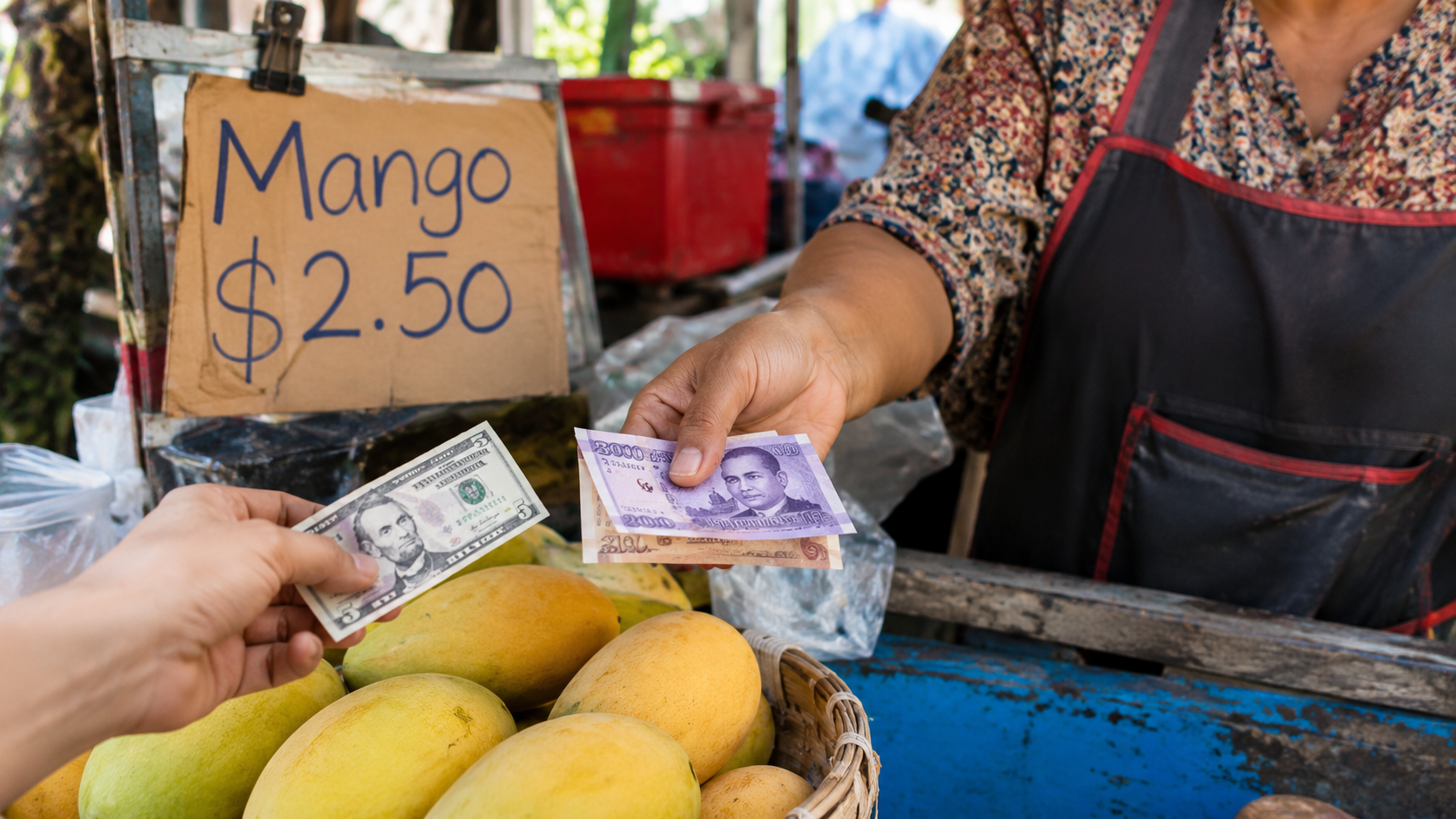
If you earn or save in dollars, you can hold US dollars and other currencies in a Grey account, which keeps your trip budget in the currency Cambodia already prices in.
For most trips, carry small, undamaged US dollar notes for everyday spending, a little riel for small purchases, and a card for the places that accept one. Cash is the main way to pay in much of the country, so a few habits protect you from the usual losses:
Cards work in a narrower set of places. The same source says they're accepted at upscale hotels, shops and restaurants in the major tourist towns and generally not elsewhere, and that most businesses that take cards add a fee of 2% to 4%. Ask before you pay, and keep cash as your backup.
Your own bank is the other place money leaks. Many cards add a foreign transaction fee on purchases in another currency, and how to avoid foreign transaction fees explains what to look for. Because many Cambodian prices are in dollars, a dollar card can pay those without a currency conversion, while riel prices are a different currency and may trigger a conversion or cross-border fee depending on the card.
Sending US dollars is often a practical way to send money to Cambodia, as USD is widely used for everyday payments, pricing and savings. With Grey, you can send USD directly to a bank account in Cambodia via SWIFT, with a flat $30 transfer fee and limits ranging from $100 to $5,000 per transaction.
You can also send money from the US to other supported destinations, including Thailand, where Thai baht is the local currency.
Before you send, check three costs:
If you're travelling rather than sending, a Grey virtual card lets you spend from a USD balance. Grey doesn't charge a foreign transaction fee on purchases made in the card's base currency, which is USD for the virtual USD card. A cross-border card fee of 2% plus $0.50 applies to non-USD purchases, so a purchase priced in riel would carry it. Card acceptance varies by merchant, so keep some cash too.
Grey is a financial technology company, not a bank: banking services are provided by licensed banking partners.
The currency of Cambodia is the Cambodian riel (KHR). US dollars circulate alongside it and are widely used for larger purchases and in tourist areas, while riel is used mostly for small amounts and change.
The riel symbol is ៛. You may see it on price lists in Cambodia, while banks and currency converters use the code KHR instead.
The currency code is KHR. Use it in currency converters, bank forms and exchange apps when you look up the Cambodian riel.
Yes. Dollars are widely accepted in cities and tourist areas, and most ATMs dispense them. Change under a dollar comes back in riel, and torn or heavily marked notes may be refused, so carry clean, small bills.
Yes, carry a small amount for tuk-tuks, snacks and small shops, where riel is the usual currency. It has little value outside Cambodia, so spend or exchange what's left before you leave.
Grey lists Cambodia among the countries that can receive USD transfers by SWIFT, with a flat $30 fee and a limit of $100 to $5,000 per transfer. Check the fee and any exchange-rate margin before you confirm, and ask the recipient whether their bank charges for incoming transfers.
A single member LLC gives one owner liability protection with pass-through tax. Learn how it works and the five steps to form one. Get started today.
Olayoyin Olorunmota
•
November 1, 2026
•
2 min read
A client’s accounts team emails you: before they can pay the next invoice, they need your business name and an EIN. Until now, you’ve invoiced under your own name, and a friend has told you a single-member LLC (sometimes called a single-member LLC) will sort it all out. It gives you a separate legal entity, but it won’t change how you pay tax unless you ask it to. This guide explains what the structure does, how it’s taxed, and the five steps to set one up.
A single-member LLC is a limited liability company with one owner. It limits your personal liability for business debts and, by default, is taxed as a disregarded entity, so profits pass through to your personal tax return. You set one up by filing formation documents with your state and getting an EIN.
A single-member LLC is a limited liability company with exactly one owner, called the member, who owns the business and keeps its profits. You create it by filing with a US state, and the state treats the LLC as a legal entity that is separate from you. The member can be an individual or another company.
People also search for this structure as a single-member LLC. It’s the same thing: the name only describes how many owners the company has. Freelancers, consultants, online sellers, and solo founders use it because it adds a legal layer between the owner and the business without the paperwork required for a corporation.
That legal layer is the main reason to form one. An LLC generally limits your personal liability for the business’s debts, so a creditor of the company can normally go after what the company owns, not your home or savings. The protection has limits:
A sole proprietor has no such separation, because the owner and the business are legally the same person. If you’re weighing the two, LLC vs sole proprietorship compares them side by side.
Owners don’t need to live in the US. A non-resident can own a US LLC, which is why many freelancers abroad form one to invoice American clients. The tax and reporting rules for them differ, and the FAQ below covers the basics.
By default, the IRS treats a single-member LLC as a disregarded entity: it ignores the LLC for income tax and taxes the profit as your own. The LLC doesn’t file a federal income tax return of its own. Per IRS guidance on single-member LLCs, an individual owner reports the business on Schedule C, E, or F of Form 1040, depending on the type of income.
This is what “pass-through” means: the profit passes through the LLC to your personal return and is taxed there, at your personal rate, with no separate tax at the company level.
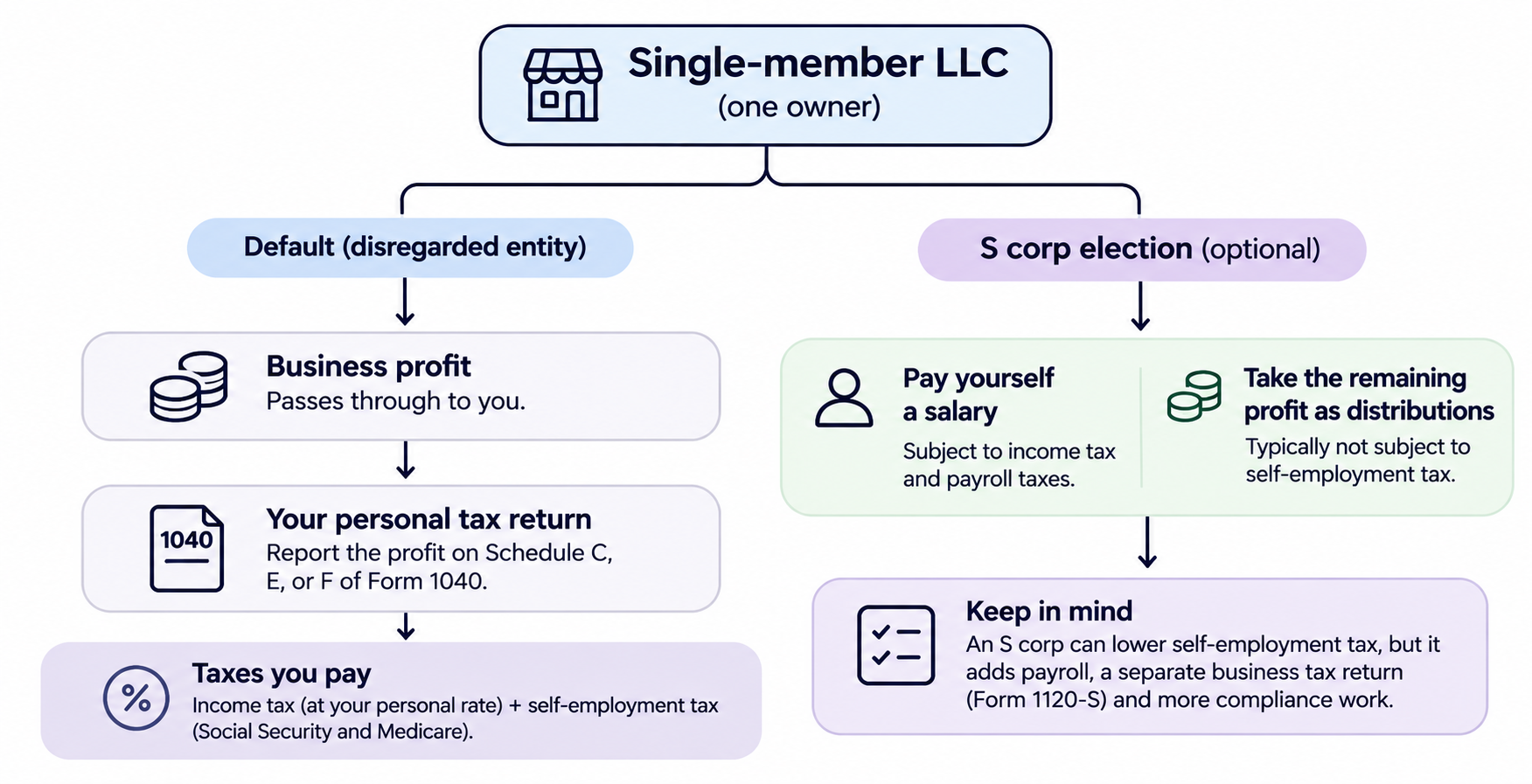
An individual owner also pays self-employment tax on the LLC’s net earnings, the same as a sole proprietor. This is the tax that funds Social Security and Medicare for people who don’t have an employer paying into them, and it’s charged on top of income tax. It’s the part of the bill that the options below can change.
If you’re paid for services by US clients, they may send you a Form 1099-NEC at the end of the year. The 1099 form for contractors records what a client paid you, and it’s a reporting document, not a bill. You report all your business income whether or not a client sends you one, so keep your own invoices and bank records.
A single-member LLC isn’t locked into the default. You can file Form 8832 to elect to be taxed as a corporation, and you can also elect S corporation status. An S corp election can lower self-employment tax because you pay yourself a salary and take the remaining profit as distributions, but it adds payroll, a separate business tax return and more compliance work. S corp vs LLC covers when the switch is worth considering.
One exception applies even to a disregarded LLC. For employment and excise taxes, the IRS treats the LLC as a separate entity, so an LLC with employees reports payroll under its own name and EIN.
This is general guidance, not professional tax advice. Consult a certified tax professional for your specific situation.
You set up a single-member LLC in five steps: choose a name, appoint a registered agent, file formation documents with your state, get an EIN, and open a business bank account. The SBA’s guide to registering a business sets out the same sequence. The details vary by state, so check your state’s Secretary of State or business agency website before you file.
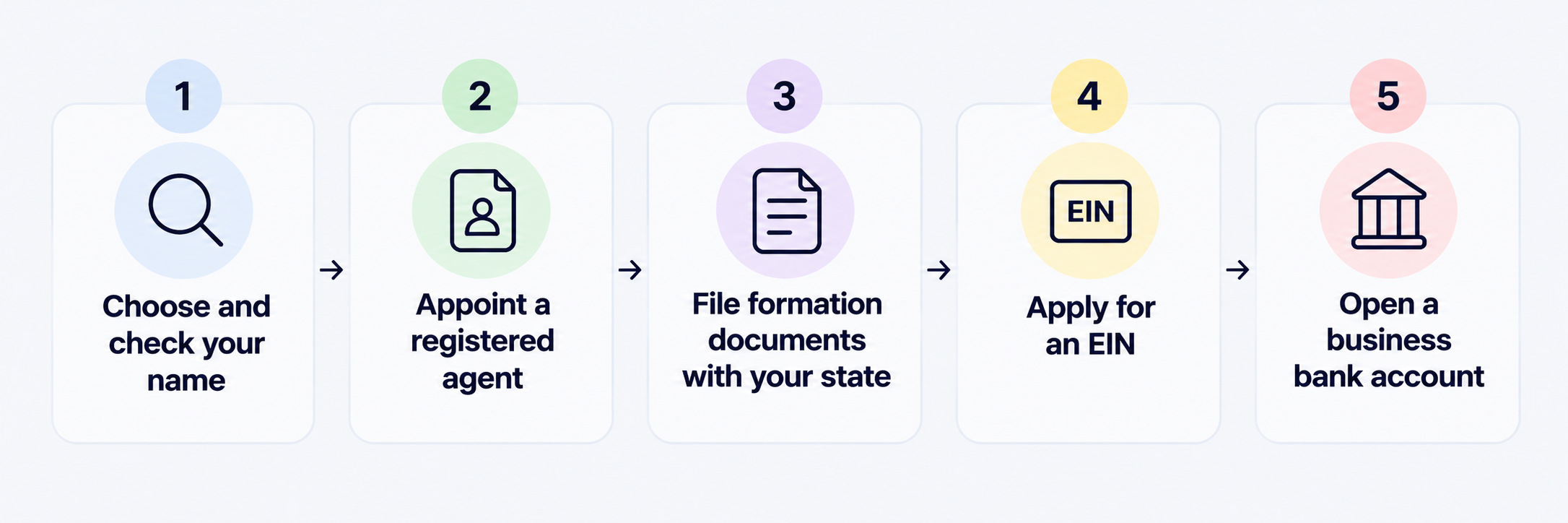
After you register, check whether your state wants anything further. Some states require an initial report within 30 to 90 days of registering, and some require a state tax ID depending on their income and employment tax rules. If you operate in more than one state, you may need to register as a foreign LLC in each of them, even if you’re a US resident. That’s a state-law term, not a reference to where you live.
A single-member LLC is worth it when the liability protection and client credibility matter more to you than the added cost and admin, and it’s not worth it if you earn little and have no business debts to protect against. This table weighs each factor from both sides.
The pattern is that the protection and the credibility come with a fixed cost and a regular admin routine. If you’re a freelancer with few assets and a single client, a sole proprietorship may be enough until your income or your risk grows. If you sign contracts, hold stock, employ people or work with larger clients, the case for an LLC gets stronger.
Once the LLC and its bank account exist, the next question is how clients pay it. US clients usually pay by bank transfer into a US account, while overseas clients may need to pay in euros or pounds. If your clients are spread across currencies, or you run the LLC from outside the US, a business account that holds several currencies can save you from collecting each payment through a separate route.
You can open a Grey Business account for your LLC to hold USD, EUR and GBP in one place. Grey is a financial technology company, not a bank: banking services are provided by licensed banking partners. Its invoicing tool is free, lets you send an invoice by email or download it as a PDF, and automatically fills in your Grey account details, so a client can pay in the currency they’re sending.
If your clients are in the US, get paid from the US covers how to receive money from the US. If your LLC pays contractors or relatives in India, you can also send money from the US to India. Whichever route you use, keep the business’s income in the business account and pay yourself from it, so your records stay clear for tax time.
Before you move money, check three costs: the fee charged when money arrives, the fee for converting between currencies, and the exchange-rate margin. The margin is built into the rate rather than shown as a line item, so Grey states it up front in the app before you confirm a transaction.
A single-member LLC is a limited liability company with one owner. It's a legal entity separate from you that limits your personal liability for business debts, and by default, the IRS ignores it for income tax and taxes the profit on your personal return.
By default, it’s taxed as a disregarded entity, so you report the profit on your own return, usually on Schedule C, and pay self-employment tax on net earnings. You can instead elect corporate or S corporation treatment, which changes how profits and salaries are taxed and adds payroll and filing requirements.
Usually, yes. The IRS says most new single-member LLCs need an EIN, and you need one if you have employees or excise tax liability. You’ll also use it to open a business bank account.
Choose a name, appoint a registered agent, file your formation documents with your state, apply for an EIN, and open a business bank account. State fees vary, and the SBA usually puts the total cost under $300.
Generally, yes: it limits your personal liability for the LLC’s debts, so creditors of the business normally can’t reach your own property. It doesn’t protect debts you’ve personally guaranteed, and the protection can be lost if you mix personal and business money.
Yes, a non-resident can own a US LLC. If you have no US address, the IRS’s online EIN application isn’t available to you, so you apply by phone, fax or post using Form SS-4, and the IRS instructions for Form SS-4 explain how to complete it without an SSN or ITIN. A foreign-owned single-member LLC may also have to file Form 5472 each year, so take advice from a certified tax professional before you form one.
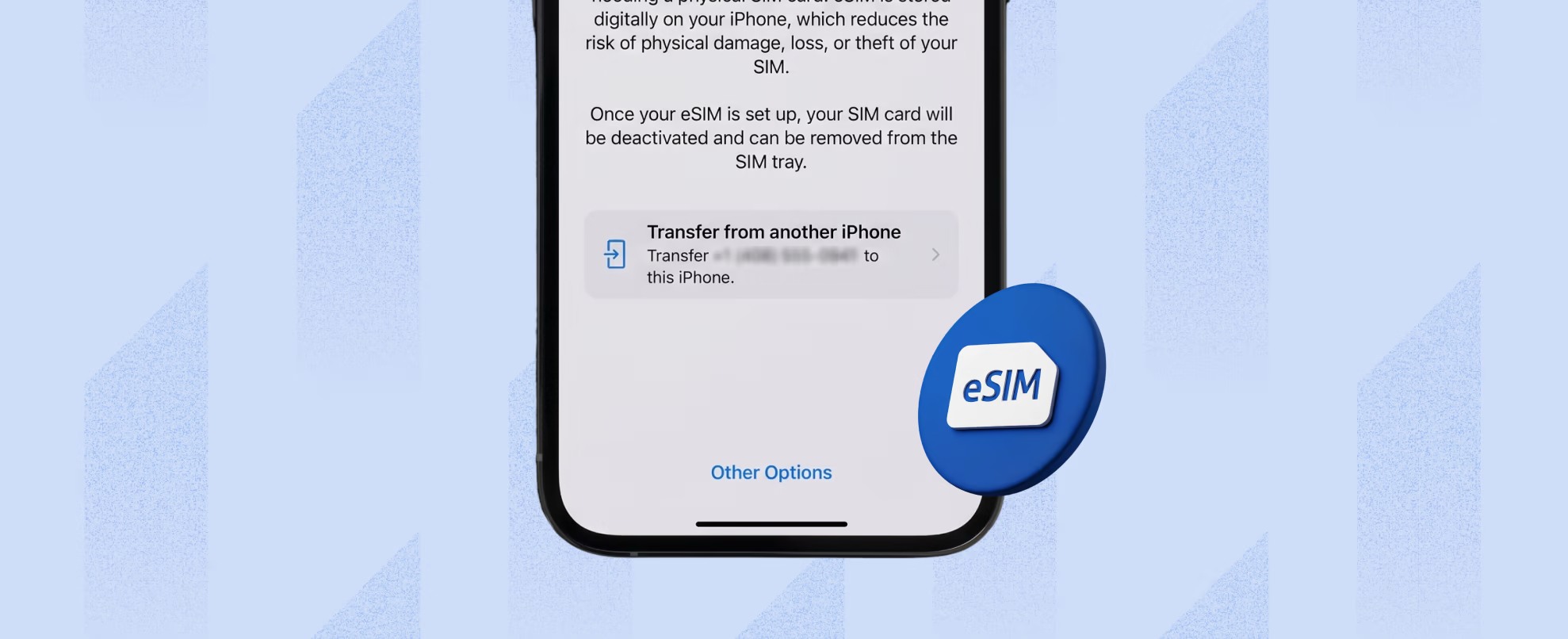
Transfer an eSIM from one iPhone to another in a few taps, with no carrier visit and no lost number. See the full steps. Start your transfer.
Olayoyin Olorunmota
•
November 1, 2026
•
2 min read
Your new iPhone is on the table, and your phone number lives on the old one as an eSIM. There’s no SIM tray to open and no card to slide across, so it isn’t obvious how to transfer an eSIM from one iPhone to another without losing service. The answer depends on your carrier and on which version of iOS both phones are running. This guide covers the quick route, the route for after setup, the fixes when it fails, and what changes for travel eSIMs.
You can move an eSIM between iPhones with eSIM Quick Transfer, during setup or later in Settings. On the new iPhone, choose Transfer From Nearby iPhone, then tap Transfer on the old one. Both iPhones need iOS 18.4 or later, Bluetooth on and a carrier that supports Quick Transfer. If yours doesn't, your carrier can issue a QR code.
eSIM Quick Transfer is an iPhone feature that moves your phone number's eSIM from your previous iPhone to your new one over a nearby connection, so in many cases you don't need to ask your carrier for a new QR code. It's the quickest way to complete an eSIM transfer on iPhone, but it only works when your carrier supports it.
Per Apple's eSIM instructions, you need all of the following:
Quick Transfer appears during setup if you’re asked to transfer your phone number to the new iPhone. If you skip that prompt or your iPhone is already set up, you can start the transfer later in Settings. If neither option appears, your carrier probably doesn’t support Quick Transfer, so use the QR code route in the troubleshooting section.
If either iPhone is on older software, update it first. Check with your carrier too: support depends on the carrier, not only on the phones.
To transfer an eSIM during setup, turn on the new iPhone, follow the prompts until it asks you to transfer your phone number, and approve the transfer on your previous iPhone. Keep both phones close together and unlocked, with Bluetooth on, until the new plan activates. These steps use Apple’s wording for the buttons:
1. Start setup on the new iPhone. Follow the setup screens and sign in with your Apple Account when asked. Keep the previous iPhone nearby, unlocked and connected to Wi-Fi.
2. Reach the cellular screen. When the new iPhone asks you to set up cellular or to transfer your phone number, choose to transfer from your previous iPhone. If no list of numbers appears, tap Transfer From Nearby iPhone.
3. Choose the plan to move. If you have several numbers, pick the one you want to transfer.
4. Confirm on the previous iPhone. Follow the instructions that appear on it and tap Transfer. If it asks for a verification code, enter the code shown on the new iPhone.
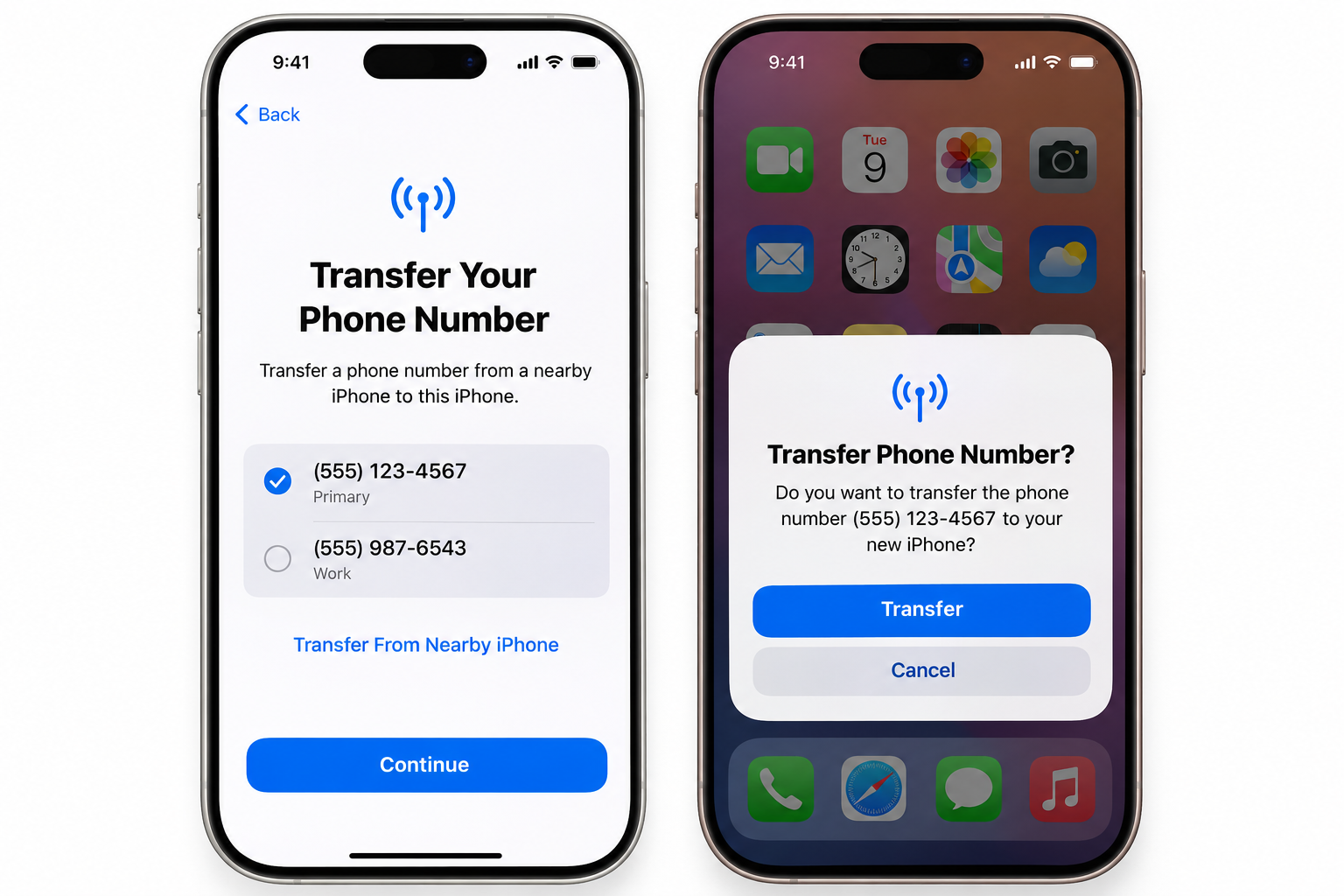
5. Wait for the plan to activate. Activating the plan on the new iPhone deactivates the SIM on the previous one, so don’t switch the old phone off in the middle of the transfer.
6. Finish with your carrier if asked. If a banner reads Finish Setting Up Your Carrier’s Cellular Plan, tap it and complete the transfer on your carrier’s website.
7. Test the line. Make a call from the new iPhone to confirm it has service.
Apple’s page doesn’t spell out the setup screens word-for-word, so the labels you see may vary slightly across iOS versions and carriers. The Quick Transfer buttons themselves, Transfer From Nearby iPhone and Transfer, match Apple’s instructions. If you transfer several numbers at once, make sure both iPhones run iOS 26 or later.
If your new iPhone is already set up, you can move the eSIM from Settings by going to Cellular, then Add eSIM, and choosing a plan to transfer from your previous iPhone. This is the route to use if you skipped the prompt during setup or recently got a new iPhone. The same requirements apply: both iPhones running iOS 18.4 or later, Bluetooth and Wi-Fi on, and a carrier that supports Quick Transfer. To move an eSIM to a new iPhone this way:
1. Open Settings on the new iPhone and tap Cellular. In some regions, this menu is called “Mobile” or “Mobile Data”.
2. Tap Set Up Cellular or Add eSIM.
3. Choose a plan to transfer from another iPhone. If no list of numbers appears, tap Transfer From Nearby iPhone.
4. On the previous iPhone, follow the prompts and tap Transfer, or enter the verification code shown on the new iPhone if prompted.
5. Wait for the plan to activate on the new iPhone. This deactivates the SIM on the previous one.
6. If a banner reads Finish Setting Up Your Carrier’s Cellular Plan, tap it. You’ll be redirected to your carrier’s website to complete the transfer.
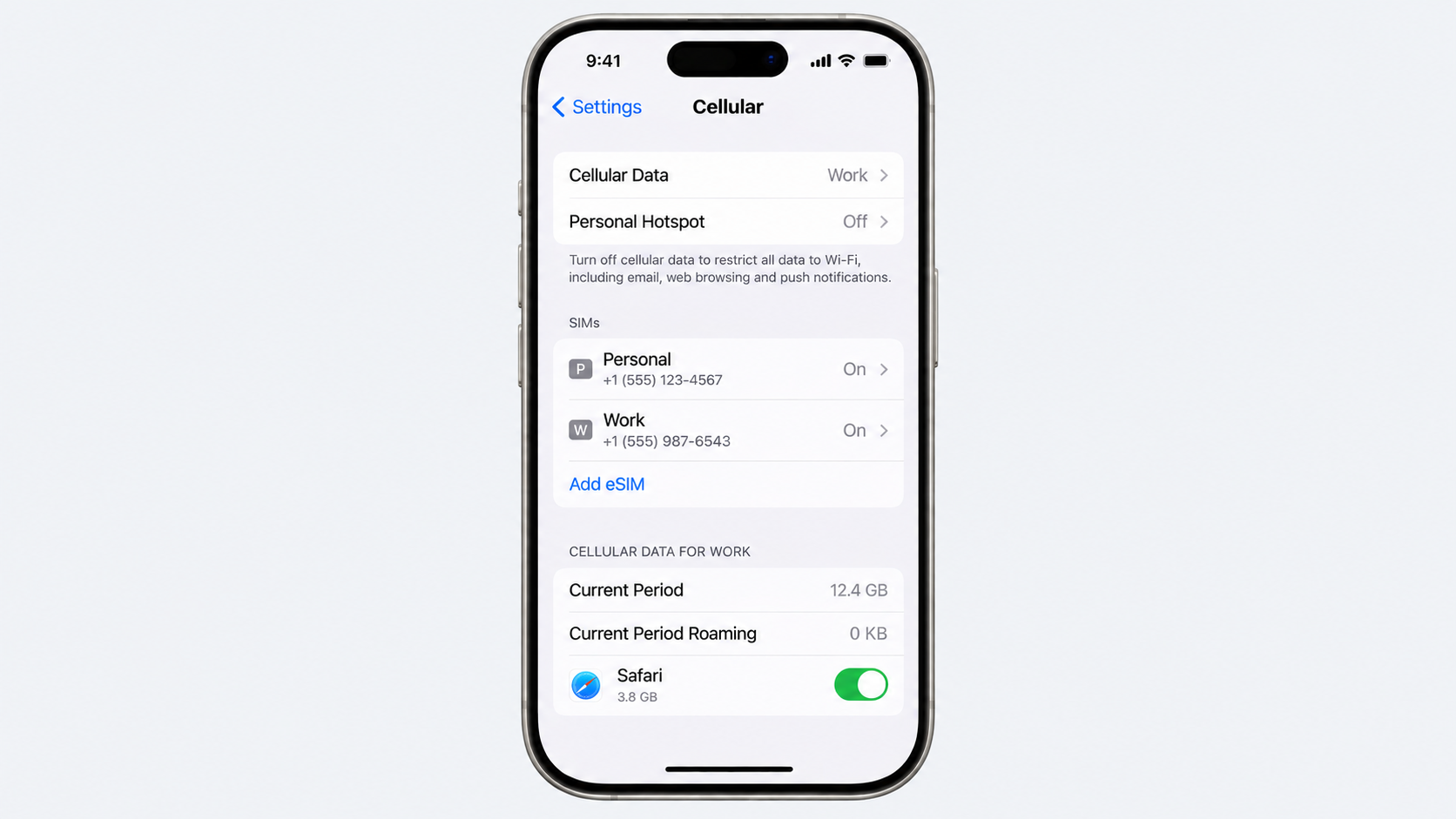
When it’s done, return to Settings and Cellular to check that the plan is listed. If you have two plans on the same iPhone, both will appear there. Then call someone to confirm the line works.
An eSIM transfer usually fails because your carrier doesn’t support Quick Transfer, or because one of the requirements isn’t met: Bluetooth is off, an iPhone is on an older iOS, or the phones aren’t signed in to the same Apple Account. Work through these checks in order, then fall back to your carrier’s QR code if the transfer still won’t start.
If none of these fixes it, use the QR code route, which doesn’t depend on Quick Transfer. Ask your carrier for a QR code, then use one of these methods:
Some carriers also let you transfer your number in their own app. If the transfer still fails, contact your carrier: it can see what’s happening on your account.
A carrier eSIM is linked to your phone number, so Quick Transfer or your carrier can move it to a new iPhone, whereas a travel eSIM is a data plan installed via a QR code and may not move at all. The difference matters if you’re changing phones before or during a trip. A QR code for a travel plan, which is the eSIM QR code iPhone owners scan to install it, is a profile for one device, not a number that travels with you.
If you’re about to switch phones during a trip, don’t delete a travel eSIM from the old iPhone until you know whether the provider can reissue it. Some providers advise waiting to install a travel plan until you have the new phone. If you’re buying a plan for an upcoming trip, install it on the iPhone you’ll carry. The best eSIMs for international travel compares the options.
You can buy a travel eSIM on Grey in the Lifestyle tab of the Grey app and pay for it from your Grey balance. Availability depends on where you are and where you’re going. If you’re travelling to India, you can also send money from the US to India before you go. A Grey virtual card lets you pay for online purchases, such as eSIM plans, from your USD balance.
Grey is a financial technology company, not a bank: banking services are provided by licensed banking partners.
Yes, if your carrier supports eSIM Quick Transfer and both iPhones meet Apple’s requirements. You then move the plan from the new iPhone and approve it on the old one. If your carrier doesn’t support Quick Transfer, you’ll need a QR code or a transfer through its app.
It stops working there. Apple says activating the plan on the new iPhone deactivates your previous SIM, but its instructions don’t say whether the eSIM is removed from the old iPhone’s settings. Check that the new iPhone has service before you reset or sell the old one.
Sometimes. Apple says that with iOS 26 and later, some carriers and select smartphone manufacturers support moving a SIM between Android and iPhone, in either direction. Otherwise, contact your carrier for a new eSIM.
It depends on the provider. A travel eSIM is activated via a QR code that many providers offer on one device only, so the plan may not transfer with the phone. Contact the provider before deleting it from the old iPhone and ask whether it can issue a new code.
Usually, yes. Apple lists a Wi-Fi network or hotspot among its requirements, though some eSIM-only iPhone models in certain countries can activate without one. Both iPhones also need Bluetooth on.
Yes, on iPhone 13 and later, according to Apple’s Dual SIM guidance. Earlier models pair one eSIM with a physical SIM. Your iPhone uses only one cellular data network at a time.
Learn how to plan a trip on a budget, from flights and stays to daily spend, with a Disney World example and no-markup ways to pay. Start.
Tunde Aladeloba
•
October 31, 2026
•
2 min read
A good trip doesn’t have to cost a fortune. Whether you’re planning a weekend getaway or a two-week holiday abroad, knowing how much you can afford before you start booking helps you enjoy the experience without worrying about money throughout your trip.
Learning how to plan a trip on a budget starts with setting a total spending limit and working backwards. Think about flights, accommodation, food, transport, activities and the extra costs that are easy to overlook. Once you know what you can spend, you can make smarter choices about where to go, when to travel and what to book.
Small decisions can also make a noticeable difference. Travelling during shoulder season, keeping your dates flexible and choosing accommodation with a kitchen can help you save. It’s also worth checking foreign transaction fees before using your card abroad. During your trip, tracking daily expenses helps you spot overspending early and keep your plans on track without missing out on the experiences that matter most.
Before you compare flight prices or save pictures of hotels, decide how much you can comfortably spend on your trip. Starting with a total budget helps you make choices based on what you can afford rather than adding bookings together and hoping the final cost works out.
To understand how to travel on a budget, break your total into the main expenses: flights, accommodation, food, local transport, activities and travel insurance. Set aside some money for unexpected costs, too. This gives you a clearer picture of how much you can spend in each area without stretching your finances.
For example, if your budget is $1,500, you might allocate $450 to flights, $400 to accommodation, $250 to food, $150 to transport, $150 to activities and $100 for emergencies. These amounts are only a starting point; your destination and travel dates will affect the actual costs.
Once you have your limits, compare options and adjust your plans where necessary. You could choose a less expensive hotel to afford a special activity or shorten your stay to keep flights within budget. A free trip itinerary template can help you organise your bookings, daily plans and estimated expenses in one place.
Saving money on a trip doesn’t mean choosing the cheapest option every time. It means knowing where to spend less so you have more money for the experiences you care about. A few practical changes to your plans can make a noticeable difference.
Be flexible with your travel dates: Flights and hotels often cost more during school holidays, festive periods and major events. Compare different dates and consider travelling during shoulder season, when destinations may be quieter and prices lower.
Compare flights before booking: Check different airlines, nearby airports and departure times. Look at the total fare, including baggage and seat selection, rather than choosing based on the advertised price alone.
Choose accommodation carefully: Hostels, guesthouses and holiday rentals can cost less than hotels. Staying somewhere with a kitchen also lets you prepare some meals instead of eating out every day. If you’re interested in backpacking on a budget, travelling light and choosing affordable accommodation can help you stretch your money further.
Spend less on food and transport: Shop at local markets, carry snacks and use public transport where practical. Walking between nearby attractions can save money while helping you see more of your destination.
Finally, track your spending each day. Small purchases can add up quickly, and checking your budget regularly helps you adjust before you overspend.
A trip to Walt Disney World in Florida can get expensive quickly, especially when you add park tickets, accommodation, meals and souvenirs. The key to keeping costs down is deciding what matters most and setting limits before you book.
Imagine you’re planning a three-day trip for one adult. Here’s a sample budget to show how the costs might add up:
These figures are illustrative, not live prices. Actual ticket costs vary by date and park, while accommodation prices depend on location and availability. Flights are also excluded, so include them if you’re travelling from outside Florida.
How can you bring the total down? Visit during a less busy period, compare hotels away from the resort, share accommodation with a travel companion and set a daily food budget. You could also bring snacks where permitted and decide on a souvenir limit before arriving.
The goal isn’t to cut every expense. It’s to spend intentionally, so you can enjoy the attractions you care about without returning home to a holiday bill you can’t comfortably afford.
You may have planned your flights, hotel and daily spending, only to discover that your trip costs more than expected. The reason could be the small charges that come with spending money abroad: foreign exchange markups, ATM withdrawal fees and mobile roaming charges.
Card fees: Some banks and card providers add a foreign transaction fee or use an exchange rate that costs more than the market rate. Before travelling, check your card’s fees and compare the rate you’ll receive. With Grey, you can pay with a virtual card without a markup, helping you manage eligible international purchases without additional exchange markups from Grey. Check the card’s current terms for any other applicable charges.
ATM fees: Withdrawing cash abroad may attract fees from both your bank and the ATM operator. Take out cash only when needed, and check the charges before confirming a withdrawal.
Roaming costs: Using your regular mobile plan overseas can lead to unexpectedly high bills. Instead, consider buying a travel eSIM instead of paying for roaming to access mobile data at a price that suits your trip.
These costs may look small individually, but they can quickly eat into your travel budget. Check them before departure so more of your money goes towards enjoying your trip.
Planning a trip on a budget becomes easier when you can see how much you’ve saved and how much you have left to spend. Instead of keeping your travel money mixed with your everyday funds, set it aside in a dedicated place and track your progress as your departure date approaches.
With Grey, you can use a Pouch goal to organise money for a specific purpose, such as flights, accommodation or your spending money abroad. You can save towards your trip in a Pouch and build your travel fund gradually, setting aside an amount that fits your income and timeline.
Once your trip begins, track your spending daily. Record what you spend on meals, transport, activities and small purchases, then compare it with your budget. This helps you spot overspending early and decide where to cut back without missing the experiences you planned for.
Saving ahead and checking your expenses regularly gives you a clearer picture of your finances, helping you enjoy your holiday with greater confidence and fewer money worries.
Start by deciding how much you can comfortably spend, then divide that amount between flights, accommodation, food, transport, activities and emergencies. Compare prices before booking, stay flexible with travel dates and track your spending. Having a clear budget helps you make choices without overspending or missing experiences that matter.
Travel during shoulder season, compare flight prices across different dates and consider budget accommodation, hostels or guesthouses. Preparing some meals, using public transport and exploring free attractions can also reduce costs. Plan ahead, but leave room for affordable local experiences that make your trip memorable without stretching your budget.
Check your bank’s foreign transaction fees and exchange rates before travelling. Choose a card with low or no foreign exchange markup, and always check the currency displayed at checkout. When offered a choice, paying in the local currency often helps you avoid unfavourable conversion rates set by merchants.
Booking ahead can give you more options and help you avoid last-minute price increases, especially during busy travel periods. However, there is no single booking window that guarantees the lowest fare. Compare prices across dates, check baggage charges and consider nearby airports before deciding when to book.
Set a daily spending limit and check your expenses each evening. Include meals, transport, activities and small purchases in your tracking. Keep some money aside for unexpected costs, and prioritise experiences you genuinely want. Reviewing your spending regularly helps you make adjustments before you exceed your overall budget.
Set aside a contingency fund for unexpected expenses, such as transport changes, medical needs or unplanned purchases. The amount depends on your destination, trip length and personal circumstances. Include this reserve when calculating your total budget, rather than relying on credit cards or money intended for essential expenses.
Travelling on a budget? Save in a Grey Pouch, pay with no markup on a virtual card, and skip roaming with a travel eSIM.

See how much an African safari costs across five regions, with flights, lodges, park fees and a budget range for each traveller. Compare.
Tunde Aladeloba
•
October 31, 2026
•
2 min read
An African safari can cost a few thousand dollars or well over $10,000 per person, depending on where you go, how long you stay and the kind of experience you want. For a one-week trip, a reasonable starting estimate is $2,500 to $7,000 per person, excluding or including international flights depending on the package. Knowing what your budget covers helps you compare options without unexpected expenses.
Budget camping safaris typically cost around $2,500 to $3,500 per person for a week, while mid-range lodge safaris often range from $4,000 to $6,000. Luxury experiences can start at $8,000 or more, especially when private guides, exclusive lodges and premium services are included.
The highest costs are usually accommodation, game drives, park fees, meals and transfers between destinations. International flights, visa fees, travel insurance, tips and optional activities can increase the total. Before booking a safari trip, check exactly what your package includes and what you’ll pay separately. This guide breaks down the main expenses so you can estimate the cost of your safari trip and choose an experience that fits your budget.
The Africa safari trip cost depends on where you go, how you travel and the level of comfort you want. For a one-week safari, budget around 2,500–3,500 per person for camping, 4,000–6,000 for a mid-range lodge and $8,000 or more for a luxury experience. These are general estimates, and what’s included varies by destination and tour operator.

Camping safaris suit travellers who want to spend less while enjoying guided game drives and time in nature. Mid-range lodge safaris offer more comfort, with proper beds, private bathrooms and meals often included. Luxury safaris may feature exclusive camps, private guides, charter flights and personalised service.
Park fees are another important part of your budget. They generally cover entry to a national park or reserve, helping fund conservation and park operations. Depending on the destination and package, they may be included in your safari price or charged separately. Game drives, transfers, meals and accommodation may also cost extra.
To estimate your Africa safari trip cost accurately, check the inclusions before booking. If you’re planning a more independent adventure, this backpacking trip planning guide can help you budget for transport, accommodation and daily expenses alongside your safari.
Planning an African safari from the USA means budgeting for international flights as well as your time on the ground. Return flights to popular safari destinations, such as Kenya, Tanzania and South Africa, can cost roughly 900-1,800, depending on your departure city, travel dates and how early you book.
Add the safari package, and a one-week trip may cost around 3,400-7,800 per person for a budget or mid-range experience. Luxury safaris can push the total well beyond $10,000. These estimates may not include visas, travel insurance, tips, vaccinations or extra activities, so leave room for additional expenses.
You can reduce costs by travelling outside peak season, comparing flight dates and choosing a safari package that includes accommodation, meals, park fees and game drives. It’s also worth planning how you’ll pay for expenses once you arrive. With Grey, you can manage your money and make payments from the USA, helping you prepare for travel expenses before departure.

Planning an African safari from North America means budgeting for international flights, accommodation, park fees and guided game drives. Return flights from the US or Canada to popular destinations such as Kenya, Tanzania and South Africa typically cost around 1,000-1,900, depending on your departure city, travel dates and airline.
Including flights, a one-week Africa safari trip cost may range from approximately $3,500 to $8,000 per person for a budget or mid-range experience. Luxury safaris can exceed $10,000, particularly when private guides, exclusive lodges and charter flights are involved.
To manage your budget, compare flight dates, travel during quieter seasons and check what your safari package includes. Remember to account for visas, travel insurance, tips and other personal expenses when estimating your total. Booking early and understanding the full cost can help you plan your safari with fewer financial surprises.
Planning an African safari from Europe means budgeting for flights, accommodation, park fees and guided game drives. Return flights to popular destinations such as Kenya, Tanzania and South Africa can cost around €500-€1,000, depending on your departure city, travel dates and airline.
Including flights, a one-week Africa safari trip cost may range from €2,800 to €6,500 per person for a budget or mid-range experience. Luxury safaris can cost considerably more, especially when private guides and exclusive lodges are included.
To keep costs down, compare flight dates, travel during quieter seasons and check which expenses your safari package covers. You’ll also need a convenient way to manage your euros and pay for travel expenses. A Grey account can help eligible users hold euros and manage international payments. Check your eligibility, account features and applicable fees before travelling.
An African safari can be more affordable when you’re travelling from within the continent, particularly if you live in a country with regional connections to major wildlife destinations. Return flights may cost around 200–800, depending on your departure country, destination and travel dates.
For a one-week trip, the total Africa safari trip cost could range from $2,000 to $4,000 per person for a budget or mid-range experience, including regional flights. Luxury lodges and private safari experiences can cost considerably more.
Your starting point makes a difference. Travellers from Nigeria or Ghana might fly to Kenya or South Africa before continuing to a safari destination, while those already in Kenya, Tanzania or South Africa may have easier access to nearby parks and reserves. Destinations such as Botswana and Tanzania offer different wildlife experiences, from elephant encounters to the Great Migration. Your passport, visa requirements and the distance between your home and the safari area will also shape the overall cost.
Travelling from South America to Africa for a safari can cost more because of the long journey and limited direct flight connections. Return flights from cities such as São Paulo, Buenos Aires, or Santiago may cost around 1,200-2,500, depending on your destination, travel dates and airline.
For a one-week trip, the total cost of an Africa safari could range from $3,000 to $7,000 per person for a budget or mid-range experience, including flights. Luxury safaris can exceed $10,000, particularly when private guides and exclusive lodges are involved.
Your destination also shapes the journey. Travellers may fly to South Africa for wildlife reserves such as Kruger National Park, or continue to Kenya and Tanzania for savannah safaris and the Great Migration. Botswana offers another option for travellers interested in remote wilderness and elephant encounters.
The highest costs of an African safari are usually accommodation, transport, guided game drives and park entry fees. For 2026, a budget camping safari can cost around 150-400 per person per day, while a mid-range lodge safari may cost 400-900. Luxury experiences can exceed $900 per person per day, before international flights.
The key difference is what your package includes. Camping safaris typically use basic campsites and shared vehicles, while lodge packages may include comfortable accommodation, meals and guided drives. Park fees may be included or charged separately, depending on the operator and destination. For example, you can check the Nairobi National Park entry fees and booking options to see how these charges apply at a specific park.
For a clearer estimate, here is an illustrative seven-day breakdown. Actual prices depend on the country, season, group size and package inclusions.
Once you’ve set your safari budget, plan how you’ll pay for bookings, daily expenses and unexpected costs. Some tour operators require a deposit before arrival, with the balance due closer to your travel date. Confirm the payment terms, accepted currencies and refund policy before sending money.
If you’re booking with an operator in another country, Grey can help with international payments. For example, travellers paying a South African operator can use Grey to send money from the US to South Africa, while those booking a Kenyan safari can send money from the US to Kenya.
For smaller expenses, such as online bookings and travel essentials, a Grey virtual card lets you pay online using your USD card balance. You’ll also need mobile data for maps, reservations and contacting your guide. A travel eSIM can help you stay connected without relying on expensive roaming; learn how to buy a travel eSIM for your safari before departure. Keep some local currency available for tips and places that don’t accept cards.
A one-week African safari can cost around 1,000-2,800 for a budget trip, 2,800-6,300 for a mid-range experience, or $6,300 and above for luxury. These estimates generally exclude international flights, visas and insurance. Your destination, travel season, accommodation and package inclusions determine the final cost.
South Africa and Namibia are often among the most affordable options, especially for travellers comfortable with self-driving and staying in national park camps. South Africa’s Kruger National Park offers wildlife viewing with relatively accessible roads and accommodation. Namibia is another option for travellers who want to explore at their own pace.
Many packages include accommodation, meals, guided game drives, park entry fees and transfers between destinations. However, inclusions vary by operator. International flights, visas, tips, travel insurance, premium drinks and optional activities may cost extra. Always check the itinerary and package terms to understand what you’re paying for before booking.
The best time depends on your destination and priorities. The dry season often makes wildlife easier to spot around water sources, while the green season can bring lower accommodation rates and lush scenery. In East Africa, the timing of the Great Migration also matters. Check local weather and wildlife patterns before choosing dates.
Sometimes. Many guided safari packages include park entry and conservation fees, but independent trips and some budget packages charge them separately. Fees vary by park, visitor category and season. For example, check the official Nairobi National Park entry fees when budgeting for a visit in Kenya.
Usually. Camping safaris often use basic campsites, shared vehicles and simpler facilities, making them more affordable than lodge packages. Lodges offer greater comfort and may include meals and guided activities. Both options can provide excellent wildlife experiences; the right choice depends on your budget, comfort preferences and the type of trip you want.
Planning a safari? Spend on a Grey virtual card with no markup, grab a travel eSIM, and pay operators across borders.
Redeem an Amazon gift card in under a minute on desktop, mobile or the Alexa app. Fix common errors and check your balance first. Follow the steps.
Olayoyin Olorunmota
•
October 31, 2026
•
2 min read
A friend in the US sends you a $50 Amazon gift card by email. You want it on your account before the next sale ends, but the code looks like a random string of letters and numbers, and you're not sure where to apply it or whether it works outside the US. This guide shows how to redeem an Amazon gift card, how to fix the usual errors, and what changes if you're outside the US.
Go to amazon.com/gc/redeem, sign in, enter the claim code exactly as printed and select Apply to Your Balance. The value is added to your Amazon gift card balance and applies automatically to your next eligible order, so you don't need to enter the code again.
You redeem an Amazon gift card by entering its claim code at amazon.com/gc/redeem, or in the Amazon app under Gift Card Balance, and selecting Apply to Your Balance. A claim code is 14 or 15 characters, a mix of letters and numbers, and sits under a peel-off sticker or a scratch-off strip on the back of a physical card. Electronic cards have no code to type: you open the email, text or link and select Apply to your Amazon Account. Amazon’s own gift card redemption page is the place to start from either route.
You need an Amazon account first. If you were hoping to redeem an Amazon gift card without an account, that isn’t possible because Amazon stores redeemed funds in an account. Create one before you apply the code.
If you haven’t redeemed a physical card by the time you check out, you can also select “Use a gift card, voucher, or promo code” on the payment page, enter the claim code, and select Apply.
If you give gift cards as well as receive them, you can buy, send and manage gift cards with Grey.
On a computer, go to Account & Lists, then Account, then Gift Cards to see your current balance; in the Amazon app, tap the user icon and look under Gift Card Balance. The balance is stored on your account, not on the card or the email, so it appears here once the code has been redeemed.
To check your Amazon gift card balance and see where it went, open the balance history. It lists the date each code was claimed, the last four digits of the code, and the items the balance paid for. That makes it the first place to look when Amazon says a code has already been redeemed, because the funds may already be sitting in your account.
Amazon applies the balance automatically to your next eligible order, so you don’t need to select it at checkout.
An Amazon gift card most often stops working because the code is being applied to the wrong account or Amazon store, or because it has already been redeemed. Those two causes are the quickest to rule out, so check them first. Confirm which email address you’re signed in with, then open your gift card balance and balance history to see whether the code has already been claimed.
If neither explains it, find your symptom in the table below.
If you type a code by hand, copy it from the original email whenever possible, or use the camera scan in the app for a physical card. Both cut out typing mistakes. If the card still won’t work after these checks, contact Amazon customer service and have the card’s serial number ready.
One safety point: never read a claim code out to someone who contacts you first and asks for it. Anyone holding the code can spend the balance.
Yes. Every code you redeem is added to the same Amazon gift card balance on your account, so you don’t need to merge cards yourself. If you hold three cards, redeem each code in turn, and the balance page shows the running total, with each claim listed in your balance history.
Amazon applies that balance to your next eligible order automatically. If an order costs more than your balance, you can pay the difference with another payment method on your account.
Two limits matter once the money is in:
Because redeeming is a one-way step, hold off on redeeming a card you’re not sure you’ll spend. A card that’s still unredeemed can be sold, and this guide explains how to sell a gift card for cash instead.
A US Amazon gift card is tied to Amazon’s US store, so you apply the code on amazon.com, and the balance only pays for orders there. It doesn’t carry over to a local Amazon site such as Amazon.co.uk, and Amazon doesn’t let you move a redeemed balance from one country’s store to another. If someone sends you a US card while you’re abroad, check this before you redeem it, because the balance can’t be moved afterwards.
What the balance can buy depends on what amazon.com will deliver to where you live. Eligible items, shipping options, and import costs vary by country, so check the delivery options on a product page before relying on a card to pay for it. A gift card also can’t be turned into cash, so it’s the wrong tool if what you need is money in your bank account.
That situation comes up often in Nigeria, where a relative or client in the US sometimes sends an Amazon card because it's the simplest thing to hand over. If the goal is to get money to you, you can send money from the US to Nigeria instead, and spend it anywhere once it arrives.
If you’d rather shop on amazon.com without a gift card, you can spend online with a Grey virtual card. You create the card in the Grey app and fund it with your USD balance, and Amazon is one of the merchants where it works. Creating a card costs a one-time $5, with no monthly fee. Because amazon.com charges in dollars, the 2% plus $0.50 charge on non-USD card purchases doesn’t apply. If you start from naira, converting to dollars carries a 1% fee, capped at $6, plus the exchange-rate margin shown in the app before you confirm.
Standard Amazon gift cards don’t carry an expiry date, but promotional credits and certificates can have an end date. Check the terms shown with the offer, and redeem any promotional code before that date.
No. Amazon stores the value of a gift card as a balance on an account, so you need to sign in or create an account before you can apply the code. Once the balance is on your account, it applies to your next eligible order.
Amazon can temporarily stop further attempts if a code keeps failing, and it doesn’t publish how many tries it allows. Stop after a couple of failed tries, check the code character by character, and contact Amazon customer service with the card’s serial number if you’re still blocked.
No. A gift card balance can’t be used to buy another gift card, so you need another payment method for that purchase. Your balance still covers eligible physical and digital items.
It’s risky. Discounted cards sold on social media or by unknown sellers are a common route for scams, and the code may already be used or may have been obtained fraudulently. Buy from Amazon or from a retailer you trust, and check that the code works as soon as you receive it.
No. A card issued for amazon.com only works on amazon.com, and Amazon doesn’t move a redeemed balance between country stores. To spend in pounds on Amazon.co.uk, you need a card issued for that store.
Open a Grey account and spend your balance online with a virtual card.

See how much a trip to the Bahamas costs from five regions, with flights, resorts and daily spend, plus a budget range for each. Compare.
Tunde Aladeloba
•
October 30, 2026
•
2 min read
A trip to the Bahamas can cost a few hundred dollars or several thousand, depending on where you’re travelling from, how long you plan to stay, and the kind of holiday you want. Flights, accommodation, food, local transport, and activities all affect your budget. If you’re travelling during peak season, expect to pay more for flights and hotels.
Looking at trip packages to the Bahamas can help you plan your spending before you book. Some packages combine flights and accommodation, while others include meals, airport transfers, or excursions. These options can make budgeting easier, but check what’s included so you don’t end up paying extra for things you expected to be covered.
Your travel dates and choice of island also matter. Nassau and Paradise Island offer plenty of resorts and activities, while other islands may suit a quieter getaway. In this guide, you’ll learn what to budget for flights, hotels, food, and activities so you can plan a Bahamas trip that fits your wallet.
A 7-day trip to the Bahamas can cost around $1,000 per person for a budget holiday, about $2,000 for a mid-range trip, or more than $4,300 for a luxury stay. Your final cost depends on where you stay, how you travel, and the activities you choose.

Accommodation is one of the biggest expenses, with standard resorts averaging around $242 per night. Food can also take up a large part of your budget, especially if you eat at sit-down restaurants, where daily spending may reach 100–200 per person. Excursions add to the cost, too. Popular Exuma boat tours can range from $215 to over $570, depending on the experience.
Getting around also matters. Local jitney buses are generally cheaper than private taxis, helping you save money on transport. When comparing trip packages to the Bahamas, check whether flights, hotel stays, meals, transfers, and activities are included. This helps you compare the total cost and avoid unexpected expenses.
A one-week trip to the Bahamas from Europe can cost around €2,000 to €5,000 per person, depending on your departure city, accommodation, and travel plans. Budget travellers may spend €2,000 to €2,800, while mid-range holidays can cost €3,000 to €5,000. Luxury trips can cost considerably more.
Flights: Return flights from Europe to the Bahamas typically cost around €500 to €900, although prices vary by season, airline, and booking date. You may also need connecting flights, which can affect your travel time and total fare.
Accommodation: Hotels and resorts are often a major expense. Budget hotels help keep costs down, while beachfront and all-inclusive resorts can cost much more per night.
Daily expenses: Food, transport, and excursions add to your budget. To save money, compare flight prices, travel outside peak periods, and check what your hotel package includes before booking.
Also read: How much does an all-inclusive Caribbean trip cost?
A one-week trip to the Bahamas from Africa can cost around $2,200 to $4,500 per person, depending on your departure city, flights, accommodation, and activities. Travelling from cities like Lagos or Johannesburg can be expensive because flights usually involve connections through Europe or the United States.
Flights: Return flights from major African cities to Nassau may cost around $1,100 to $1,600, depending on the airline, season, and booking date. Check different routes and travel dates to find a suitable fare.
Accommodation: Budget travellers can save by staying in guesthouses or affordable hotels. Mid-range travellers may spend more on three-star resorts and comfortable accommodation close to popular attractions.
Daily expenses: Food, local transport, and excursions add to the total. Budget travellers can spend around $2,100 to $2,600 for the week, while mid-range trips may cost $3,100 to $4,500 per person.
Before booking, compare flight and hotel prices separately and allow extra money for travel insurance, visa requirements where applicable, and unexpected expenses.
A one-week trip to the Bahamas from South America can cost around $1,800 to $4,000 per person, depending on your departure city, accommodation, and activities. Your total budget will depend on flight prices and the type of holiday you want.
Flights: Return flights from South American cities to Nassau may cost around $600 to $1,200. Prices vary by country, airline, travel season, and whether you need connecting flights.
Accommodation: Budget hotels and guesthouses help keep costs lower, while beachfront resorts and all-inclusive hotels can increase your spending significantly.
Daily expenses: Food, transport, and excursions add to your total. You can save by eating at local restaurants, using affordable transport, and booking activities in advance.
The table below compares the cost of a six-night stay in the Bahamas for one traveller departing from Africa. It covers two options: a mid-range resort and a budget-friendly Airbnb, with estimated costs for flights, accommodation, food, activities, and local transport.
| Category | Mid-range resort | Budget Airbnb |
|---|---|---|
| Flights | $1,400 | $1,400 |
| Accommodation | 1,950(325/night) | 720(120/night) |
| Food and drinks | $1,050 | $525 |
| Excursions | $500 | $100 |
| Local transport | $150 | $50 |
| Total estimated cost | $5,050 | $2,795 |
Planning your Bahamas trip starts with knowing how much you can afford to spend. Set a budget for flights, accommodation, meals, transport, and excursions, then set aside extra money for unexpected expenses. Book major travel costs early and compare prices before paying.
How you manage your money matters, too. With Grey, you can move money before you travel into your foreign currency account and spend with a virtual card for eligible online payments, including flight bookings, hotel reservations, and activities. Check the card’s availability, fees, and acceptance before your trip.
Staying connected is just as important. You can also buy a travel eSIM for the Bahamas, where available, to access mobile data without relying entirely on expensive roaming charges.
Track your spending throughout the trip, compare exchange rates before converting money, and keep a backup payment option handy. A little preparation can help you enjoy the Bahamas without stretching your budget.
A mid-range seven-day trip to the Bahamas costs around $2,000 to $3,500 per person, depending on where you travel from. This estimate covers flights, accommodation, meals, local transport, and a few popular excursions.
Yes, travel packages can save you money by combining flights and accommodation into one booking. Compare package prices with separate bookings, check what is included, and look for deals on all-inclusive resorts in Nassau and Paradise Island.
The Bahamas uses the Bahamian dollar (BSD), which is pegged at one-to-one with the US dollar. Both currencies are widely accepted, so US dollars are convenient for visitors. However, you may receive Bahamian dollars as change.
August to November can offer lower flight and hotel prices because it falls within the quieter travel season. However, this period overlaps with hurricane season, so check weather forecasts, cancellation policies, and travel insurance before booking.
Visa requirements depend on your nationality and travel circumstances. Many African passport holders need a Bahamian visa, while some may qualify for exemptions. Check the official Bahamas immigration requirements and any US or European transit visa rules before booking.
Save on meals by visiting local food spots instead of dining exclusively at resorts. Arawak Cay’s Fish Fry is popular for Bahamian dishes such as conch salad and fried seafood. Mixing local meals with groceries can help keep daily food costs manageable.
Bahamas bound? Move money before you travel, spend with a Grey virtual card with no markup, and buy a travel eSIM for the Bahamas to stay connected throughout your trip.

Compare the 7 best peer to peer payments apps on fees, speed, limits and whether they work abroad. See which fits the way you pay people. Choose yours.
Tunde Aladeloba
•
October 29, 2026
•
2 min read
The best peer-to-peer payment apps let you send money to friends and family in seconds using a phone number, email address or username. Venmo, Zelle, Cash App and PayPal lead in the US, while Grey covers payments to people abroad. Compare fees, transfer limits, speed and whether the app works across borders.
Choosing a peer-to-peer payments app should be simple, but the right option depends on who you are paying and where they live. An app that works well for sending money to a friend in the US may not help when you need to pay someone abroad. Fees, transfer limits, and how quickly the money arrives can also vary.
Some apps are designed for local payments, while others offer ways to send money internationally. Before choosing one, consider whether you need free bank transfers, instant payments, or a way to send money across borders without paying more than necessary.
This guide compares seven peer-to-peer payment apps, including their key features, costs, and limitations, so you can choose the right option for your needs.
A peer-to-peer payment app is an app that lets you send money directly to another person using a linked bank account or debit card. Instead of withdrawing cash or exchanging bank details, you can often pay someone using their phone number, email address, or username. Apps like Venmo, Cash App, and PayPal make everyday payments easier, from paying friends back to sharing household bills.
The main difference between a peer-to-peer payment app and a regular bank transfer is how you send the money. With a payment app, you can often select a contact and send funds in a few taps. A bank transfer usually requires the recipient’s bank details, such as their account number and bank name. However, both methods can move money between bank accounts, depending on the service.
Not every app supports the same payment methods or locations. Some focus on payments within the US, while others offer international transfers. Before choosing an app, check its fees, transfer limits, processing times, and whether it supports the country where your recipient lives.
The 7 best peer-to-peer payment apps
From instant transfers to international payments, these seven peer-to-peer payment apps offer different features for sending money to friends, family, and other people.
Each payment app has different fees, sending limits, and international payment options. Compare the costs of instant transfers and card payments, how much you can send, and whether you can use the app to pay people in other countries.
| App | Instant transfer fee | Card funding fee | Weekly sending limit | International support |
|---|---|---|---|---|
| Grey | 1% fee plus an exchange rate margin. | Varies by currency and card type | $3,000 | Yes; supports global accounts and multiple currencies |
| Venmo | 1.75% (minimum $0.25, maximum $25) | Free for debit; 3% for credit cards | $4,999.99 for verified accounts | No; US only |
| Zelle | Free; transfers are generally fast | Not applicable; uses linked bank accounts | Set by bank, often 2,500–5,000 | No; US only |
| Cash App | 0.5%–1.75% | Free for debit; 3% for credit cards | $7,500 for verified accounts | Limited; US and UK |
| PayPal | 1.75% (maximum $25) | Free for US debit-funded P2P; credit card fees apply | No weekly limit stated; up to $60,000 per transaction | Yes; available in many countries, with conversion fees |
| Apple Cash | 1.5% (minimum $0.25, maximum $15) | No separate fee for eligible debit funding | $10,000 | No; US only |
| Google Wallet | 1.5% (minimum $0.31) | Free for debit cards | $5,000 over a rolling seven-day period | Limited; P2P sending depends on region |
Peer-to-peer (P2P) payment apps are generally safe for sending money, but they are not free from risks. Scammers may trick you into sending money to the wrong person, and recovering it can be difficult once you approve the payment. Unlike some credit card purchases, transfers may not come with automatic purchase protection. Before sending money, double-check the recipient’s details and make sure you trust them.
Common scams include fake payment notifications, phishing messages, and claims that someone sent you money by mistake. Be careful when buying items from strangers, especially if they ask you to use a payment option that offers no buyer protection. You should also check Zelle transfer limits and your app’s rules before making large payments, as limits and protections vary by provider.
Another thing to consider is deposit insurance. Money held in a payment app is not automatically FDIC-insured in every case. Coverage depends on how the funds are held and the provider’s arrangements. The Consumer Financial Protection Bureau offers guidance on payment app risks and protecting your money.
Zelle and Venmo are useful for sending money within the US, but they are not designed for sending payments directly to recipients in most other countries. If you need to pay family, friends, or service providers abroad, you need a service that supports international transfers.
Grey lets you send USD to 170+ countries, giving you a way to pay recipients abroad without relying on a US-only payment app. You can choose the destination, enter the recipient’s payment details, and check the exchange rate and applicable fees before confirming the transfer.
For example, if you need to support family or pay someone in Mexico, you can send money from the US to Mexico directly to their Mexican bank account in pesos. Your recipient does not need a Grey account to receive the money. Transfer times and fees depend on the destination and funding method, so check the details before sending.
Venmo and Cash App are popular choices for everyday payments in the US, while PayPal serves users in many countries. Zelle is widely used for sending money directly through participating banks. The best option depends on where you live, who you pay, and which apps they already use.
Zelle generally charges no fees for sending or receiving money, although your bank may apply charges. Venmo and Cash App offer free standard transfers to linked bank accounts, but instant withdrawals and credit card payments may cost extra. Check each app’s current fee schedule before sending money.
Venmo and Zelle are primarily designed for domestic US payments and generally cannot send money directly to international bank accounts. If you need to pay someone abroad, choose a service that supports your destination country, such as Grey, Wise, or Remitly.
The safest option depends on how you send money and who receives it. PayPal offers purchase protection for eligible transactions, but not every personal payment is covered. Whichever app you choose, verify the recipient, protect your login details, and avoid sending money to strangers you cannot trust.
Sending limits vary by app, account verification, bank, and payment method. Zelle limits are set by participating banks, while PayPal limits depend on account status and transaction details. Check your account’s current limits before making a large payment to avoid delays or declined transfers.
To send money to family abroad, choose an international payment service that supports their country and preferred payout method. Grey, Wise, and Remitly offer different international transfer options. Compare exchange rates, fees, delivery times, and available payment methods before choosing how to send the money.
Whether you’re supporting family, paying a supplier, or sending money to a friend overseas, Grey helps you send money abroad in minutes, so your money gets where it needs to go.