
Freelancing in Morocco has never been more viable. Developers in Casablanca, designers in Rabat, consultants in Marrakech, and even content writers across the country are building sustainable incomes by working with clients in countries such as France, Spain, Germany, and the UK. With the growing availability of work and the platforms being accessible, demand for Moroccan talent is growing.
The financial infrastructure, however, requires deliberate setup. Morocco’s currency is managed and not freely convertible. Every international payment that arrives at a Moroccan bank gets converted to dirhams immediately at the bank’s rate, which typically sits 2 to 4% below the mid-market rate. The tax system for freelancers also has two distinct regimes with different obligations, thresholds, and quarterly deadlines. And the choice of payment platform determines how much of every invoice actually reaches your account.
This article covers the full picture: how to register legally, your tax obligations, how Morocco’s foreign currency rules affect your income, and which payment platforms handle international income most efficiently.
Operating as an unregistered freelancer in Morocco creates real problems. International clients, particularly European companies with compliance requirements, require a tax identification number before processing payment. Without legal registration, you can’t issue a compliant invoice, open certain types of bank accounts, or avoid income falling into a compliance grey area.
Morocco offers two main routes for freelancers to register.
The auto-entrepreneur regime
The auto-entrepreneur status in Morocco is governed by Law 114-13, and offers simplified taxation at turnover-based rates for small businesses. It is the most accessible route for most freelancers and the one most appropriate for those starting out or operating at modest revenue levels.
The revenue threshold for service activities is MAD 200,000 per year. For commercial, industrial, or artisanal activities, the threshold is MAD 500,000. If your freelance income exceeds these limits for two consecutive years, you must migrate to a different registration status.
Auto-entrepreneurs pay a single tax on turnover: 1% for commercial and industrial activities and 2% for service activities. This simplified tax replaces corporate income tax, VAT, and professional tax. That means a designer earning MAD 150,000 annually pays MAD 3,000 in income tax. A software developer earning the same pays the same rate. These are among the lowest effective tax rates for freelancers anywhere in the world.
You must make quarterly declarations of turnover, and the tax due must be paid during the month following the quarter concerned. Specifically: Q1 (January to March) declared by April 30th; Q2 (April to June) by July 31st; Q3 (July to September) by October 31st; Q4 (October to December) by January 31st. Missing these deadlines can lead to late penalties.
To register, go through the National Register of Auto-Entrepreneurs (RNAE) portal online, then finalise at a Barid Al-Maghrib post office with your printed form, national ID or passport, a photo, and proof of address. No minimum capital is required, and no VAT registration is needed while turnover stays below the applicable threshold.
Social security registration with the CNSS is mandatory. Contributions cover health insurance (AMO) and pension entitlements. This is an ongoing obligation, not optional.
The entreprise individuelle (general regime)
The general regime applies to freelancers earning above the auto-entrepreneur thresholds or working in excluded professions. Your income will be taxed under Morocco’s progressive personal income tax system at rates ranging from 0% to 37%. This regime requires more detailed accounting, annual rather than quarterly declarations, and registration with the Central Commercial Register (Registre Central du Commerce) within three months of starting activity, which carries a MAD 180 registration fee.
The general regime has no revenue ceiling, allows expense deduction, and suits freelancers scaling beyond auto-entrepreneur limits.
What is the MAD 80,000 single-client rule?
When the annual income from a single client exceeds MAD 80,000, the surplus is subject to a 30% withholding tax applied by that client. This means if you earn MAD 120,000 from one French agency in a year, the agency is required to withhold 30% of the MAD 40,000 above the threshold before paying you. You then claim this against your annual tax liability.
In practice, this means Moroccan freelancers working with large international retainer clients need to factor this rule into their pricing and contracts. If a single client relationship is likely to generate more than MAD 80,000 annually (approximately €7,400 at current rates), plan for the withholding mechanism from the start.
The Moroccan dirham is a controlled currency. Bank Al-Maghrib (Morocco’s Central Bank) regulates the inflow and outflow of foreign currency, and Moroccan commercial banks are required to convert most incoming foreign payments into dirhams upon receipt.
This has a direct practical consequence. If a European client sends €2,000 directly to your Moroccan bank account, your bank converts it to MAD on the day it arrives, at the bank’s commercial rate. Most Moroccan banks apply a spread of 2% to 4% above the mid-market rate on foreign currency conversions. On €2,000, a 3% spread costs you approximately €60 in conversion losses, every time, on every payment.
Morocco’s foreign exchange is managed by the Office des Changes (Foreign Exchange Office). The dirham trades within a 5% band of a reference rate weighted 60% to the euro and 40% to the US dollar.
The implication is that the choice of payment infrastructure matters more in Morocco than in markets where you can freely hold foreign currency. If you receive euros directly into a EUR account held via a fintech platform, you control when and at what rate the conversion happens. If the euros are deposited directly into a Moroccan bank account, that control is removed entirely.
Planning your payment infrastructure carefully and using platforms that allow you to hold EUR before converting is how you exercise control over the conversion rate despite the managed currency environment.
What payment platform options do you have in Morocco?
This is where the financial management decision has the largest day-to-day impact. The platform you use to receive international payments determines the conversion cost, the speed of receipt, and how much control you have over when MAD hits your account.
PayPal
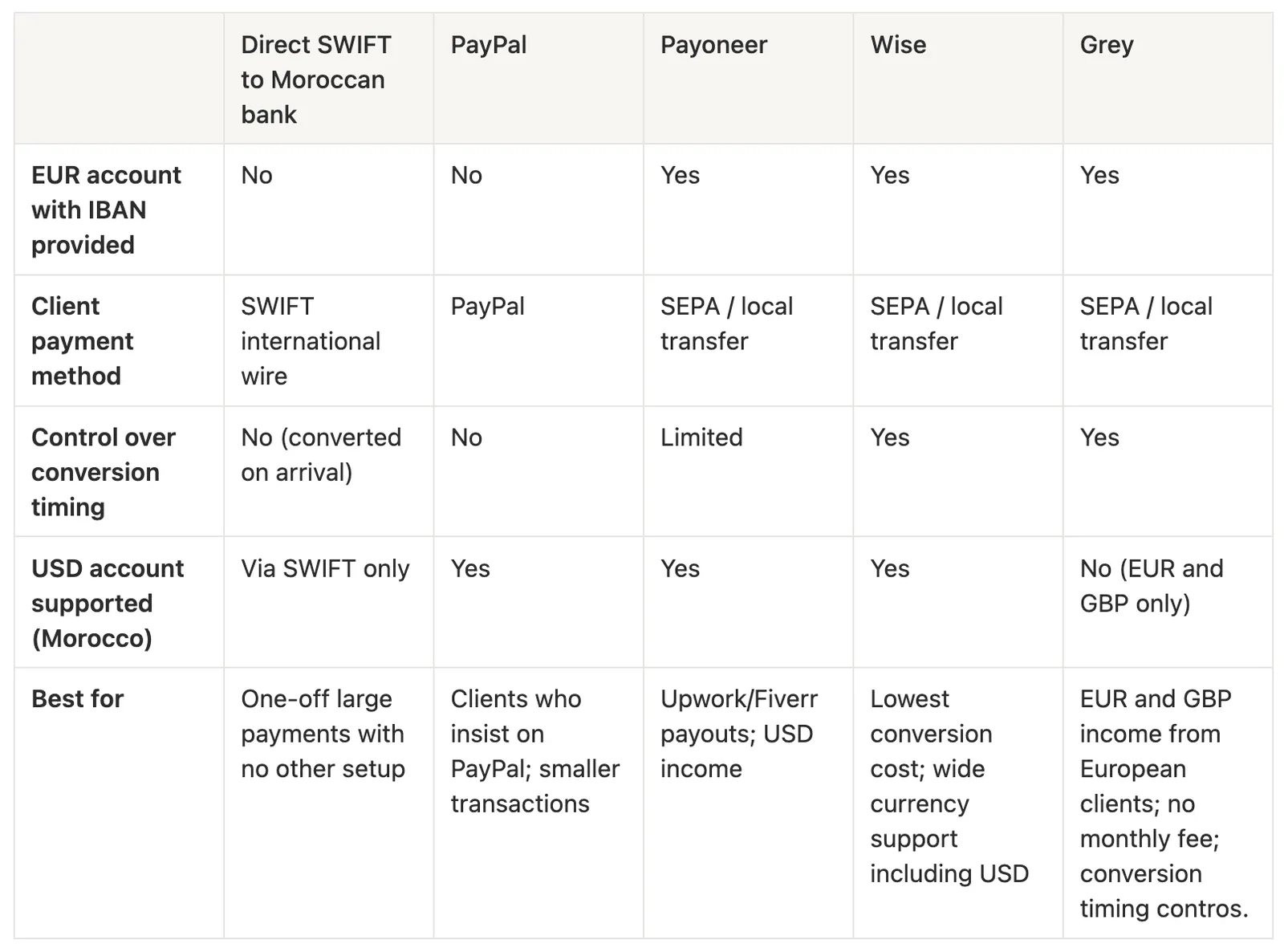
PayPal charges around 3.9% plus a fixed fee per transaction for receiving international payments. When withdrawing to a Moroccan bank account, PayPal applies its own exchange rate, with a 3-4% markup over mid-market rates. Withdrawals will also take one to five business days.
PayPal works for one-off, smaller transactions where the client already has an account. It’s a relatively expensive option for regular professional income.
Payoneer
Payoneer provides accounts that can hold USD, EUR, or GBP. To withdraw to a Moroccan bank, Payoneer charges a 2 to 3% currency conversion fee. Withdrawals typically take two to three business days. Payoneer is widely used among Moroccan freelancers on platforms like Upwork and Fiverr, where it’s often the default payout method. For standalone client payments, the conversion margin is higher than Wise or Grey.
Wise
Wise provides EUR, GBP, and USD accounts with local banking details. European clients can pay via SEPA to the EUR IBAN, which will usually arrive in one to two business days.
Wise also lets you hold EUR in your account and convert at your convenience, giving you control over conversion timing that a direct bank transfer doesn’t.
Grey
Grey provides Moroccan freelancers with EUR and GBP accounts with local banking details: a SEPA IBAN for EUR and a UK sort code and account number for GBP. European clients can pay via SEPA or Faster Payments as a local transfer. You can then convert to MAD when you’re ready.
The SEPA deposit fee on Grey is 0.8%, capped at €10. On a €1,000 payment, that’s €8. The conversion fee is 1%, capped at €6 or £6, and the withdrawal fee is a flat $2.
How do different payment platforms compare for Moroccan freelancers?
A practical financial management framework for Moroccan freelancers
Managing freelance finances in Morocco well comes down to four habits applied consistently.
Separate your income by currency: If you earn EUR from French clients and GBP from UK clients, hold them in separate currency accounts. Converting everything to MAD immediately means you lose control over the rate.
Track every payment against its invoice. Your quarterly auto-entrepreneur declaration is based on turnover collected, not invoiced. Every payment received, in whatever currency, needs to be recorded with the date received and the MAD equivalent at that date’s rate. Gaps in this record can create problems at the time of declaration.
File and pay quarterly without exceptions: Declarations and payments are due before the end of the month following each quarter. Calendar these deadlines at the start of the year and treat them as non-negotiable.
Monitor the MAD 80,000 single-client threshold: If one client relationship is approaching that annual total, plan the withholding conversation in advance. Document it clearly in your contract so both parties are aware.
The bottom line
Managing freelance finances in Morocco requires three things working together: the right legal registration, the right payment infrastructure, and consistent tax compliance habits.
The auto-entrepreneur regime is genuinely one of the most accessible and low-cost freelance tax structures available anywhere. The registration process is straightforward. The quarterly declarations are manageable once they’re in your calendar. The 2% tax on service turnover is low enough that compliance is financially sensible rather than punitive.
When set up correctly, Moroccan freelancers can access some of the best international clients in the world, pay among the lowest freelance tax rates anywhere, and keep more of every payment than their counterparts in many other markets. The infrastructure to do that well is available and not expensive to set up. It just requires knowing what it is.
Frequently asked questions
Why should I register as an auto-entrepreneur to freelance in Morocco? Proper registration means you can issue compliant invoices, which many international clients require before processing payment. This creates compliance risks and limits your ability to attract professional clients.
What is the auto-entrepreneur tax rate for service activities in Morocco? Auto-entrepreneurs providing services pay 2% tax on turnover, with a revenue ceiling of MAD 200,000 per year. This rate replaces income tax, VAT, and professional tax, making it one of the most straightforward tax regimes for freelancers globally.
What happens when I earn more than MAD 80,000 from a single client? When annual income from a single client exceeds MAD 80,000, the surplus is subject to a 30% withholding tax applied by that client.
Can I hold foreign currency as a Moroccan auto-entrepreneur? Auto-entrepreneurs cannot hold foreign income in a convertible dirham account as companies can. In practice, you can hold EUR or GBP in a fintech account like Grey before converting to MAD.
Grey charges fees on deposits, conversions, and withdrawals. Deposits via SEPA incur a 0.8% fee (minimum €2, maximum €10). Currency conversions are charged at 1%, capped at $6. Withdrawal fees: flat $2. Exchange rates are variable and include a margin over the mid-market rate. Grey does not currently support USD accounts or local bank withdrawal for Moroccan users. Always review fees, the rate, and current product availability at grey.co before transacting. Visit grey.co/pricing for current rates.
Fiverr has opened doors for South African freelancers, offering them opportunities to work with clients worldwide. Yet, while securing work is exciting, receiving payments quickly and affordably can be challenging. In 2026, freelancers in South Africa no longer need to deal with slow transfers, high fees, or complicated international payment systems, as Grey makes it simple and seamless.
In this guide, we’ll show you how freelancers in South Africa can easily use Grey to receive Fiverr payments.
For many South African freelancers, receiving payments from international clients can be tricky. High bank fees, long processing times, and poor exchange rates often cut into hard-earned earnings. This payment challenge has left freelancers searching for better solutions to access their funds without unnecessary delays or costs.
How to use Grey to receive Fiverr payments in South Africa
1. Sign up for a free Grey account
Head to Grey’s website, create an account, and get access to your virtual multi-currency details for USD, GBP, or EUR.
2. Update your Fiverr payment settings.
Log in to your Fiverr account and navigate to payment options.
Select a withdrawal method such as bank transfer.
Enter your Grey account details for your preferred currency.
3. Withdraw your earnings effortlessly
Once Fiverr releases your payment, it lands in your Grey account. You can then easily convert it to euros and transfer it to your local South African bank account.
As a South African freelancer, you deserve a payment solution as efficient as your work. Grey simplifies the process, helping you receive Fiverr payments quickly and affordably.
Tanzania is known for the unparalleled creativity among its people. This is evident as more Tanzanian sellers are tapping into Etsy’s global marketplace.
Etsy is a platform for creative entrepreneurs, to sell unique, handcrafted items, vintage goods, and craft supplies. The next hurdle becomes receiving payments from international buyers as Tanzania isn't directly supported for payouts.
In this guide, we’ll show you how to streamline the payment process on Etsy with Grey, so you can focus on what you love most: creating.
Why Tanzanian sellers should use Etsy
Etsy is a favourite among buyers and sellers for several reasons:
Global reach: You can reach millions of buyers worldwide who value handmade and vintage products.
Diverse product categories: Etsy caters to nearly every creative niche.
Supportive community: Etsy fosters a network of sellers and buyers who appreciate craftsmanship and creativity.
Choose whether you’re registering as an individual or a business.
Enter your personal information, i.e. name and address.
Add your Grey US, EU, or UK bank account details, depending on your preference.
Etsy will process payments to your Grey account, making it easy to manage your earnings.
With your Grey account linked, you can receive Etsy payouts directly into your international bank account.It is important to note that you will have to provide a valid ID and depending on the location you pick, may have to fill in a valid address and social security number for your account to be verified.
With Grey, you can stop worrying about receiving Etsy payouts or converting your earnings from Etsy. Manage your finances seamlessly and focus on growing your creative business.
Want to receive Amazon payments in the Philippines? With the right tools in place, it’s simpler than you might imagine. A few smart adjustments can help you maximise your earnings, enjoy competitive exchange rates, and easily manage cross-border transactions. Ready to get started? Let’s explore how!
Grey helps professionals, freelancers, and digital nomads in emerging markets easily receive Amazon payments.
Understanding Amazon seller payments
Amazon follows a structured process when paying its sellers. It’s essential to understand how this works to make the most of your earnings:
Earnings calculation: Amazon deducts fees, refunds, and other charges from your sales revenue to determine your net income.
Payment schedule: Disbursements typically occur every 14 days, though this may vary based on your account status and marketplace policies.
Currency specifics: Amazon transfers funds in the marketplace currency where you sell. If your account uses a different currency, you may incur conversion fees.
Bank account requirements: Sellers must provide valid bank account details to receive payouts. Grey helps you get US, UK, and Euro bank accounts to simplify the process of receiving your cash internationally.
A step-by-step guide to receiving Amazon payments in the Philippines
Follow these steps to get started with Grey and receive payments directly into your account:
Sign up for a Grey account: Visit the Grey website or download the app to open a free account.
Select your preferred currency account: Grey provides multi-currency virtual accounts, including USD, GBP, and EUR, suitable for Amazon marketplace payouts.
Integrate with Amazon Seller Central: Add your Grey account details to Amazon Seller Central to receive payments directly into your virtual account.
Access your funds: Once payments are disbursed, they will be available in your Grey account for use or withdrawal.
Why Grey is ideal for Amazon payments in the Philippines
Grey’s platform is designed to support global sellers, offering benefits tailored to the needs of users in the Philippines:
Multi-currency support: Hold and manage funds in currencies such as USD, GBP, and EUR without conversion hassles.
Transparent exchange rates: Convert currencies at competitive rates with no hidden fees, maximising your earnings.
Quick transfers: Experience faster payment processing than traditional banks, giving you quicker access to your funds.
User-friendly app: Manage your finances effortlessly with Grey’s intuitive mobile app.
How to receive Amazon payments in the Philippines with Grey
Connecting your Grey account to Amazon Seller Central is easy. Follow these steps:
Log in to Seller Central: Go to Settings > Account Info > Payment Info > Bank Account Info.
Add your Grey UK, US or Euro bank account details: Select “Add new deposit method” and input your Grey virtual account information.
Verify your account: Upload the required documents (eg: a bank statement), to confirm your details.
Complete the setup: After verification, your Grey account will be ready to receive Amazon payouts.
Manage Amazon payments in multiple currencies
Grey allows you to streamline international payments and minimise conversion fees. Here’s how:
Avoid unnecessary conversion: Retain your funds in the currency of the Amazon marketplace to reduce exchange losses.
Flexible currency management: Convert funds only when needed, using Grey’s competitive in-app exchange rates.
Effortless withdrawals and account management
Once your Amazon earnings are deposited, you can manage them efficiently:
Withdraw your earnings: Transfer funds to a local bank account or mobile wallet quickly and easily.
Monitor transactions: Keep track of payments and access your transaction history through the Grey app.
Why Grey is the top choice for sellers in the Philippines
Maximise earnings: Benefit from low fees and transparent conversion rates.
Global reach: Accept payments from multiple Amazon marketplaces and international clients.
Direct payouts: Receive funds directly into your Grey virtual account without third-party intermediaries.
Convenience on the go: Use the Grey app to manage your funds anytime, anywhere.
Take control of your Amazon payments
Receiving Amazon payments doesn’t need to be complicated. Grey offers a seamless solution to streamline your financial management. Whether you’re a new seller or a seasoned professional, Grey helps you handle your Amazon earnings efficiently and cost-effectively.
Sign up with Grey today to simplify your payment process and enjoy greater control over your finances.
Many Egyptians working with Amazon often discover that receiving payments is more layered than it appears at first glance. It is a bit like finishing a long journey and expecting a straight road home, only to realise there are multiple checkpoints before you actually arrive. After completing a month of sales on Amazon US or Amazon UK, earnings show up in the seller dashboard in US dollars or British pounds, indicating funds that are ready for withdrawal. On the surface, the process seems straightforward, but the real consideration begins when transferring those funds into Egypt.
For many sellers, the first withdrawal highlights the gap between earning and actually receiving money locally. A payout is initiated with the expectation that it will arrive directly in an Egyptian bank account in EGP, but the process may involve intermediary banks, conversion steps, and variations in the final amount received. These factors can affect both timing and total value.
This is why understanding how Amazon payments move through the system is important. From currency conversion methods to approved receiving accounts and withdrawal pathways, each step influences how efficiently earnings are accessed and how much value is retained once funds reach Egypt.
Understanding Amazon seller payment options and eligibility
When selling on Amazon from Egypt, understanding payment options and eligibility is essential for smooth operations. Once your seller account is set up, Amazon typically pays proceeds directly into a local Egyptian bank account through automated bank transfers. These payments follow a predictable cycle, but funds are usually held for around 14 days. This holding period allows Amazon to manage potential refunds and buyer protection claims under its A-to-Z Guarantee policy.
For sellers who may accumulate fees higher than their sales, Amazon provides accepted methods for clearing balances, including credit or debit card payments and international wire transfers, as outlined in Seller Central guidelines.
Before any of this becomes possible, eligibility must be confirmed. Individual sellers are required to provide a valid National Egyptian ID, while business sellers must present a recognised Commercial Registration. Together, these requirements ensure compliance, security, and trust within the Amazon marketplace, allowing sellers in Egypt to operate within a verified financial and legal framework.
Common delays and payment rejection issues with Amazon payments in Egypt
Payment delays and rejections in Egypt often arise within the normal processing cycle of cross-border transactions, where financial systems apply checks to ensure security, accuracy, and compliance.
Mandatory security hold
Whenever bank account details are updated on Amazon Seller Central, a mandatory three-day security hold is automatically applied. This pause is a protective measure designed to prevent fraudulent withdrawals and ensure that the account changes are legitimate. During this period, sellers will not receive disbursements, even if payments are due, which can temporarily affect cash flow planning.
Account reserves
Amazon often places a portion of funds in reserve to cover potential returns, chargebacks, or customer claims. This is a standard risk management practice across marketplaces. While it may feel like a delay in payment, it ensures that sufficient funds are available if disputes arise after a sale has been completed.
Unconfirmed shipments
Payments may also be delayed when orders are not properly marked as shipped or when tracking information is missing. Amazon requires accurate shipment confirmation before releasing funds, as this verifies that the customer has received or is in the process of receiving the product. Without this step, payouts remain on hold.
Incorrect card details
Errors in entering card information, such as the card number, CVV, expiry date, or cardholder name, can lead to failed payment attempts. Even small mistakes can trigger rejection, so details must be entered exactly as they appear on the bank card to avoid disruptions.
Bank security blocks
Egyptian banks may automatically block international or online transactions if they appear unusual or are not pre-approved for cross-border use. This often happens when a card is not activated for online payments or when spending patterns deviate from normal behaviour, resulting in rejected Amazon transactions.
Billing address mismatch
A mismatch between the billing address provided on Amazon and the one registered with the bank can also cause payment issues. Even minor differences, such as postcode or formatting errors, may trigger a rejection. Ensuring that all details match bank records helps prevent unnecessary delays in processing payments.
Setting up Amazon payments in Egypt involves a guided process within Seller Central, where each step ensures your account is properly linked and ready.
Open Seller Central
Begin by logging into your Amazon Seller Central account, which serves as the control centre for all selling activities. This is where payments, orders, and account settings are managed, making it the starting point for setting up how and where your funds will be received.
Navigate to settings
Once inside, move to the Settings section and select Account Info. This area contains the financial and operational details tied to your seller profile, and it is where you begin the process of linking your bank account for receiving payments.
Add a deposit method
Under Payment Information, locate the option labelled Bank Account Information. This is where you initiate the process of adding a deposit method, so Amazon knows exactly where to transfer your earnings once they are ready for disbursement.
Enter account details
Select Egypt as your bank location and carefully input your bank account details. Accuracy is important here, as even small errors can lead to delays or failed transfers, so ensure all information matches your official banking records.
Currency converter
If your bank account operates in a currency other than the Amazon marketplace currency, you will need to accept the Amazon Currency Converter terms. This allows funds to be converted seamlessly before reaching your account, simplifying cross-border transactions.
Verification
After adding your bank details, Amazon applies a short verification period. A three-day security hold is placed on payments to confirm the changes, ensuring that your account remains protected while the new information is securely processed.
Best platforms to receive Amazon payments in Egypt
Choosing the best platform to receive Amazon payments in Egypt often depends on how you sell, where your customers are, and how you prefer to access funds.
Payoneer
For many Egyptian sellers working with international Amazon marketplaces, Payoneer often feels like the default starting point. You sign up, get access to a virtual USD account, and suddenly receiving payments from Amazon US or UK becomes straightforward. The real experience, however, begins when you try to move that money locally. Transfers to Egyptian bank accounts are reliable, but the fees can quietly add up, especially when converting to EGP. It works well for scale and global reach, but requires close attention to cost efficiency over time.
1% receiving fee from Amazon
3% – 4.5% withdrawal fee
5.7% – 8.5% total cost when converting to EGP
Grey
Grey offers a more modern, streamlined experience, especially for sellers who want clarity and lower fees. Once connected to Amazon Seller Central, it feels less like a workaround and more like a clean financial pipeline. You receive funds in foreign currency, then withdraw directly to your Egyptian bank account or even a mobile wallet. The interface is simple, and the transparency around fees makes planning easier. For many, it is a quieter, more efficient alternative to traditional platforms, particularly when margins matter.
1.4% total fees
Amazon Payment Services (APS)
If your focus is local, especially selling on Amazon, the Payment Services feel built for that environment. It supports local payment methods like Meeza cards and digital wallets, making it easier for Egyptian customers to complete purchases. There’s also the added advantage of instalment options through ValU, which can drive higher conversion rates. However, the structure is more formal, with setup and monthly costs that make it better suited to established businesses than to individuals just starting out.
Setup fee: approx. 1,200 EGP
Monthly fee: approx. 650 EGP
Transaction fee: 2.75% + 2.5 EGP per transaction
PayMob & Fawry
For sellers building within Egypt’s local e-commerce space, PayMob and Fawry offer familiarity and reach. These platforms are widely used, making them easy to integrate into existing customer habits. The experience is less about receiving international Amazon payouts and more about enabling smooth local transactions and disbursements. They are particularly useful if your Amazon presence connects with a broader local sales strategy, where convenience and accessibility for Egyptian customers matter most.
Comparing options for receiving Amazon payments in Egypt
What to look out for when choosing an Amazon payment platform in Egypt
Choosing the right Amazon payment platform in Egypt requires careful evaluation of how funds move, how quickly they arrive, and how efficiently they integrate into your operations.
Currency support: The currency you receive depends on where you sell. However, selling on international marketplaces like Amazon US or UK introduces foreign currencies, requiring a system that can receive, hold, and convert USD, EUR, or GBP efficiently.
Transaction fees: Fees can quietly shape your overall profit, especially when dealing with cross-border payments. Third-party platforms like Payoneer or similar providers often charge layered fees, including receiving, conversion, and withdrawal costs. Comparing these against your local bank’s charges helps you avoid unnecessary erosion of earnings over time.
Withdrawal time: Once Amazon releases your funds, the next concern is how quickly they reach your local account. Some providers process withdrawals within a few business days, while others take longer due to intermediary banks. Faster withdrawal times can significantly improve cash flow and operational flexibility.
Ease of linking: A smooth setup process matters more than it seems. Providers that integrate easily with the Deposit Methods section in Amazon Seller Central reduce friction, minimise setup errors, and make it easier to manage your account without repeated verification issues or technical delays.
Support and stability: When payments are delayed or fail, responsive customer support becomes critical. Choosing a provider known for reliability and quick issue resolution ensures that problems are addressed promptly, reducing downtime and helping you maintain consistent access to your funds.
Frequently Asked Questions
1. Why does Amazon hold my payments for 14 days?
Amazon applies a standard holding period to manage risk across its marketplace. This window allows time to process returns, refunds, or disputes before releasing funds. It protects both buyers and the platform, but requires sellers to plan cash flow carefully.
2. Can I receive Amazon payments in USD while living in Egypt?
Yes, but only through supported third-party providers or foreign currency accounts. Amazon itself does not pay Egyptian sellers in USD locally, so you’ll need a service that can receive international payouts and convert or transfer them into EGP
3. Is it better to receive in USD first or convert directly to EGP?
Receiving in USD gives more control over timing and exchange rates, especially in volatile markets. However, it introduces extra steps and fees. Direct EGP settlement is simpler, but it may lock you into lower conversion rates.
4. Why do some sellers receive less than expected even after accounting for fees?
Beyond visible fees, hidden FX markups and intermediary bank charges often reduce final payouts. Some providers apply unfavourable exchange rates rather than explicit fees, making it harder to track real costs unless you compare mid-market rates consistently.
Managing Amazon payments with Grey
Managing Amazon payments in Egypt is now far simpler with modern digital payment platforms designed for global sellers. Grey provides Amazon sellers with virtual GBP, USD, and EUR accounts that come with real banking details, allowing Amazon marketplaces like the UK or US to send payouts as if they were local transfers. This removes the friction of traditional cross-border banking and makes receiving funds more predictable and structured.
With a Grey, you can manage multiple currencies, convert at competitive exchange rates, and withdraw directly to your Egyptian bank account in a few steps. Grey also offers flexibility for handling international subscriptions and purchases, making it easier to stay operational across markets. Sign up on Grey and download the app to receive your Amazon payment easily.
Grey charges fees on deposits, conversions, and withdrawals. Deposits via ACH, SEPA, or FPS incur a 0.8% fee (minimum $2/€2/£2, maximum $10/€10/£10). Currency conversions are charged at 1%, capped at $6. Withdrawal fees vary by currency: ₦35 for NGN, 0.5% for EUR/GBP (minimum €2/£2, maximum €10/£10), and $0.50 to $0.65 for KES/UGX/TZS. Cross-border card transactions (non-USD purchases on a USD card) incur a 2% fee plus $0.50. Exchange rates are variable and include a margin over the mid-market rate. Always review fees and the rate before confirming a transaction. Visit our pricing page for current rates.
France has always been synonymous with creativity. With Etsy, French sellers can now share their artistry with buyers from every corner of the globe. While showcasing your creations is simple, receiving USD payments can sometimes get complicated.
This guide will help you learn how to streamline Etsy payouts and manage international earnings effortlessly with Grey.
Why French sellers should use Etsy
Etsy is a favourite among buyers and sellers for several reasons:
Global reach: You can reach millions of buyers worldwide who value handmade and vintage products.
Diverse product categories: Etsy caters to nearly every creative niche.
Supportive community: Etsy fosters a network of sellers and buyers who appreciate craftsmanship and creativity.
Choose whether you’re registering as an individual or a business.
Enter your personal information, i.e. name and address.
Add your Grey US, EU, or UK bank account details, depending on your preference.
Etsy will process payments to your Grey account, making it easy to manage your earnings.
With your Grey account linked, you can receive Etsy payouts directly into your international bank account. It's important to note that you will have to provide a valid ID and depending on the location you pick, may have to fill in a valid address and social security number for your account to be verified.
With Grey, you can stop worrying about receiving Etsy payouts or converting your earnings from Etsy. Manage your finances seamlessly and focus on growing your creative business.
Would you like to receive Amazon payments in Singapore? It’s easier than you think — with the right setup. A few simple tweaks can help you keep more of your hard-earned money, take advantage of great exchange rates, and handle cross-border transactions effortlessly. Ready to make it happen? Let’s dive in!
Grey helps professionals, freelancers, and digital nomads in emerging markets to receive Amazon payments with ease.
Key details about Amazon seller payments
Amazon employs a structured system for processing payments to its sellers. Knowing how this works ensures you’ll optimise your earnings:
Earnings computation: Amazon calculates your net revenue after deducting various fees, refunds, and other charges.
Payment cycle: Payments are typically disbursed every 14 days, though this might differ based on your account settings and marketplace regulations.
Currency considerations: Amazon issues payments in the marketplace’s local currency. If your account uses a different currency, additional conversion fees may apply.
Banking requirements: Sellers must provide valid bank account details to receive payouts. Grey helps you get US, UK, and Euro bank accounts to simplify the process of receiving your cash internationally.
Grey provides a smart way to manage international payments, helping you save on fees and streamline operations:
Minimise conversion fees: Retain earnings in the marketplace’s currency to avoid unnecessary exchange costs.
Effortless currency management: Convert funds only when needed, using Grey’s in-app competitive rates.
Manage withdrawals and finances easily
After receiving payments in your Grey account, managing your funds is simple:
Transfer funds locally: Withdraw money to your Singapore bank account or mobile wallet with ease.
Track your earnings: Use the Grey app to monitor payments and view your transaction history anytime.
Why Amazon sellers in Singapore choose Grey
Higher earnings retention: Keep more of your income with Grey’s low fees and favourable rates.
Global compatibility: Receive payments from multiple Amazon marketplaces worldwide.
Direct deposits: Eliminate intermediaries and get paid straight into your Grey account.
On-the-go management: Access and control your finances using Grey’s app, wherever you are.
Start using Grey for Amazon payments in Singapore today
Getting started with Grey is fast and hassle-free:
Download the app: Available for iOS and Android devices.
Complete registration: Sign up and verify your account quickly.
Start receiving payments: Access multi-currency accounts and manage your Amazon payouts effectively.
Take control of Amazon payments in Singapore
With Grey, handling Amazon payments is simple and cost-effective. Whether you’re just beginning or are an experienced seller, Grey provides the tools you need to manage your earnings efficiently.
Sign up with Grey today to enjoy a seamless payment experience and take control of your financial future.